I am a reader and writer of historical fiction with a keen interest in the Earth's history and all it involves, both physically and socially. I like nothing better than to be outdoors, especially in faraway places, and baking is something I do when my eyes need respite from my computer screen.
Word of the Week (WOW) is a weekly challenge created by Heena Rathore P. It’s a fun way to improve vocabulary by learning new words every week.
To participate, simply do a post with your word and leave the link as a comment on Heena’s WOW post for this week (above link).
I’m up to the letter X this week and this one was a bit of a challenge. There are relatively few words beginning with X, and many of the words that do either refer to something biological, botanical, or chemical, or are names of people or places. I ended up picking a noun that is familiar to me, and I want to attempt a couple of sentences using it in a metaphorical way, or perhaps in a simile.
I was nominated for both the Premio Dardos Bloggers Award and the Real Neat Blog Award in June. Since then, I’ve been away for a week to Wales and had a week with no Internet, so I haven’t really caught up with myself. yet. Today I thought it was time to bring both of these nominations out of hibernation:
Pemio Dardos Bloggers Award
For the Premio Dardos Award, I am very grateful to Joycelin Leahy at Tribalmystic stories. Joycelin is a fantastic blogger, whose posts include articles and stories set in her native Papua New Guinea as well as posts about art (her own art work is stunning) writing and environmental issues. They are fascinating and I recommend her blog to everyone.
This is the information that comes with this award:
The Premio Dardos Award acknowledges the values that every blogger shows in their effort to transmit cultural, ethical, literary, and personal values every day. These stamps were created with the intention of promoting fraternization between bloggers, a way of showing affection and gratitude for work that adds value to the Web.
And here are the very simple rules:
1. Accept the award by posting it on your blog along with the name of the person who granted the award and a link to his or her blog.
2. Include the image of the “Premio Dardos” in the post.
3. Pass the award to another 15 blogs that are worthy of this acknowledgement.
There are no questions to answer or write for nominees with this award.
I also want to say a big thank you to Francesca at A Smith’s World for nominating me for the Real Neat Blog Award. Francesca is a talented writer who does a lot of great flash fiction stories. Her work is very descriptive and often emotionally charged and I recommend you to take a look.
And these are the rules:
1. Put the award logo on your blog 2. Thank the person who nominated you, linking to their blog 3. Answer 7 questions asked by the person who nominated you 4. Nominate any number of bloggers you like, linking to their blogs 5. Let them know you nominated them (by commenting on their blog, etc.)
Numbers 1 and 2 are duly done, so here are my answers for Q.3.
1. What word best describes you?
There are lots of words I could use to describe myself – stubborn being one of them; impatient another – although impatience is only ever aimed at myself. The most flattering word I can use to describe myself is industrious. I always work hard and rarely give up until I’ve completed whatever I’m doing to my own satisfaction.
2. What is your greatest fear?
I’ve been paranoid about sharks for many years, and although I’m a good swimmer and love being in the sea, I’m very nervous when I venture out further than knee-deep and spend my time looking for fins. This was made worse when I was snorkelling around Lady Elliot Island (Great Barrier Reef) and there were reef sharks out there. I didn’t know that when I was snorkelling, of course. I only found out once I’d climbed back into the boat and one of the two cheerful Australian guys in charge of our day, asked me whether I’d noticed the reef shark. I’ve been snorkelling since in the Indian Ocean and the Caribbean, but I’m very nervous and keep with the group.
Image courtesy of Pixabay
3. Why do you have a blog?
I started my blog because everyone said that authors should have one. My blog is not quite a year old, and in that time, I’ve found that I’ve loved connecting with people from around the world. I enjoy writing blog posts and doing flash fiction challenges (although I’ve had to cut down on these recently in order to spend more time on my third book). I’ve really enjoyed writing my historical sites posts (castles and such-like) and some about travel – which are also historically themed. I rarely write posts about my books, unless I have a 5 free-days promotion on Amazon coming up. I suppose I should do more, such as sharing the progress of my new book – but that would be so boring!
4. What is your favourite quote?
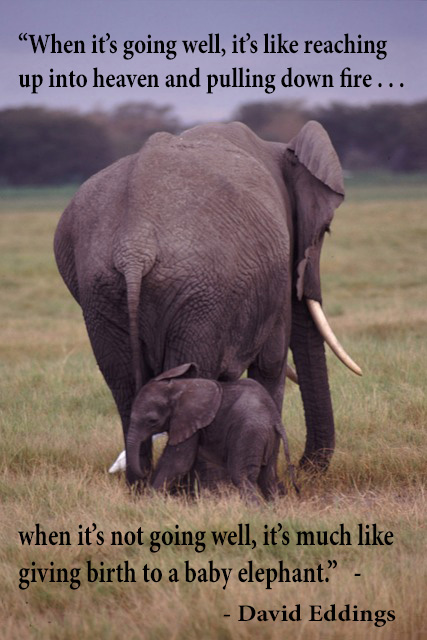
I like lots of different quotes, for different things, but my favourite quote about writing is one by David Eddings, which I put on my quote challenge a few weeks ago:
5. Compose a quote about writing or the power of words:
“Words are like raindrops pattering inside my head, giving life to gathering thoughts”.
Not the best quote in the world, but all I can come up with at short notice.
6. What continent would you pick to be from if you had the option and why?
I’m very happy living in Europe and wouldn’t want to move anywhere else – although I want to visit as many countries as I can!
7. If you were a politician what policy would you implement?
I’m not comfortable about discussing politics, although I do have very strong feelings about many issues. One policy I’d like to see implemented (in the U.K. at least) is that all new buildings are constructed with solar panels. Many people are having them installed, but they are expensive and not a possibility for any but the ‘better off’.
Flash Fiction for for Aspiring Writers is a writing challenge hosted by Priceless Joy. It asks us to write a piece of fiction from the photo prompt provided in around 100-150 words – give or take 25 words. It encourages us to comment, constructively, on other entries, so supporting each other’s writing. If you’d like to join in with this challenge, follow the above link to see what to do. The challenge runs from Wednesday to Wednesday every week.
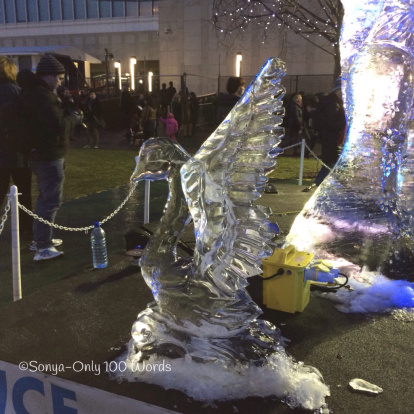
Here is this week’s prompt, kindly provided by Sonya at Only 100 Words:
. . . and this is my story:
Alexei surveyed the solid ice block before him, considering the shape he was about to sculpt. He knew every curve of the slender neck, every line of the beautiful face. He’d marvelled at her exquisite elegance as he’d watched her glide effortlessly from one position to the next.
As the ice took on its overall shape, Alexei deftly used his little ice knife and small, flat chisel to create the finer features. He imagined those intelligent, dark eyes, gazing back at him. How close the two of them had become in such a short while. He’d never imagined he would lose her.
‘But I must go to Moscow, Alexei!’ Katerina had exclaimed at his feeble requests that she stay. ‘My life would be nothing without the Ballet. I shall be Odette, the beautiful swan. And I shall return to you once we close.’
So long ago…
Now a prima ballerina, Katerina had chosen the adoration of millions over Alexei’s love. To him she had become a beautiful, icy swan, destined to just melt away…
Word Count: 174
*
If you’d like to view other entries, click the little blue frog below:
***
For anyone interested, here is some information about The History of Ice Sculpture. from various sources:
Ice sculpture is the art of carving shapes out of ice, ranging from small table decorations to entire towns of ice seen at winter festivals all over the world. The origins of ice scupting are credited to both China and Russia:
In the 1600s, hunters and fishermen of the Chinese province of Heilongjiang, on the border of Russia, designed ice lanterns. They filled buckets with water to make ice, then slid it out and put a candle in the hole to make a lantern. People started hanging decorated lanterns from homes and parading them in carnivals. Here’s a pictute of an ice lantern I found that looks bucket-shaped, and how I imagine those made in China might have looked:
Lantern of Ice. Uploaded by Eric Sylwan. Commons
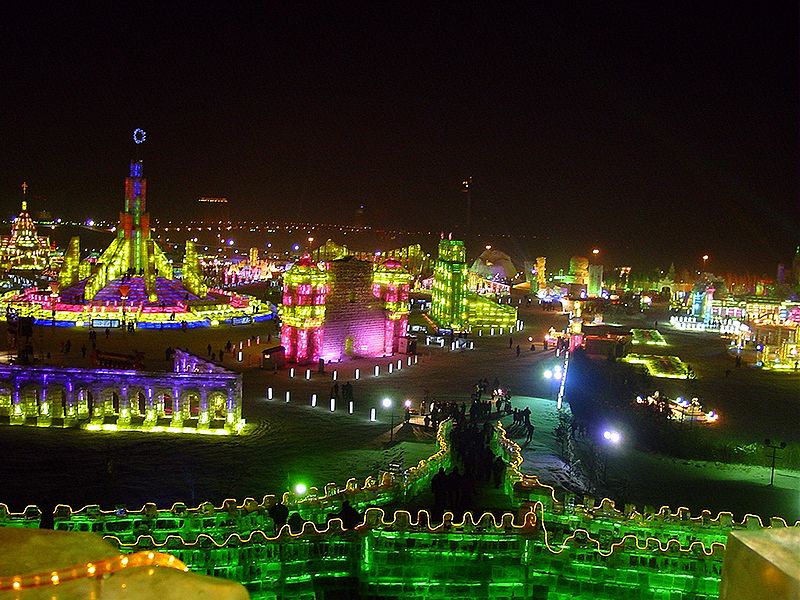
In 1897, the Trans Siberian Railway was extended through the small Chinese fishing town of Harbin in Heilongjiang. Increased traffic resulted in Harbin growing into a cosmopolitan city. With below freezing winds from Siberia, and ice from the frozen Songhua river, Harbin became the home of the annual International Ice and Snow Sculpture Festival. Currently, this festival features the work of thousands of artists from all over the world and holds the Guinness World Record for the largest snow sculpture. The sculpture, entitled “Romantic Feelings”, measured 115 ft tall and 656 ft long.
Harbin Ice Festival. Originally uploaded by LiYan. Commons
The first historical occurrence of ice sculpture in Russia was in 1740 when the Empress Anna Ivanovna commissioned the building of an ice palace in St. Petersburg. The palace was intended to be an elaborate joke, but to the empress it was meant as something darker. She delighted in humiliating nobility, and Prince Mikhail Galitzine had annoyed her by insisting on marrying an Italian Catholic. After the death of this first wife, the empress forced him to marry her ugly, elderly servant woman. The ice palace was built as the stage for the wedding. Following the church ceremony, the couple were fastened inside an iron cage on the back of an elephant and paraded toward the palace in a procession of horses, camels, wolves and pigs. They were then forced to spend the night inside the frozen mansion, with guards posted outside to ensure they stayed there.
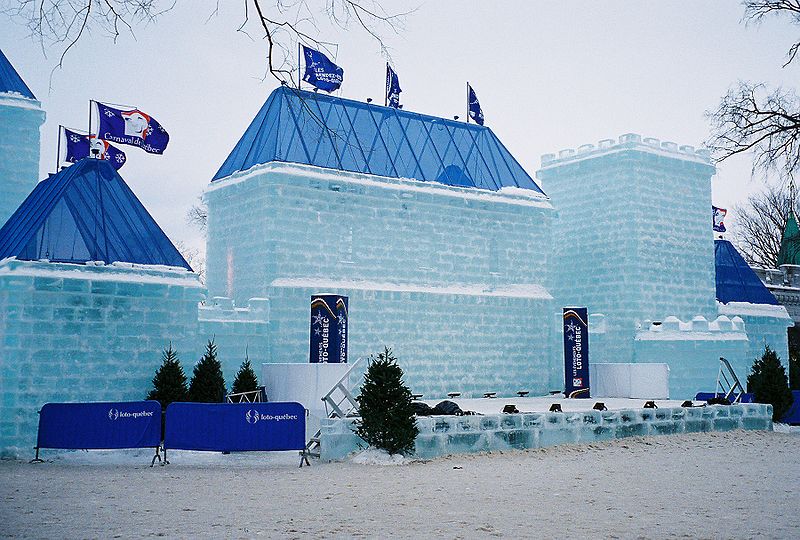
Today, there are a number of ice festivals around the world. Other than the one at Harbin, China, they include those in Japan, Canada, Alaska (USA), Belgium, Sweden, Russia and the UK.
Ice castle during the Quebec Winter Carnival of 2009. Uploaded by Shapiros 10. Commons
Ai Weiweis Ice Sculpture in Stockholm, Sweden, 2014. Uploaded by Frankie Fouganthin (own work).
I’ve been nominated again for the Three Quotes Challenge, this time by the lovely Galit Balli, an excellent blogger whose posts are really interesting and varied. Not only does Galit write great book reviews for ‘The Reading Bud’, she also shares her experiences of writing her own book as well as doing lots of other fun and interesting posts.
These are the challenge rules:
Post one quotation a day for three days (they can be from other sources or one of your own).
Nominate 3 other bloggers to participate per post.
Thank the blogger who nominated you.
The last time I did this challenge I decided to do quotes about writing, so this time I thought I’d do three quotes about the weather. So far, I’ve posted quotes about rain and sunshine. For my last post in the challenge I’ve chosen a weather-type that I don’t like… the wind. I don’t like fog either, especially the thick, persistent type that can cause so many accicents. But I can only do three quotes, so windy weather it is…
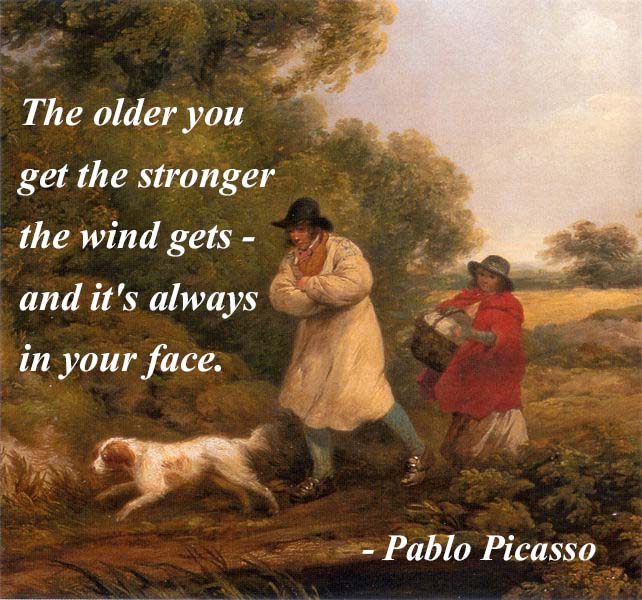
This is my Quote for Day Three:
I really couldn’t decide which of these two images to use for this quote. They’re quite different and give a different ‘feel’ to Picasso’s quote. I think Picasso intended his words to be taken as a bit of fun – but perhaps that’s just my interpretation. Anyway, I’m posting both pictures, so see what you think:
A Windy Day (1790s). Oil on canvas, Fitzwilliam Museum. Scanned by George Morland from ‘The Dress of Peole: Everyday Fashion in 18c England’ by John Styles. Public Domain.
***
This is nothing to do with the challenge, but here is one of my favourite poems about the wind – which most people will already know. It’s a simple little poem, but so effective:
Who Has seen the Wind?
Who has seen the wind?
Neither I nor you
But when the leaves hang trembling
The wind is passing through
*
Who has seen the wind?
Neither you nor I
But when the trees bow down their heads
The wind is passing by
by
Christina Rossetti
Windy Day in Killarney. Painting by John Siburt. Author: Hrhpower. Commons
I’ve been nominated again for the Three Quotes Challenge, this time by the lovely Galit Balli, an excellent blogger whose posts are really interesting and varied. Not only does Galit write great book reviews for ‘The Reading Bud’, she also shares her experiences of writing her own book as well as doing lots of other fun and interesting posts.
These are the challenge rules:
Post one quotation a day for three days (they can be from other sources or one of your own).
Nominate 3 other bloggers to participate per post.
Thank the blogger who nominated you.
The last time I did this challenge I decided to do quotes about writing, so this time I thought I’d do three quotes about the weather. Living in Britain, the weather becomes almost an obsession, and is definitely our main topic of conversation.
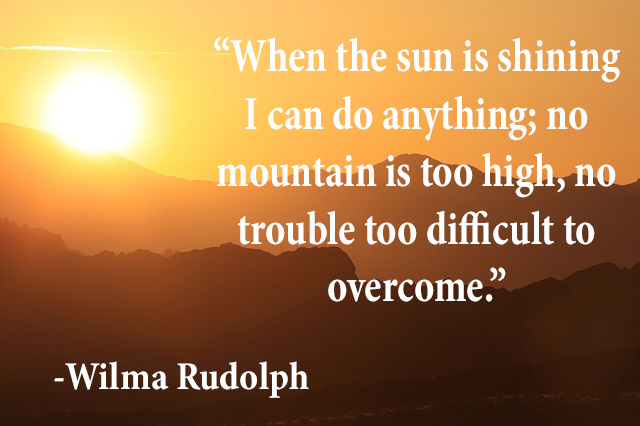
Yesterday I posted a quote about the rain – which I do love (as long as it isn’t coming down in bucketfuls!). Today, I’ve chosen a weather-type that gets most people smiling.
I’ve been nominated again for the Three Quotes Challenge, this time by the lovely Galit Balli, an excellent blogger whose posts are really interesting and varied. Not only does Galit write great book reviews for ‘The Reading Bud’, she also shares her experiences of writing her own book as well as doing lots of other fun and interesting posts.
These are the challenge rules:
Post one quotation a day for three days (they can be from other sources or one of your own).
Nominate 3 other bloggers to participate per post.
Thank the blogger who nominated you.
The last time I did this challenge I decided to do quotes about writing, so this time I thought I’d do three quotes about the weather. Living in Britain, the weather becomes almost an obsession, and is definitely our main topic of conversation.
Spinning top bought in Prague by Philippe Teuen from Belgium. Commons
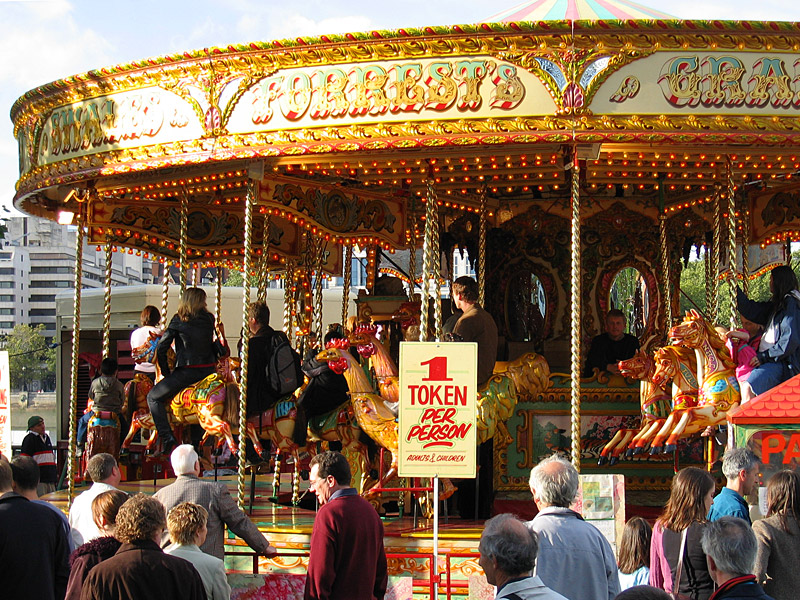
2. A carousel; a merry-go-round
Carousel on London’s Southy Bank during a summer festival. Photo: Andrew Dunn. Commons
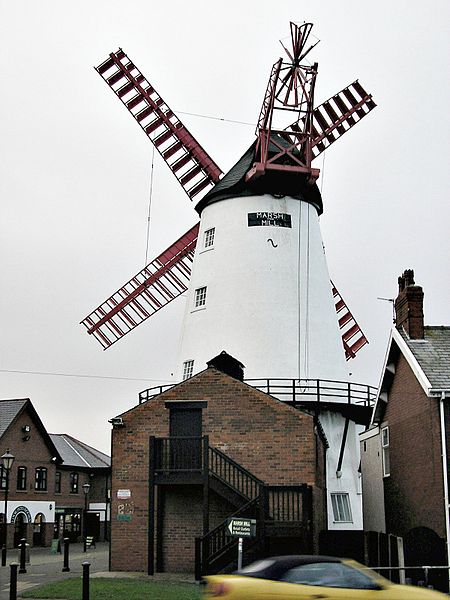
3. Something that continuously whirls, spins or moves in a circular or giddy way (e.g. the whirligig of social life or a windmill)
Windmill at Marsh Hill, Thornton, Lancs. Author Roger W. Haworth, uploaded by Hohum. Commons
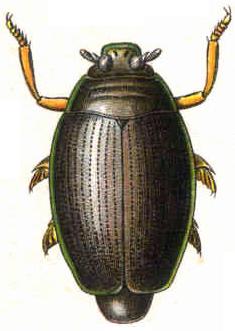
4. A whirligig beetle (a small, black, predatory beetle which swims rapidly in circles on the surface of still or slow-moving water and dives when alarmed).
Whirligig beetle, Gyrinus natador. Author Edmund Reitter 1845-1920.
3. (As a verb): spin, spin around, gyrate, reel, whirl, pirouette, spiral, rotate, roll, circle
4. beetle, water beetle, insect, bug
Antonyms:
None
Word Origin:
Mid-15c: a child’s toy, from whirl (v) + gig (n). Meaning (‘anything in constant motion’ from the 1580s; ‘fickle flighty person’ is from 1600; a type of water beetle from 1713.
Use in a Sentence:
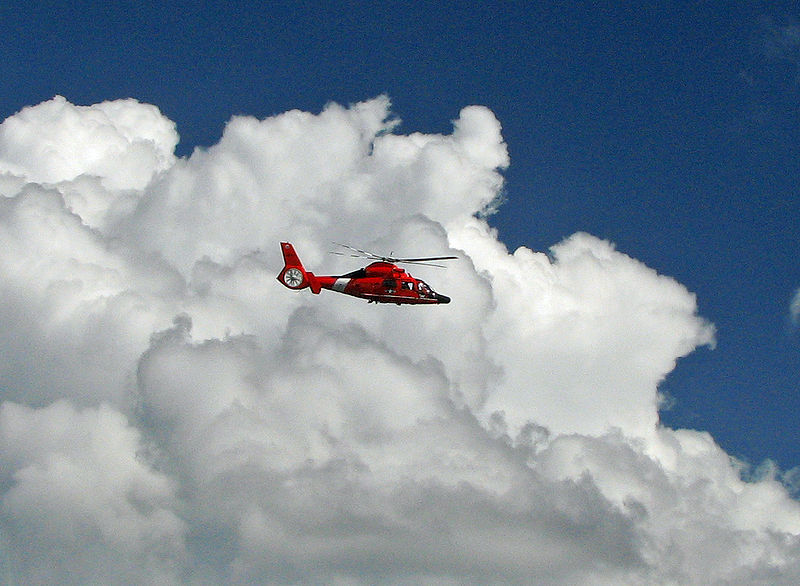
1. ‘Look at that whirligig up there in the sky!’ Susan said to her six year old son.
Search and rescue helicopter in Florida. Uploaded by Versageek. Commons
2. Doing the firm’s financial accounts left Marcia’s mind a complete whirligig.
3. It has often been said that Time is a whirligig and that all things come round again at some point, including fashions.
Wooden hourglass. Author: User: S. Sepp. Commons
If you’d like to see more interesting words visit Heena’s page:
Flash Fiction for for Aspiring Writers is a writing challenge hosted by Priceless Joy. It asks us to write a piece of fiction from the photo prompt provided in around 100-150 words – give or take 25 words. It encourages us to comment, constructively, on other entries, so supporting each other’s writing. If you’d like to join in with this challenge, follow the above link to see what to do. The challenge runs from Wednesday to Wednesday every week.
Here is this week’s prompt, kindly provided by Vanessa Rodriguez.
. . . and this is my story:
‘You realise this is the end, don’t you? After all we’ve worked so hard to achieve…’
René took his tearful wife into his arms, knowing she was right, but wanting so much to ease her distress. The vineyard had been their hope for the future… for themselves, their children, and grandchildren yet to be born. Now they faced a future of hardship and regret.
‘Another hurdle, Françoise, not the end,’ he said, instilling a positive note into his voice. ‘This is 1887 after all, and the wine industry can deal with crop diseases nowadays. We’ll see no profit this year, but –’
‘Not just no profit, René! We’ll have nothing to cover the year’s production costs … including the new wine presses we bought, and employees’ wages.’
‘Phylloxera is a new disease, ma chérie, and ways will be found to eradicate these sap-sucking insects. By next year, we’ll be back to normal.’
Françoise shook her head, unconvinced. ‘I’ll remind you of your prediction in two years time when we’re begging on the streets of Paris.’
Word Count: 175
*
My story this week is based on the phylloxera outbreak in France in 1887 (often called the ‘Great French Wine Blight’). I’ve written a little about it at the end of my ‘exta’ piece below.
If you’d like to view other entries, click the little blue frog below:
***
For anyone interested, here’s some information I’ve put together about the history of wine production:
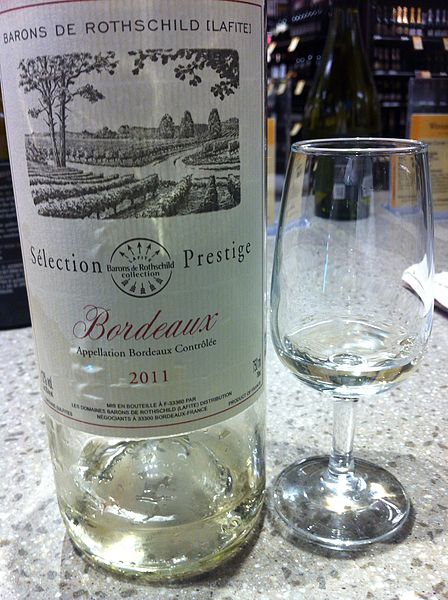
Rothschild dry white Bordeaux. Author: Agne27, Commons
The earliest evidence of a fermented drink based on grapes is in China, 7,700 – 6,600 years BC. It gradually became more widespread and we soon find evidence of it in the Near East. The grapevine and the alcoholic drink produced from it were important in Mesopotamia and Egypt and were essential aspects of Phoenician, Greek and Roman civilisations.
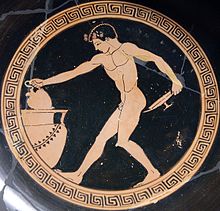
Grape cultivation and wine making in ancient Egypt. Author: Agyptischer Maler in the 1500s. Public Domain.Boy drawing wine from a crater. His nudity shows he is serving as a cup bearer at a Greek symposium or banquet. Artist: Cape Painter. Public Domain
Wine was an integral part of the Roman diet and wine making became a widely spread and precise business during the time of the Roman Empire. Most of the major wine producing regions of Western Europe today were established during that time. Wine-making technology improved during Roman times, as did the number of varieties of grapes and cultivation techniques. The design of the wine press advanced and barrels were developed for the storage and shipping of the wine.
The most famous Roman wine was Falernian, due to it high alcohol content! Anyone who has read the brilliant Falco books by Lindsey Davis (set in ancient Rome) will recognise this wine as one of Falco’s favourites. Wines were also mixed with herbs and minerals for medicinal purposes.
Throughout history, wine has often been associated with religion. The Greeks worshipped Dionysus (god of wine) and the Romans carried on his cult, calling him Bacchus. Wine has been in Jewish culture since Biblical times and has been part of the Eucharist commemorating Christ’s Last Supper in the Christian Church.
Monastic cellarer tasting wine. From a French manuscript. late 13c. Public Domain
Although Islam generally forbids the production and consumption of alcohol, during the Golden Age (8th-13th century) alchemists such as Geber pioneered wine distillation for medicinal and industrial processes (e.g. producing perfume).
In the medieval period, wine was the common drink of all classes in the south of Europe where grapes were cultivated. Further north and east, where few grapes were grown, beer and ale were the usual beverages. Wine was exported to these regions but was expensive, so was only consumed by the upper classes. Because it was used in the Catholic mass, a supply was crucial. Benedictine monks became one of the largest producers in France and Germany, followed closely by Cistercians and various other Orders.
Wine production increased dramatically from the 15th century onwards as part of European expansion. By the 18th century, the wine trade had soared, especially in France, where Bordeaux became the preeminent production.
Bordeaux Wine Region of France. Author: Trainspotter. Commons
In the New World (America) the first successful wine production was in Ohio in the 19th century. In Australia, too, wine production began about that time. In the Old World at this time, Champagne was established as a favourite luxury drink and fortified wines like sherry and port became increasingly popular in Britain.
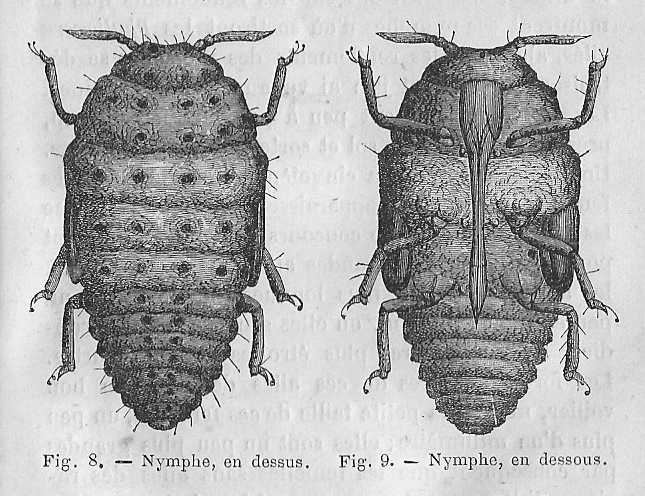
Vineyards everywhere were badly hit in 1887 by a disease called phylloxera (often grape phylloxera) which was caused by the infestation of almost microscopic, pale-yellow, sap-sucking insects related to ahpids.
Phylloxera nymphs. Author: Maurice Girad. Public Domain.Phylloxera cartoon from ‘Punch’, 1890. The caption with it reads: ‘The phylloxera, a true gourmet, finds the best vineyards and attaches itself to the best wines.’
It is possible that it originated in North America and was carried across the Atlantic in the 1850s (although this is still debated). France was the worst country to be hit but other European countries were also affected. It was dealt with by grafting European vines to the resistant American rootstock that was not susceptible to phylloxera. It proved effective, but the ‘Reconstitution’ of the French vineyards – as it was called – was a very slow process. There are still a few vineyards in Europe that inexplicably remained unscathed and exist today as they did before the disease arrived.
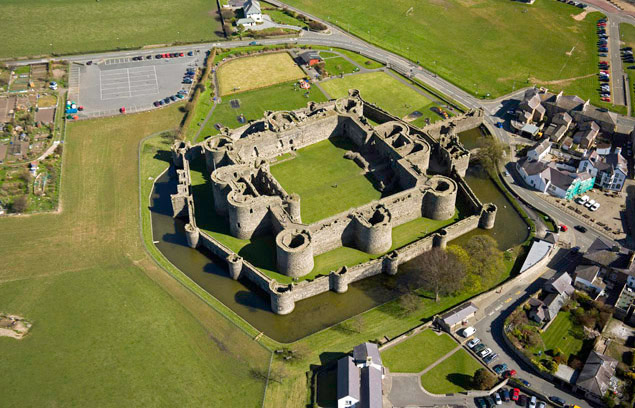
Aerial view of Beaumaris Castle, on Anglesey, Wales: By Cadw, Wales
Beaumaris was the last of the three castles I visited on my trip to North Wales two weeks ago. It is situated on the Island of Anglesey across the Menai Strait and reached by the road bridge. There is also a rail bridge, and both bridges get a fair amount of traffic, especially in the summer months. Tourists come to visit Anglesey itself or to get to Holyhead for the ferry across to Ireland.
Begun in 1295, Beaumaris was the last of the royal strongholds to be built by Edward I in Wales, so completing the ring of fortresses he had begun in 1277. By 1295, King Edward had built or refurbished 16 castles, and it seems that the one at Beaumaris had been planned as early as 1283.
Yet it was not until twelve years later that work began on the ‘fair marsh’ – Beau Mareys in Norman-French. Initially, great progress was made with the building. In the first year, 450 masons, 400 quarrymen and 2,000 labourers worked to dig the moat and begin constructing the towering walls.
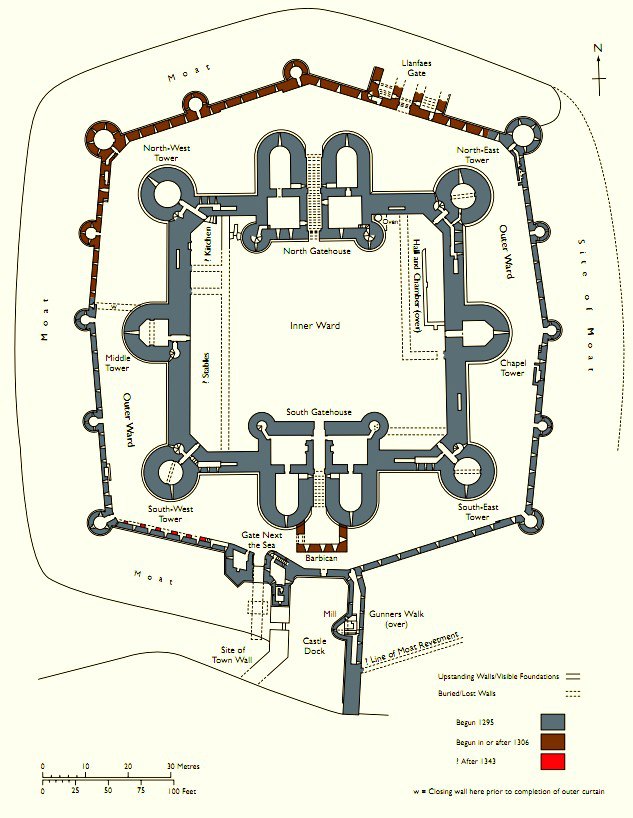
Like the castles at Rhuddlan, Aberystwyth and Harlech (and unlike those at Conwy and Caernarfon, where the shape was determined by the contours of the underlying rock) Beaumaris took advantage of the flat site and was designed in the concentric plan. The main courtyard /inner ward is surrounded by a narrow encircling ward and both are then protected by an outer moat with a controlled supply of tidal water.
Below are a few views of the outer walls, the moat (with resident swans and their cygnets) and the main entrance (called ‘The Gate Next the Sea’). Alongside this gateway is the castle dock, where boats would have moored while their cargoes were unloaded directly into the outer ward.
The gateway itself was defended in three ways. First was the drawbridge across the moat, which would be raised at the first sign of alarm. Then there was the portcullis, the grooves along which this would have operated can be seen on two of the photos above. Above the inner passageway were the ‘murder holes’, one of which can be seen in the middle photo on the last row, above. Through these, attackers who succeeded in getting through the two outer defences would have met with boiling oil, as well as a barrage of arrows through arrowloops along the passageway wall. Lastly was a heavy, two-leaved door.
Today, the castle is approached across a wooden bridge over the moat instead of a drawbridge, and through the main entrance into the outer ward. These are shown on the larger photo, top left, above.
There are several information posters around the site. This one below is about the outer ward. If you’re good at reading Welsh, try the information at the right hand side! Note the interesting snippet and ‘view through the wall’ diagram showing castle loos (bottom left illustration):
The inner gatehouse – through to the inner ward – was defended by three successive pairs of barrel gates and portcullises. It was sited deliberately off-line to force attackers into exposing their left flanks to archers waiting along the top of the inner gatehouse and wall.
The symmetry of the castle is impressive (as evident on the above plan) although the skyline has been described as visually disappointing. It lacks the turrets of Caernarfon. Conwy and Harlech and has a definite squatness that fails to dominate its surroundings. This is because, although the work went on for 35 years, when it finally ceased in the 1330s, the towers of the inner ward were still without their top storeys and the planned turrets were never even started. There were plans for 5 separate suites of lavish accommodation, 3 of which remained unfinished. Unfortunately, Edward simply ran out of money.
Here are a few photos of the inner ward and a couple looking out from the top of the inner wall over the Menai Strait toward mainland North Wales. The seagull was also nesting along the top of the inner wall.
Beaumaris Castle has relatively little recorded history. Any sieges it had to withstand were not the kind to add much to its story, as those at Harlech. Like all the North Wales castles, it was held for the king in the civil war (1642-49) and surrendered to Parliament in 1646. Some partial works of demolition were carried out after that war, but most of the original structure has remained standing until the present time.
Next time I go to North Wales, I’ll be aiming for the castles at Harlech, Rhuddlan (which is just a ruin) and Chirk. I camped in the grounds of Chirk Castle many years ago, when I was a robust Girl Guide at the age of thirteen. Happy memories!

































 Millie Thom