Saltaire

Built between 1851 and 1876, the Victorian model village of Saltaire is located in Shipley, a commuter suburb and small town in the City of Bradford Metropolitan District in West Yorkshire, UK.
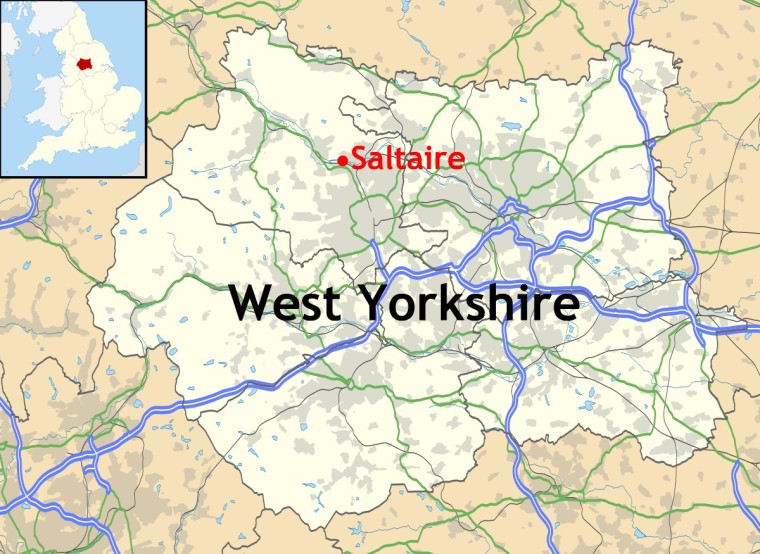
Location of Saltaire in West Yorkshire
Base map courtesy of Wikipedia

The name Saltaire is derived from the surname of industrialist, entrepreneur and philanthropist, Sir Titus Salt, who had the village built, and the River Aire which flows through it.

Every year, hundreds of visitors come to Saltaire to visit the village itself, and/or take a look round Salts Mill, the woollen ‘supermill’ that Titus Salt had built in the town. To do justice to both village and mill ideally takes (at least) a whole day. There is much to see and plenty of places where visitors can buy drinks, snacks or meals when required – both around the village and inside the mill.

Saltaire is situated by the River Aire, the Leeds and Liverpool Canal and the Airedale railway line, all ideal for the import of raw materials for Salt’s woollen mill and export of the manufactured goods.

Plan of Saltaire
Map photographed from a information board in Saltaire

Titus Salt cared about the welfare of the workers for his planned new mill on the edge of Bradford. He wanted to create a community in which they could live healthier and happier lives than they had in the slums of Bradford, where cholera epidemics were frequent. Saltaire was 3 miles from central Bradford and surrounded by open countryside with plenty of fresh air. In addition to these evident health benefits, Salt installed the latest technology in his mill, intending working conditions for his workers to be far better and safer than they were in mills elsewhere in the country. Undoubtedly, such improvements would also benefit output from his mill.

Salt employed local architects Henry Lockwood and Richard Mawson to design his new village. The first building to be finished in 1853 was the mill itself, while building work on the rest of the village continued until 1876.

When the mill opened in 1853, on Titus Salt’s 50th birthday, he threw a huge party for all his workforce. It was the biggest factory in the world, four storeys high and the room known as ‘The Shed’ measuring 600 feet in length. The mill employed 3000 workers and had 1200 looms. Over a period of twenty-five years, 30,000 yards of cloth were produced per day. The noise from the machines would have been deafening and the workplace very hot. Yet working conditions for employees in Salt’s Mill were still far better than in most other textile mills.

The following photos of the working mill  were taken from a video playing inside the mill:

Salt’s enormous success in the textile industry was partly due to his use of the wool from alpacas. He combined it with other materials to create new varieties of worsted cloth. Wool worsted cloth as well as wool/cotton and wool/silk worsted cloths already existed for making men’s suits. In Salt’s day it was fashionable for ladies clothing. Most ladies would have wanted (but many couldn’t afford) expensive silk – and Alpaca made a light, smooth fabric with the lustre of silk, but was more affordable.
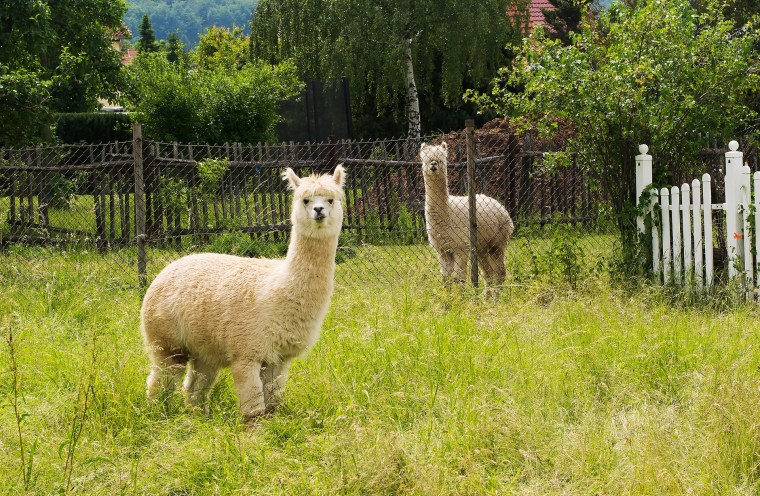
alpaca-2907771_1920
Alpacas, courtesy of Pixabay

Architecture in the village was of a classical style, inspired by the Italian Renaissance. The rows of neat stone buildings were all terraced, arranged in a grid pattern. All streets were named after members of his family, such as Caroline Street after his wife. In total there were 823 houses, shops, a school, two churches, a school an adult education institute, park, hospital, and almshouses for the aged. The streets also had gas lamps.  Each house had its own outdoor toilet – a luxury for the working classes in of the nineteenth century.

Salt also had a wash house and baths built in the village, the wash house because he objected to seeing lines of washing hanging in the back yards. Dirty washing could be brought to the wash house on Mondays to Thursdays. There were six washing machines powered by steam engines and four rubbing and boiling tubs using hot and cold water. Clothes were put through the wringing machine and dried in a drying closet before being mangled and taken home. The whole process took an hour.
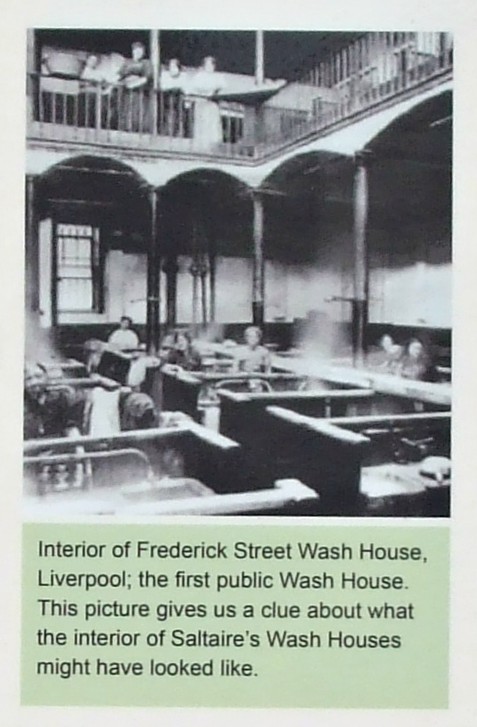
Wash House Interior
Photo taken from and information board at the community garden in Saltaire

There were 24 baths for public use with separate entrances for men and women. There was even a Turkish bath. The baths were open every day but Sunday from 8am to 8pm. Salt’s care for the health of his workers is evident but, unfortunately neither wash house nor bath house was popular and the building was converted into housing in the late 19th century. The houses were demolished in the 1930s and replaced by garages which were demolished in the 1950s. The site is now a small community garden.

Saltaire Congregational Church (now the United Reformed Church) was one of Lockwood and Mawson’s finest works and is set in a spacious landscaped garden. Salt was a staunch Methodist and insisted his workers attended chapel on Sundays. He also frowned upon gambling and the drinking of alcohol. A mausoleum beside the church is where Titus Salt was buried.

The Victoria Hall is also worth a look inside:

Robert’s Park, alongside the River Aire is a pleasant, open space to spend a little time. The alpaca statues are a reminder of the importance of their wool to the continuing success of Titus Salt, whose statue is also in the park.


Salts Mill closed as a textile mill in 1986 and was bought the following year by Bradford entrepreneur, Jonathan Silver who had it renovated. Today it houses a number of business, commerce, leisure  and residential concerns. The main mill is now an art gallery, shopping centre and restaurant complex. There is a fish restaurant and Salts Diner, a cafe which serves a variety of dishes.029

Eating inside the mill

The 1853 Gallery takes its name from the date of the building in which it is housed and it contains many paintings by local artist David Hockney. A bust of Titus Salt welcomes visitors through the door.

Today, Saltaire is a popular place to visit, as an educational experience or simply e a lovely village in which to spend some time. Families come for many reasons, and boat rides along the canal seemed popular on the day we were there. Oddly enough, one of the boats was called Titus. I wonder why…
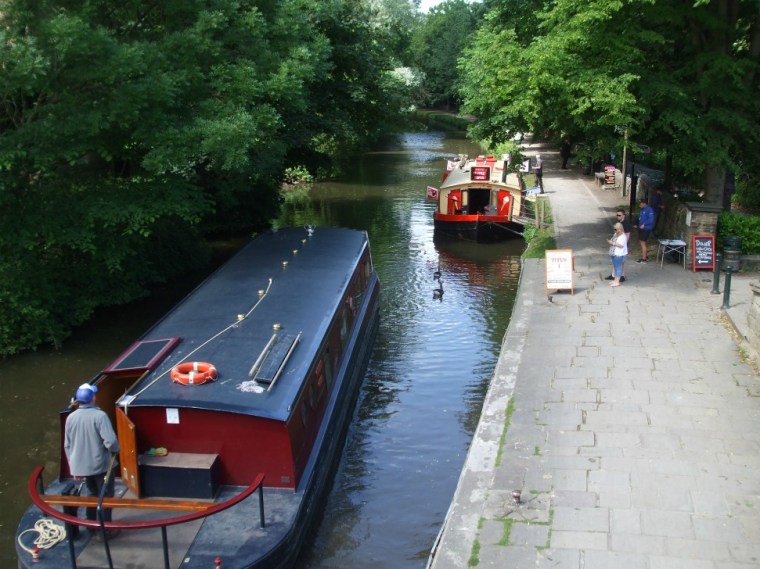
Boat rides on the Leeds and Liverpool Canal

World Heritage status was bestowed upon Saltaire in 2001. It is described on an information board in the village:

World Heritage status from a noticeboard in Saltaire

Our visit to Saltaire was three years ago now. We had planned to go back again sometime this year. But as they say, ‘All the best-laid plans of mice and men…’  Perhaps next year, then…

Refs:

  1. Information boards around Saltaire
  2. Wikipedia
  3. My Learning

The Plague Village of Eyam

Eyam is a village in Derbyshire, U.K. and lies within the Peak District National Park:

Location of Eyam in Derbyshire
The village was founded by the Anglo-Saxons and, as in many limestone areas of the Peak District, lead had been mined in the vicinity since Roman times.  In the early and mid-17th century, the industry employed many of Eyam’s inhabitants.

Today the pretty Derbyshire village attracts visitors from around the world, not only due to its location within the National Park, but because of its fame as ‘the plague village’. In addition, hundreds of visitors flock into Derbyshire from spring to autumn each year (though not this year!) to see the fabulously ‘dressed’ wells in many of the villages, Eyam being one of them.  I did a post about Well Dressing here

The plague that hit Eyam in 1665-1666 is referred to as ‘The Great Plague’. It was not ‘The Black Death’ – the outbreak of plague that reached England in 1348. The plague that occurred in both periods was basically the same bubonic plague, the different names denoting the different times in which it struck. In the 300 years between the two, numerous other outbreaks of plague occurred across the country and some small settlements disappeared altogether.

Bubonic plague is a disease carried by several rat species, most commonly the black rat, also known as house rat or ship rat.

Plague ratThe fleas that live in the rat’s fur are carriers of plague bacilli and when they feed on the rodent’s blood they leave the bacilli in its body, causing rapid death. If the number of rats plummets, infected fleas will take the blood of humans or other small mammals.

Plague Flea 2

In London alone in 1665-6, almost 70,000 deaths were recorded during this outbreak of plague, though it is thought the real number was closer to 100,000. Many towns and villages across England also suffered. In Eyam, 260 of the estimated population of 1,000 died.

The plague in Eyam is believed to have been caused by fleas that had got inside a bale of cloth brought to Eyam from London for a travelling tailor’s assistant named George Viccars who was lodging with Mary Hadfield and her family. When he unfolded the cloth it was damp, so he laid it out to dry – and the plague-carrying fleas jumped out.

George Viccar with his bale of cloth

George became the first man to die of the bubonic plague in Eyam. More deaths soon followed and within days, the disease had spread through the village, affecting many households.

The most well-known effect of bubonic plague are the buboes, the massive, tender swellings which form in the lymph nodes, generally in the armpits or groin:

Plague_-buboes
Plague patient displaying a swollen, ruptured inguinal lymph node, or buboe. Image courtesy of the Centers for Disease Control and Prevention’s Public Health Image Library. Public Domain

There are various other effects, too – fever, vomiting, headaches and delirium being just a few of them. The lungs can also become infected, causing pneumonic plague. This is less common but much more dangerous, due to the ease in which it can spread through sneezing. A third form of the disease is believed to be septicaemic plague, a life-threatening infection of the blood.

Having no scientific knowledge enabling them to account for the outbreak of the plague, to the villagers the disease could only be explained in religious or supernatural terms. The wrath of God inflicted upon sinful people could only be pacified by prayer and repentance. Many devout villagers refused to take preventative measures for fear of angering God further. Others relied on herbal and other age-old remedies. Between the September and December in 1665, 42 villagers died.

Remedies 4

Remedies 2

There is no record of how many villagers actually left Eyam and it is now believed the number was higher than originally thought. But it is known that most were wealthy landowners and mine owners – all of whom would have had somewhere else to go.

Wealthier people fled from Eyam

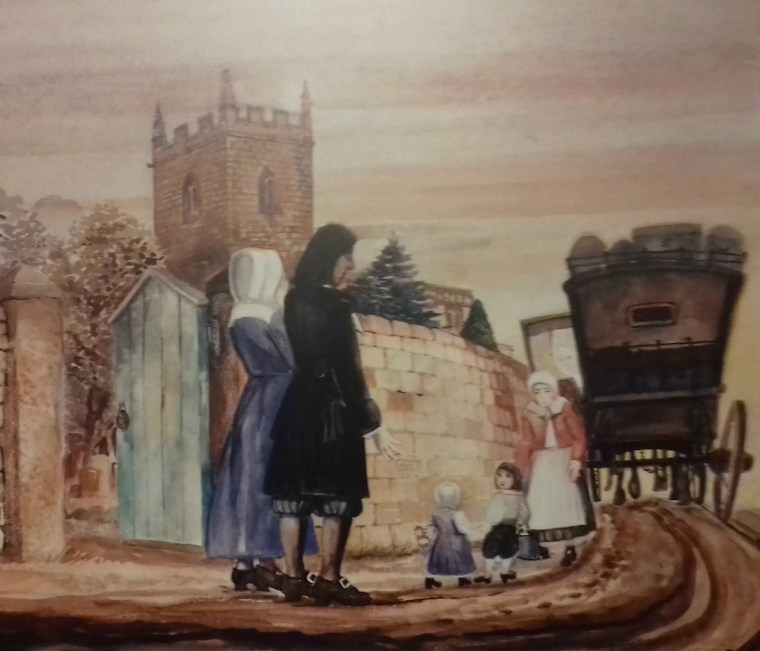
A few families sent just their children away to safety, as did William Mompesson, the recently elected reverend, and his wife, Catherine:

Children being sent from Eyam 1

Few of the poorer, tenant farmers and labourers could abandon their livelihoods and just pack up and leave, but in a bid to escape almost certain death, a few  poor people chose to try their luck elsewhere. Some built makeshift homes on nearby Eyam Moor or in fields or on hillsides.

Some poor people also fled

There is also plenty of evidence of poorer refugees of the plague being barred or violently driven away from their chosen places of refuge. The people of the city of Sheffield, approximately 15 miles away, erected barriers and posted guards. The picture below shows an Eyam woman being chased out of the nearby village of Tideswell as she attempted to mingle unnoticed with shoppers at the market.

Woman from Eyam being chased out of Tideswell

Mortality rates over the winter 1665-66 saw a drop, primarily due to the rats nesting in warm places like thatches on the roofs. There would also be ample foods for the rats in the unhygienic homes of the times. Comfortable, warm rats would provide plenty of food for the fleas, so they would have no need to seek out alternative sources of blood.

Nevertheless, death rates were still well above the normal winter average, and since the villagers knew that plague was a summer disease, the number of deaths was expected to increase with the rise in temperatures in the spring of 1666. After a slight lull in casualties in the May, a sudden and dramatic increase occurred in June, and it became clear to the newly appointed reverend, William Mompesson, that something needed to be done. Together with a former rector of Eyam, Stanley Thomas, a three-fold plan was devised.

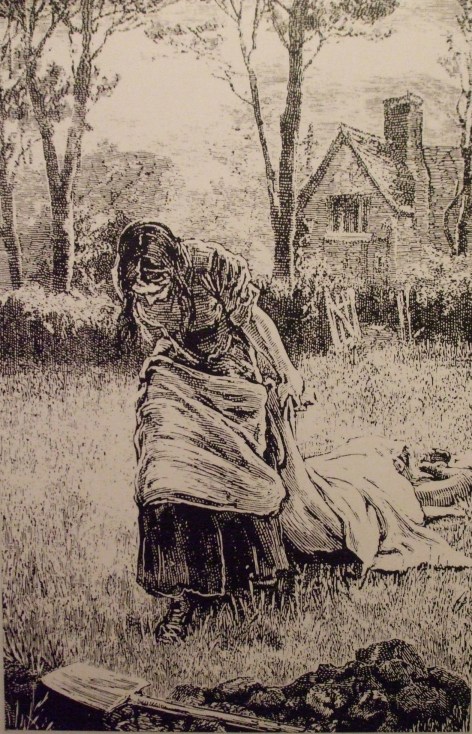
Firstly, there would be no more organised funerals and church burials. Families would be responsible for burying their own dead in their gardens, orchards or fields.

Carrying out the dead

Secondly, the church would be locked and future services held in the open air.

030

The third part of the plan was the greatest and toughest of them. A ‘cordon sanitaire’ would be imposed around the village in an attempt to stop the disease spreading further afield. In other words, the village would be quarantined – a condition to which all villagers needed to give their consent. Quarantine would mean that, shut away from the world, many people in the village would meet the inevitable end.

Mompesson promised to do all in his power to get essential foods and medications into the village. A boundary stone was erected, separating Eyam from the nearby village of Stoney Middleton. The stone had specially made holes in its top, which were filled with vinegar, which acted as a disinfectant.  Eyam villagers could put their money into these holes in exchange for supplies. The stone is still in its original place today and visitors can find it by following the signs around the village. 

Boundary stone 2

In addition, in exchange for their promise of obeying the cordon, the Earl of Devonshire from nearby Chatsworth House, freely donated foods and medications to the people of Eyam. These were left at a place known as Mompesson’s Well. 

Collecting food from Mompesson's Well 2

The highest number of deaths was recorded in August 1666, as many as 5 or 6 deaths per day. In the heat of the summer, the fleas were more active and the disease rapidly spread. Households became deserted, communal tasks left unfinished and cattle wandered unattended. Nevertheless, few people attempted to leave (only 2 known). Elizabeth Hancock buried her husband and six of her children, though she remained unaffected herself. Their graves are known as the Riley Graves, after the name of the farm on which they lived.  Like the boundary stone, these graves can be visited today.

Burial close to own home 2

William Mompesson’s wife, Catherine, worked tirelessly, visiting the sick until falling victim to the plague herself in late August, 1666.  Her tomb can be seen in the churchyard.

Catherine Mompesson's tomb

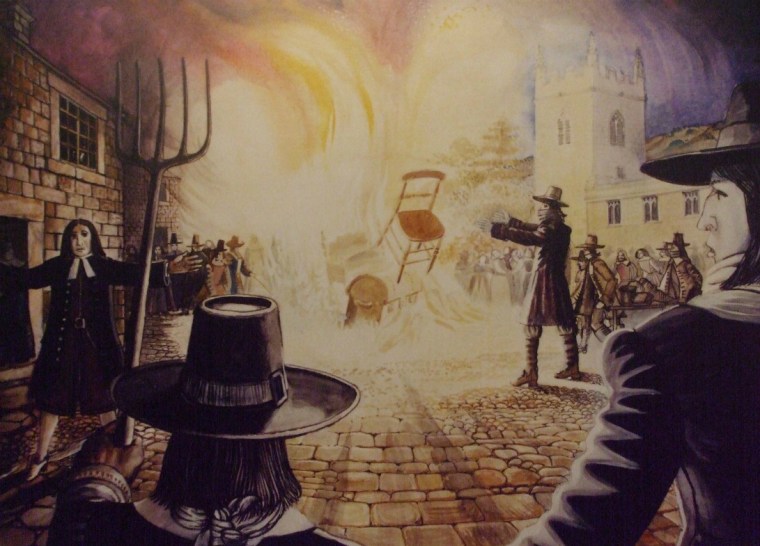
By Christmas 1666, after 14 months and the deaths of 260 people, it was all over. Life in the village slowly began to return to normal. In an effort to stop further outbreak of the pestilence the following summer, there was ‘a great burning’ of everything in Eyam that could have harboured the ‘plague seeds’. Mompesson set the example by burning everything of his own except the clothes he was wearing.

Great burning after the plague at Eyam 2

To finish with, here a few photos we took around the village. With the exception of the one buboes (which is from Wikipedia) those shown above were all taken in the little Eyam Museum, which is well worth a visit.

Also of interest, with plenty of information about the Great Plague at Eyam, are Saint Lawrence’s Church, and the Plague Cottages.  Eyam Hall – which is a 17th century, grade 2 listed historic house – is also well worth a visit. In the churchyard are Catherine Mompesson’s tomb and a fabulous Anglo-Saxon Cross dating from the 8th-9th century.

Inside the church, there is a famous stained glass window depicting scenes connected to the plague and a record of those who died from the disease.

Plague window inside Eyam Church

A Visit to Newstead Abbey

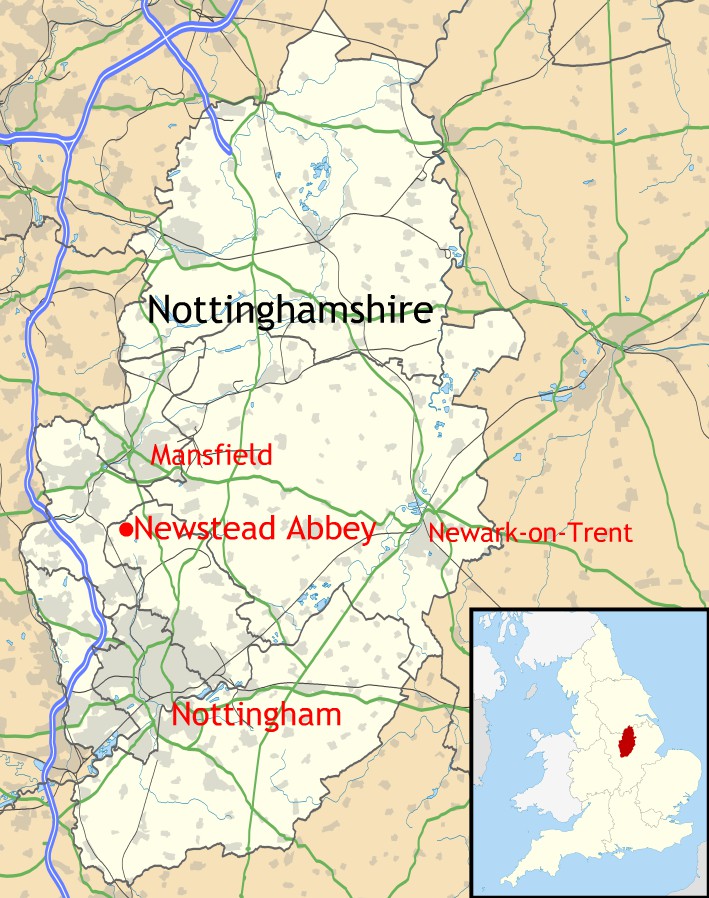
Newstead Abbey is a beautiful historic house in Nottinghamshire, UK:

Location of Newstead Abbey within Nottinghamshire

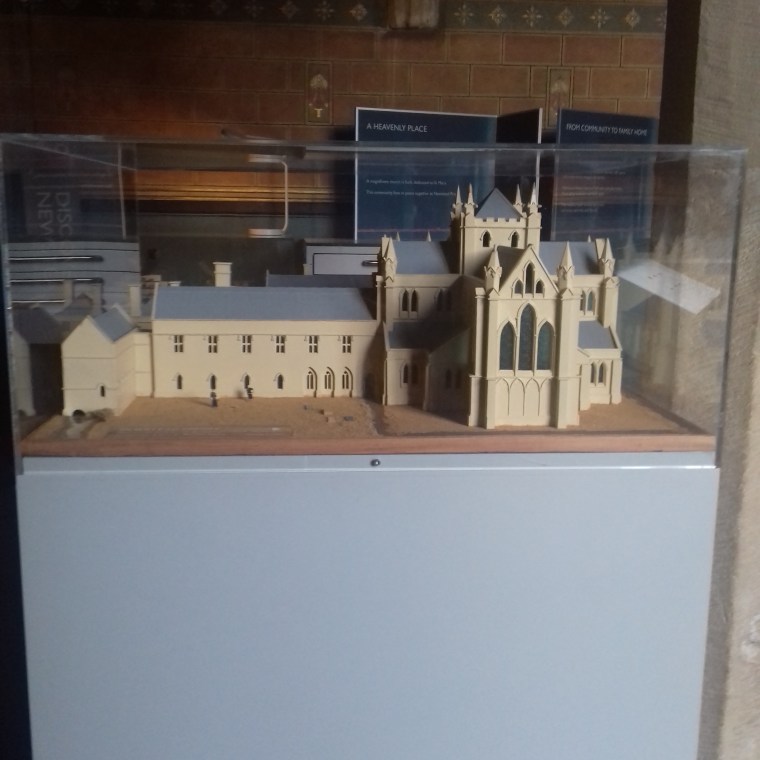
Set in over 300 acres of fabulous parkland and gardens, it was founded in 1170 by Henry 11 and, despite it’s name, it was never an abbey at all but an Augustinian priory called St. Mary of Newstead. The stonework of parts of of the old priory can still be seen today and a useful model helps visitors to visualise what it looked like:

179

The cloister of the old priory is the home for several beautiful peacocks. The photos were taken through rather hazy glass:

Following the Dissolution of the Monasteries in 1539, the priory was given to Sir John Byron of Colwick by Henry V111 and it was Sir John who started converting it into a house.

Between 1808 and 1814 Newstead was the home of the poet, Lord Byron. Byron was a colourful and flamboyant character, probably best known as much for his wild lifestyle and ill-fated marriage as his writing. Visitors to Newstead can learn a lot about both man and poet at this lovely house, as well as the history of the house itself.

Below are three portraits of Byron from around the house. The middle one shows him wearing Albanian dress, which he acquired while on a Grand Tour of the Mediterranean in 1809. (For anyone interested in Lord Byron’s life but can’t get to Newstead, there is plenty of information online).

Byron’s private apartments can be visited today, including his bedroom which is at the top of a narrow spiral staircase. For financial reasons, Byron only furnished his own private parts of the house, leaving the rest in the sad state of repair it had been when he inherited it. He used some of those rooms for his numerous sporting activities, including pistol shooting practice, fencing and wrestling in the Great Hall, which he hadn’t decorated and furnished. (The first picture below shows how it looks today). But there is much more to Byron than wild living and writing, which can be learned on a tour of the various rooms. He was a supporter of many causes, some of them abroad.

Restoration of the rest of the house was undertaken by future owners, starting with Thomas Wildman, an old university friend of Byron’s, who bought the property in 1818 when Byron was forced to sell for financial reasons. Most of the house today is of a Victorian setting.

The gardens are lovely and include a couple of lakes, one very rectangular one and the other a more natural shape with lots of water lilies. There is a small walled garden and a number of differently themed gardens, such as the Japanese Garden (my favourite) the Spanish Garden, American Garden, Subtropical Garden and so on. There are some interesting statues here and there, too – I loved the one of Pan, and there’s also one of ‘Mrs Pan’. Butterflies flutter and bumble bees buzz in the herbaceous borders and gardens, and close to the house, peacocks appear now and then to delight the visitors. These are just a few of the many photos we took around grounds and gardens last year.

We had a second visit to Newstead Abbey last year in December. The house was beautifully decorated for Christmas, though whether it will be again this year, I don’t know. This year has been dreadful for all of us, and many of our favourite sites (like Creswell Crags, which I posted about a couple of weeks ago) are suffering great financial loss and struggling to survive.

I may well share the Christmas photos sometime in December but, until then, here is just the one from outside:

The Alfred Jewel

The Alfred jewel=

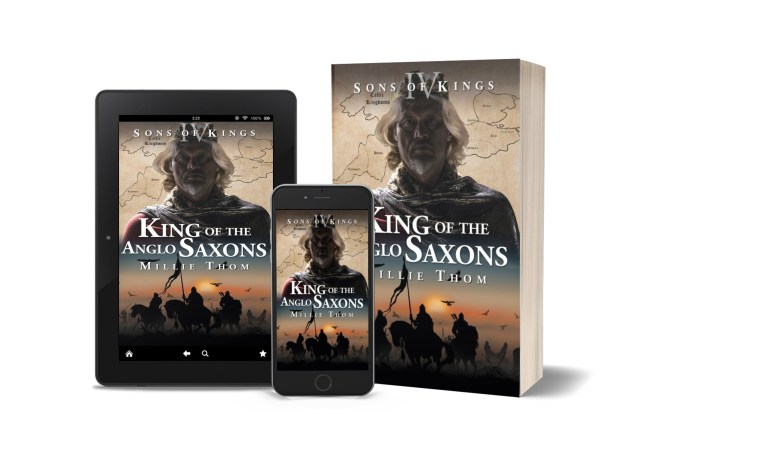
Many – or perhaps most – lovers of early medieval history will probably have heard of The Alfred Jewel. As a writer of novels set in the mid-late 9th century during the lifetime of Alfred the Great, it stands to reason that I should mention this fabulous jewel at some stage. That mention comes in the last chapter of the final book of the Sons of Kings series: King of the Anglo Saxons.

1588359128

So what is this jewel, why it is of special interest and why it has been linked to King Alfred, shown in images below?

AlfredtheGreatbyGeorgeSStuart
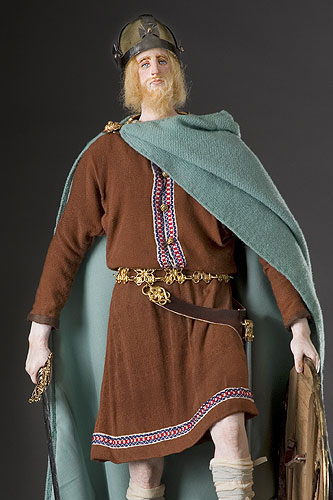
An historical mixed media figure of Alfred the Great by artist/historian George S Stuart. Photographed by Peter d’ Aprix
011 - Copy
Alfred’s statue in the Market Place in Wantage, reputedly the town of Alfred’s birth. Own photo.

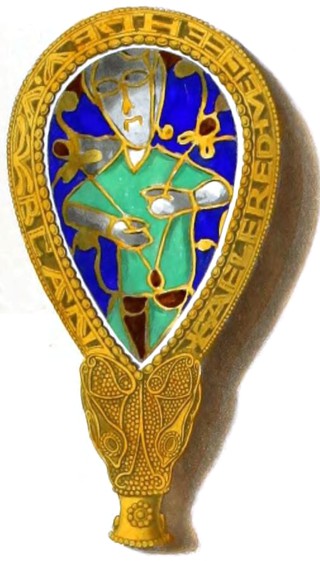
The Alfred Jewel is a rare and magnificent piece of filigreed gold enclosing a tear-shaped slice of clear quartz over a cloisonné* enamel plaque of green and blue. It is about 2.5 inches long and 1.2 inches wide, its purpose being to hold a pointer that could be attached to a page of a manuscript and moved down to facilitate reading of the text. Such implements were referred to aestels in Anglo-Saxon times.  Several others have been found, all fabulous finds, but none as exquisite, or colourful, as the Alfred Jewel.

The image on the plaque of the Alfred Jewel is of a man with prominent eyes, holding two floriate stems. It could be a picture of Alfred himself, the pope, one of the saints, a figure of Sentient Man or Christ Incarnate. Modern thought favours the last two. The back of the enclosing gold is flattened for smooth sliding over a page (as with all aestels) and is decorated with an intricate design, thought to represent the Tree of Life.

King_Alfred’s_Jewel—front,_enamel,_back

The gold thickens at the base of the ‘tear-drop’ to become a dragon-like head. Inside the creature’s mouth is a cylindrical socket/hollow tube designed to hold a pointer. Most pointers were of wood but other materials were also used, notably ivory. The pointer was held in place by a rivet. Around the edge of the jewel is the inscription, ALFRED MEC HEHT GEWYRCAN, which means ‘Alfred ordered me to be made’.

Alfred_Jewel

The jewel was ploughed up in a field on land owned by Sir Thomas Wroth at North Pemberton in Somerset in 1693. The site is a mere eight miles from Athelney, where Alfred built his stronghold in order to defend his kingdom from Guthrum, and his invading Danes in 878 (Sons of Kings, Book 3, Wyvern of Wessex). We took his photo from an information board at Athelney:

Location of Athelney from a board at the site

1589479795

The jewel was bequeathed to Oxford University by Sir Colonel Nathaniel Palmer (1661-1718) and today it is in the Ashmolean Museum in Oxford – where it has been described as ‘a matchless piece of goldsmith’s work’ by the British Archaeology Collection at the Ashmolean Museum

***

*Cloisonné is decorative work in which pieces of enamel, glass or gemstones are separated by strips of flattened wire placed edgeways on a metal body.


A Visit to Creswell Crags

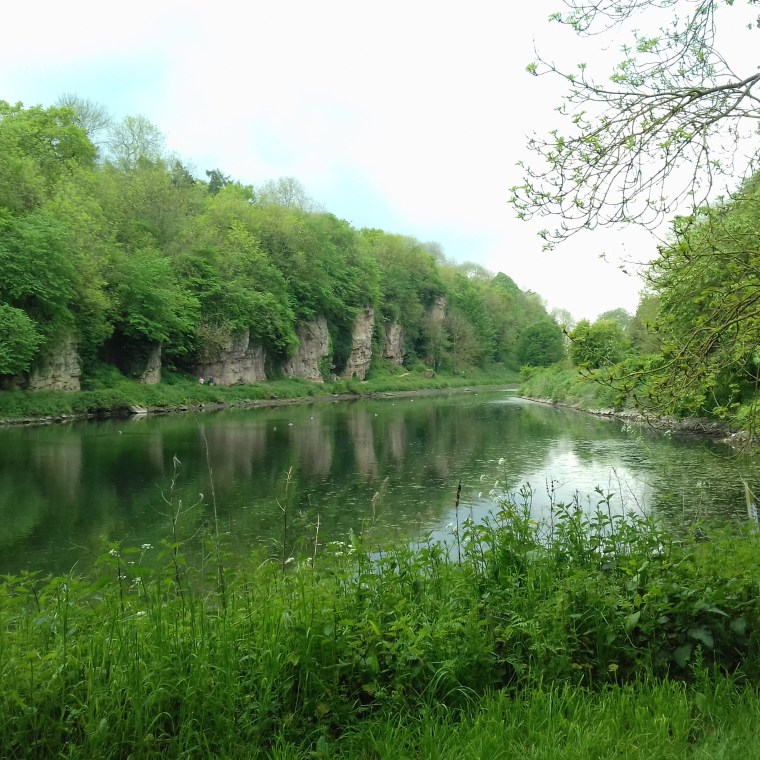
20190519_121350

From spring to autumn of most years we have a day out on a Sunday, visiting scenic or historical sites which are close enough to drive to and enjoy in a single day.  We’ve been to Creswell Crags many times and at various times of year, and it’s always worth a visit. So, because we haven’t been able to go anywhere at all this year, I thought I’d show some photos of Creswell from our day out in May 2019 and add a little bit of information about the attractions and importance of the site.

Creswell Crags is a beautiful magnesian limestone gorge situated on the border between Nottinghamshire and Derbyshire in England.

Location of Creswell Crags

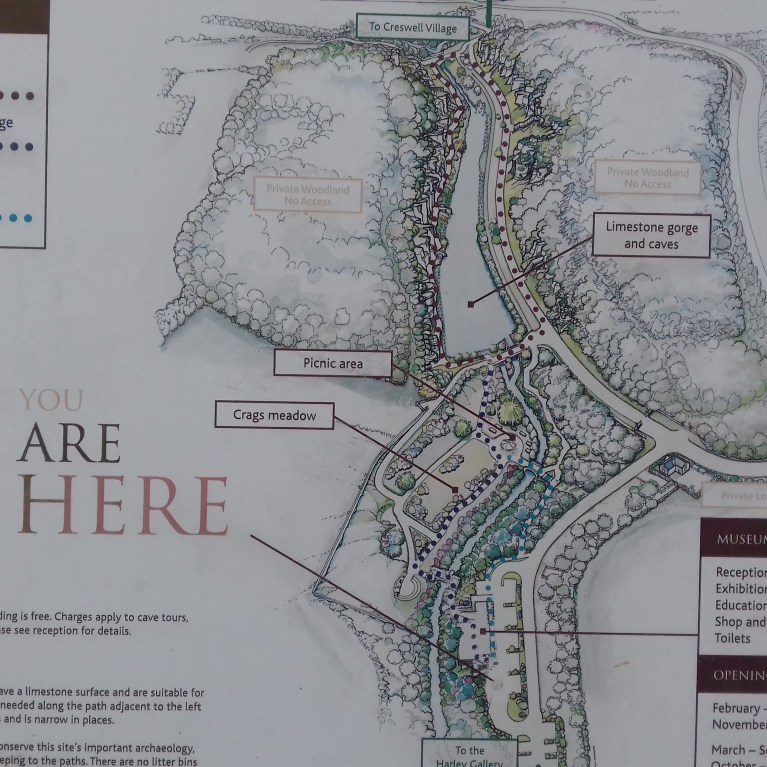
It is popular with families, walkers and horse-riders as well as academics interested in the appearance and use of the gorge and its caves in the distant past. The route down to the lake (i.e. the widened stream) from the Reception is a pretty area with delightful trackways with picnic areas, open meadows and children’s play areas.

The ‘YOU ARE HERE’ in the plan below is to the side of the Reception / Visitor Centre.

20190519_104512

The gorge itself is known throughout the world as an outstanding Ice Age archaeological site. It was designated as a Site of Special Scientific Interest (SSSI) in 1981 and as a Scheduled Ancient Monument in 1985. The caves were seasonably occupied during the Upper Paleolithic and Mesolithic periods (from around 11,500 – 6,000 BP) and there is evidences of Neanderthal, Bronze Age and post-medieval activity.  The caves  contain the northernmost cave art in Europe as well and a series of 17th and 18th century witches marks.

20190519_110959

The gorge provided a valuable summer camp for our Ice Age ancestors. It was a place where people could meet, there was food to hunt nearby and caves in which to shelter and prepare for their return to their winter territories across Doggerland to mainland Europe.

Doggerland connected Brtian to Continental Europe at the time when waters of the sea were frozen during the Ice Age
A hypothetical map showing Doggerland connecting Britain to Continental Europe at the time when waters of the sea were frozen during the Ice Age. Author Max Naylor, February 2008 Creative Commons

There are six main caves along the gorge at Creswell Crags in addition to many smaller fissures and solution hollows. Excavations in the larger caves have provided a rich fossil record, “a time capsule spanning thousands of years”. Neanderthals visited 55,000 years ago, as did the earliest, modern humans 29,000 years ago. Remains of various animals have been found. Before the Ice Age, exotic animals like hippopotamus and rhinoceros wallowed in the warm waters of the river that flows through the gorge. As the climate cooled to Ice Age conditions, lions and hyenas used the caves as dens, and were joined by woolly mammoth, woolly rhinoceros and reindeer. Skulls and other bones of various species can be seen in the small museum at the Reception – including lions, hyenas, bears, woolly rhinoceros and mammoth, plus several smaller mammals.

Here are a few photos taken of the caves and general views during our walk around the lake:

Hunter gatherers continued to use the caves long after the end of the Ice Age. Burnt hazel nut shells, cattle bones and small flints have been found. 6,000 years ago the caves were used for burials. Urns have been found as have bronze pins,which were used to hold the burial shroud. A human collarbone was found in Church Hole Cave.

Hundreds of protective marks, known as witches’ marks, have been discovered in caves at Creswell. They date from medieval to modern and are scratched into walls and ceilings over dark holes and large crevices. Originally thought to be graffiti, they are now believed to be the the largest collection in the UK.  Prior to their discovery, the largest collection was held to be in Somerset, with 57 marks. The number at Creswell far exceeds that number – there are hundreds in one cave alone.

Ritualistic protection marks were most commonly found in historic churches and houses, usually near to entrances such as doorways, windows and fireplaces, to protect the people living there from evil spirits. The most common sign is VV, believed to refer to Mary, Virgin of Virgins. The one shown below is not from Creswell. We didn’t go inside the caves last year when the Witch Marks tour was opened for the first time.

shutterstock_1726383430

Another common symbol is PM, referring to Pace Maria. Other signs, include diagonal lines, boxes and mazes. Many appear to have been added over time, possibly indicating a need to strengthen protection in periods of unexpected sickness, death or crop failure.

Although closed at present due to Covid-19 restrictions, Creswell Crags is usually open all year. There is no cost to walk round or visit the shop or cafe. Entrance to the exhibition/museum is £3 and cave tours start at £9 for adults and £7 for children. for a single cave.


Vikings at Sherwood Pines 2019

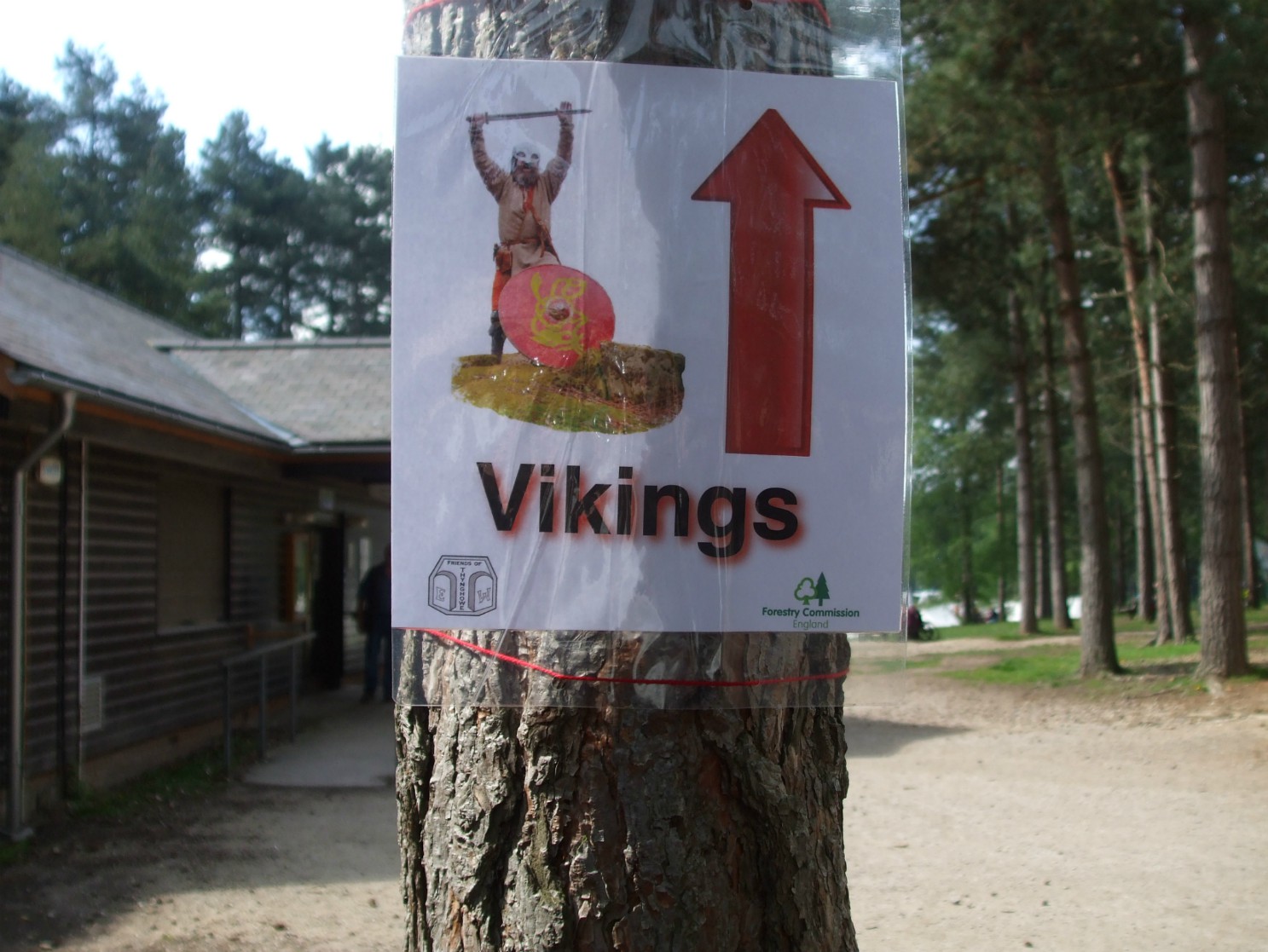
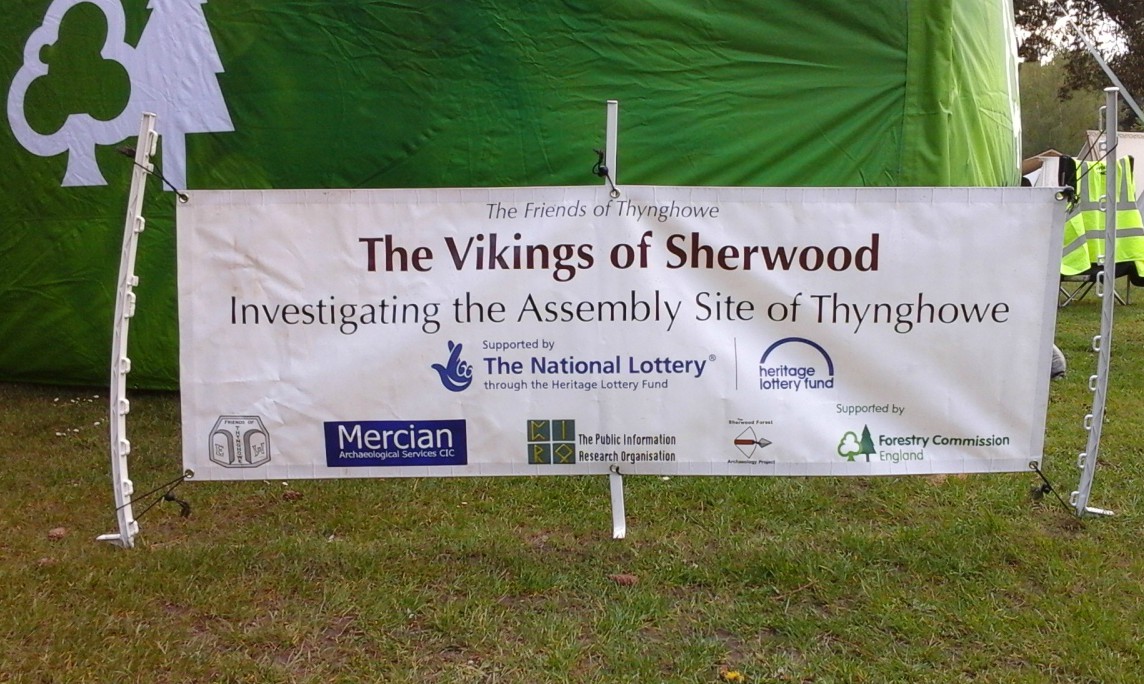
This past weekend saw Viking reenactors from Regia Anglorum groups across the country gather at a place known as Thynghowe in Sherwood Pine Forest Park for the annual event known as ‘The Spring Thing’.

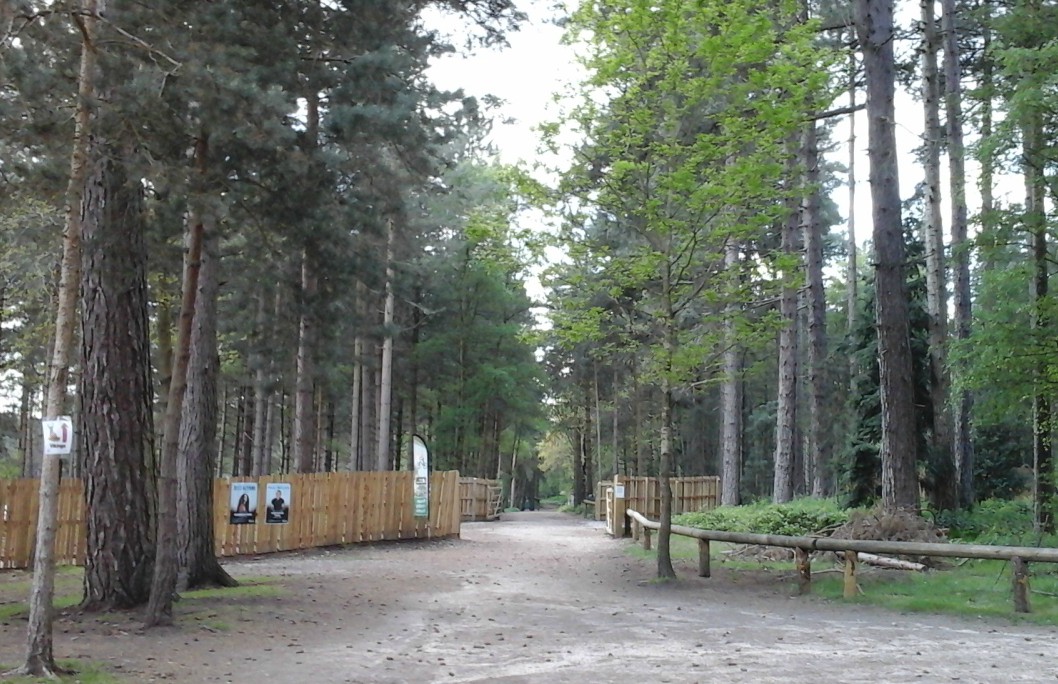
At 3,300 acres, Sherwood Pines is the largest park in the East Midlands of England. Lying close to the historic village of Edwinstowe in Nottinghamshire, it is a part of the ancient Sherwood Forest and was originally known as Clipstone Heath. It was acquired by the Forestry Commission in 1925 and replanted with pine trees as part of a response to a shortage of wood following the First World War. Today, activities are offered throughout the year, including cycling, mountain biking and segway, camping, walking, jogging, a park run, orienteering and bushcraft, a children’s adventure trail, tree climbing and ranger activities. There is also a Robin Hood hideout and Kitchener’s Trail, a café and visitor centre, and the site is perfect for a family day out – even when no event is scheduled (which in addition to the Viking Spring Thing, include various concerts and musical events as well as outdoor activities).

So, why is this spot in Sherwood Pines a perfect site for Viking gatherings and reenactments every year, and what is Thynghowe?

Thynghowe, meaning ‘thingsite’, is the name given to an important Viking Age open-air assembly place situated at the top of Hangar Hill on the western edge of Sherwood Forest, so is very close to the site where this event is held. It was (re)discovered in 2005. Vikings met at such sites for their annual ‘Thyng’ – which generally lasted for several days – during which time disputes were settled, laws were signed, punishments for crimes decided upon, marriages arranged and such like. Each community had its own Thyng/Thing/Althing, most likely dominated by a local, powerful family or families. Thyngs were often festive affairs, with tents, stalls/booths set up so goods could be bought and sold, including plenty of ale and mead.

Several such sites are known across the Viking world, including the famous Thingvellir in Iceland and Tinwald in the Isle of Man, both of which I’ve visited, plus others in the Faroe Islands, the Shetland and Orkney islands, the Scottish Highlands (Dingwall), the Wirral in England… In other words, wherever Vikings chose to settle.

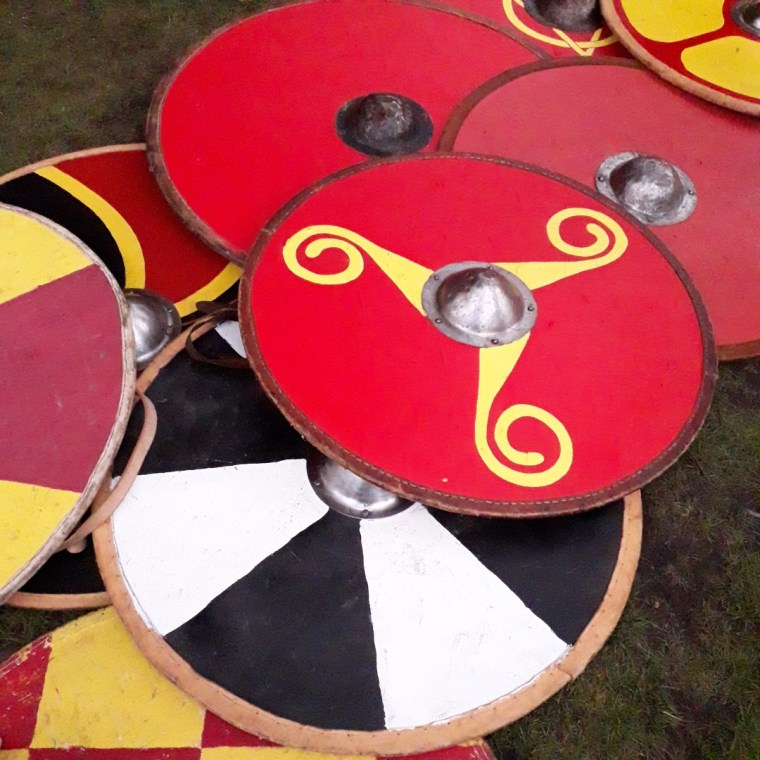
The gathering at Thynghowe was an equally festive affair, with lots of tents and stalls set up to demonstrate the Viking way of life, including cooking methods and a number of important occupations and crafts. These are a selection of photos we took around the camp as we walked round:

Here is a very short video we made of the wood turner, who was making spokes for cartwheels, while the stall next door made the actual wheels.

The stall holders/reenactors were only too happy to answer questions and chat in general. The happy-looking man in the picture below spent some time explaining not only about how Viking shields were made, but about the fabulous reenactment goup, Regia Anglorum.

This delightful, hard-working lady below also deserves our thanks for taking the time to explain and demonstrate how she was creating bast from lime wood for use in rope making. Rope made from lime bast fibre was not only important for many things around the village, but the fact that it didn’t shrink when wet (unlike rope made from hemp) made it perfect for use in the building of ships. In the photos she is stripping the bark off lime tree trunks to obtain the strands of fibre behind. After a good soaking in water, the bast is rendered soft enough to twist and plait together to make rope.

And this Viking warrior was obviously having a bad hair day. His hairdresser/friend was giving his hair a good comb, while he complained about his unruly, frizzy hair. Oh, the vanity of men! Naturally, I just had to have a feel of such frizz.

In the morning we were treated to preparatory bouts and skirmishes before the big battle planned for the afternoon. The commentary was excellent throughout, with explanations of the moves and battle tactics of the warriors, weapon use and so on. In the afternoon, there were three arena events to watch. The first was a demonstration of horsemanship.

The second an archery competition and finally, the actual battle.

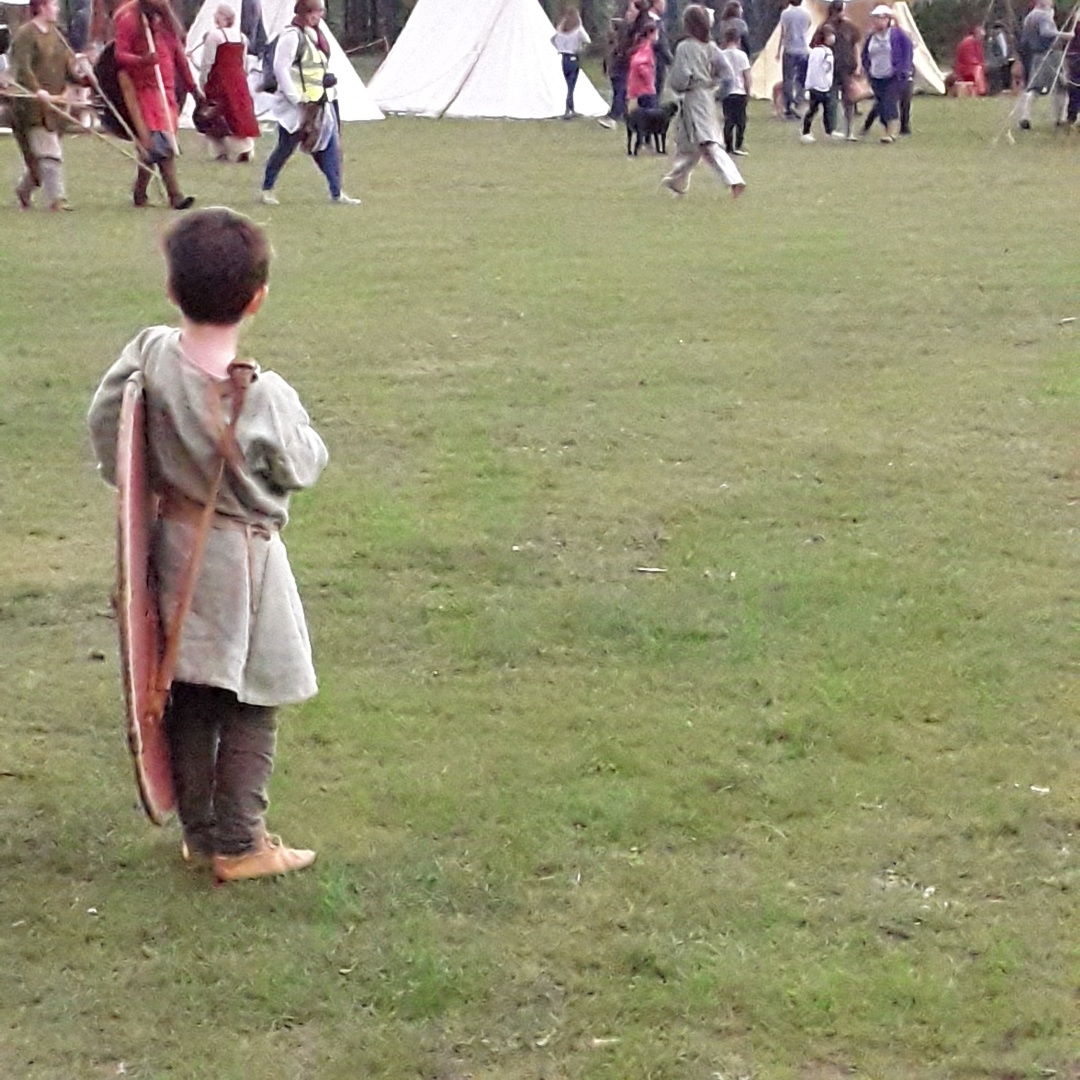
To finish off, here’s a cute mini-warrior who made me smile:

*****

Vikings at Whitby Abbey

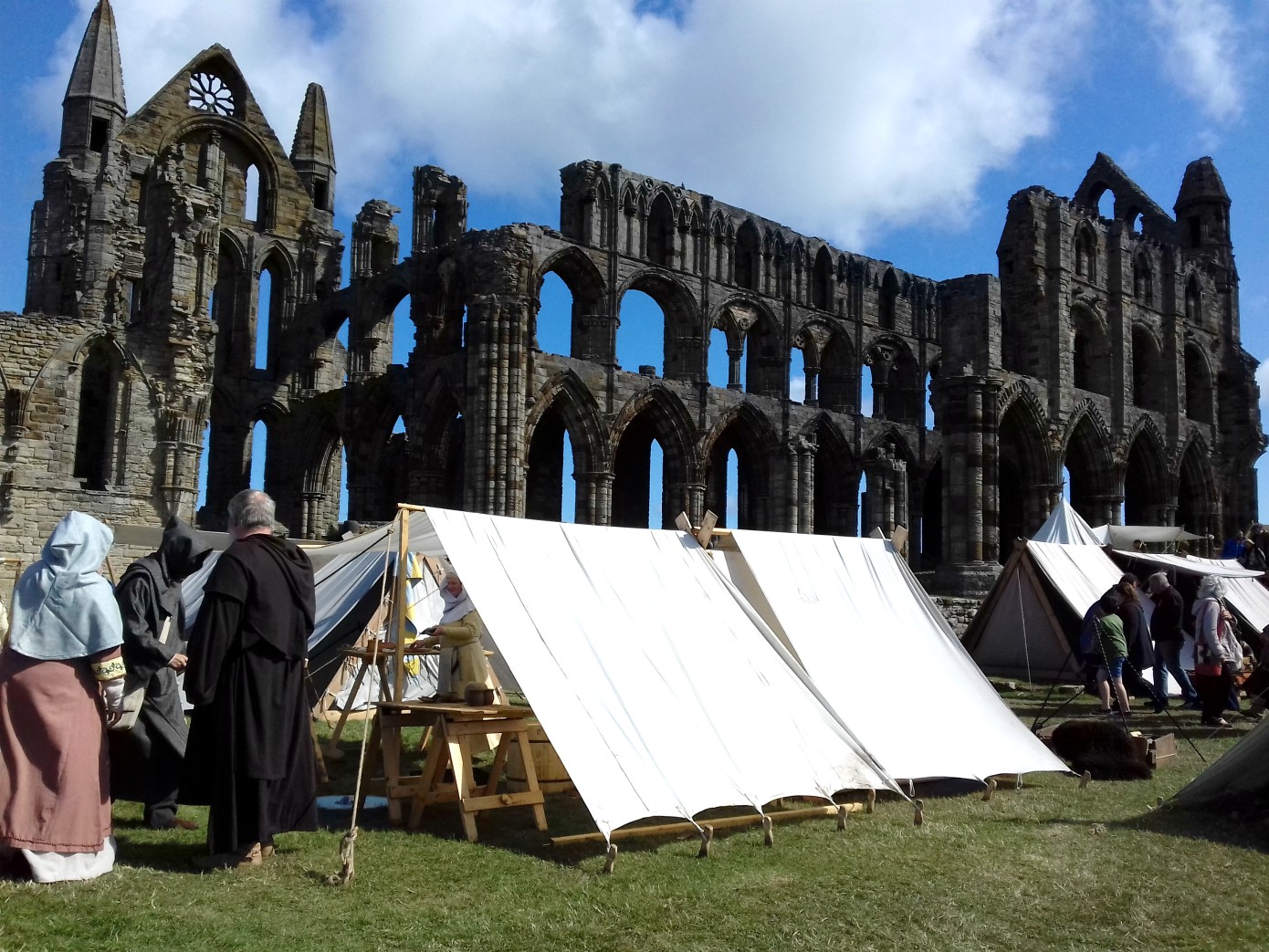
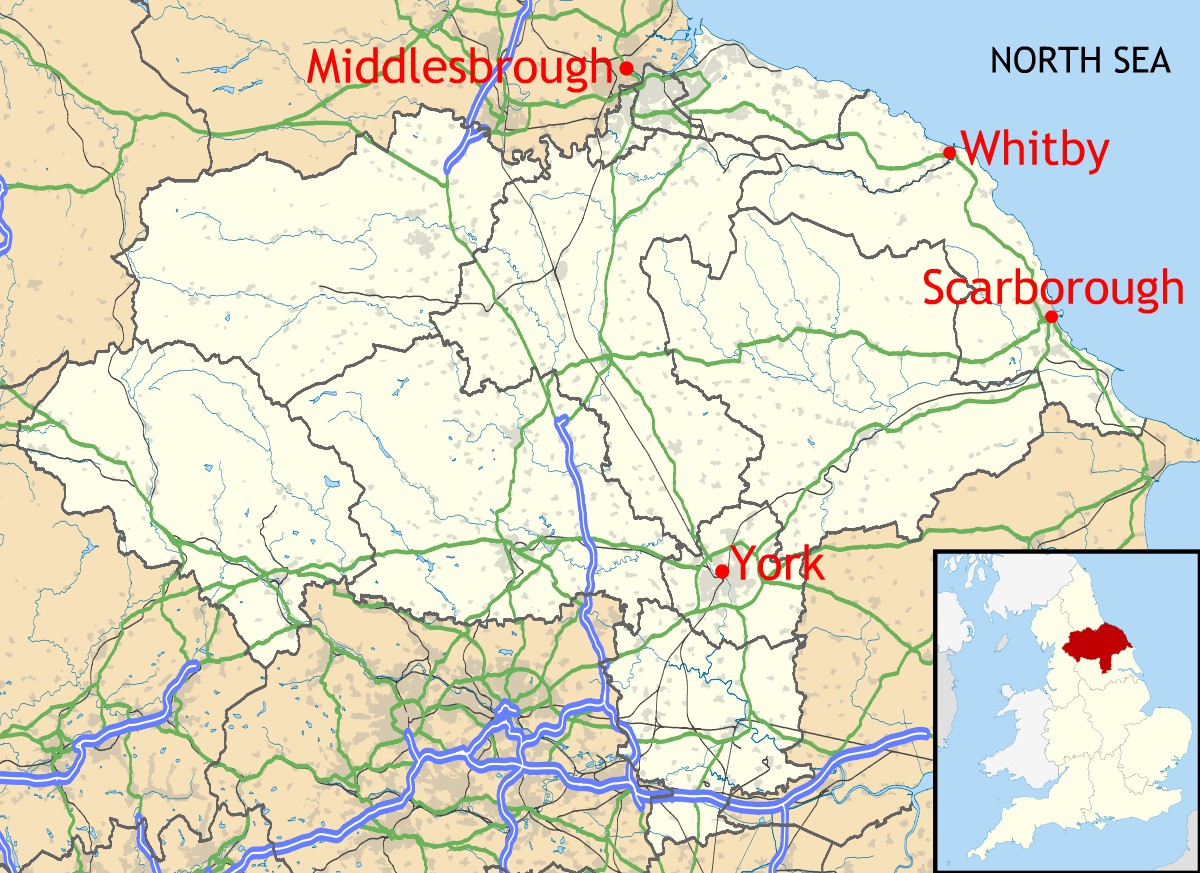
We spent the August Bank Holiday weekend up in North Yorkshire, primarily to attend yet another Viking encampment and battle. This one was at Whitby Abbey, a site we’ve visited several times in the past, but never for a reenactment. The event was staged from the Saturday to Monday (August 25th – 27th) and as the best weather report was for the Saturday, that was the day we chose to attend. And what a good thing we did! Although very windy, Saturday was a lovely, sunny day, whereas it poured down for much of Sunday, when we visited Scarborough Castle further down the coast.

Whitby shown within North Yorkshire. Source: Ordnance Survey OpenData Author: Nilfanion. Creative Commons.

The encampment itself was educational and very interesting, with demonstrations of various Viking crafts and skills, including  favoured foods and methods of cooking them, as well as displays of  a number of goods in leather, wood and metal, and features of general lifestyle. All in all, it was great family fun as well as a learning experience. The lyre player was excellent … lovely music… and two different woodturners were also great to watch. These are a few of the photos we took around the camp:

There was also a reenactment of the death of a local Saxon thegn at the hands of the invading heathens/pagans, i.e. the Vikings. His cadaver was transported from the (supposedly) nearby village by a number of monks up to the abbey for burial – and the nuns were warned of a likely attack on the abbey. Needless to say, the nuns were outraged and terrified by the thought of pillaging and raping Danes. But the corpse was blessed and arrangements made for Saxon warriors to defend the abbey:

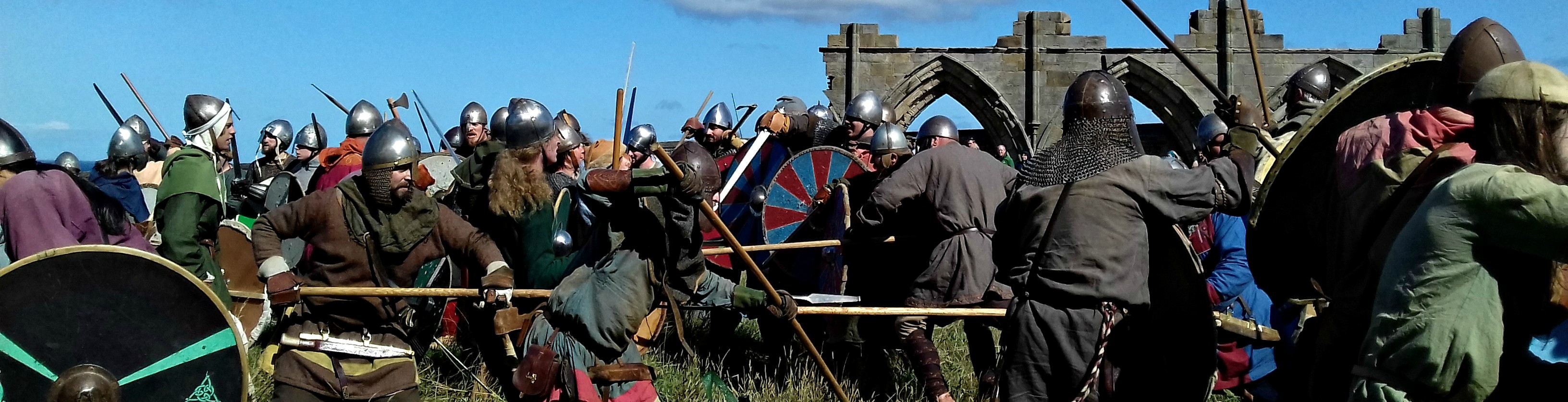
In the morning we watched the two armies warming up and practising their battle techniques, and the actual battle was in the afternoon. It was difficult to take photos during the battle, when the warriors were half killing each other close to the lines of tape encircling the battle site. Of course, the tape is vital for safety, but it meant that I have so many photos with green tape across the middle that are are unusable! (One of the hazards of being a ‘shortie’ is not being able to get my camera up higher. Still, I found that most of my photos could be cropped to make good headers, as the one above. But, then again, how many headers can I use in one post…?) 😀

Raids were common along the east coast of England during the Viking Age and monasteries, abbeys and such like would have been prime targets. So much plunder, in the form of gold or silver cups, crosses and chalices would have been irresistible to marauding bands. And the poor nuns would also have been seen as easy rape victims. Whitby Abbey itself was destroyed by Viking raiders in 867. Incidentally, the name Whitby means White settlement in Old Norse.

As with most Viking and Saxon battles, action starts with the shield wall formation of the opposing sides, during which time the warriors hammer on their shields with their swords, spears or battleaxes, generally making a great racket and yelling profanities at each other. All this is intended to intimidate and terrify their opponents. Then a number of missiles are hurled, including spears, rocks and stones – some via catapult – or arrows, if there are archers present. Once all these preliminaries are over, the two shield walls come together in an almighty clash and stab and slash out at each other in a effort to get through the wall of shields and kill or maim as many of the enemy as possible. And as men fall, so the shield wall breaks up and the one-to-one fighting takes place. On this occasion, we were treated to an excellent display of swordsmanship. We did video it, but the quality is so poor, I’d be ashamed to put it on YouTube. The fight was fast and furious but, unfortunately, that doesn’t show on a single photo. A new camera is on my Christmas list, so I hope Santa will be generous.

So here are some of the ‘usable’ photos we took:

It was a very enjoyable day, and I can only thank the various Viking and Saxon groups from around the country who came together to produce this event. The members obviously love what they do and are very proficient at doing it. Thanks must also go to English Heritage, who manages the fabulous ruin (courtesy of Henry VIII) of Whitby Abbey.

Whitby is a lovely, quaint, old seaside town and fishing port, and is packed with visitors for most of the summer, even without any events being on. The town and abbey are well worth visiting and I have many photos from the various times we’ve been there. I’ll get round to doing a post about it at some stage.

Scotland 1: Achnacarry

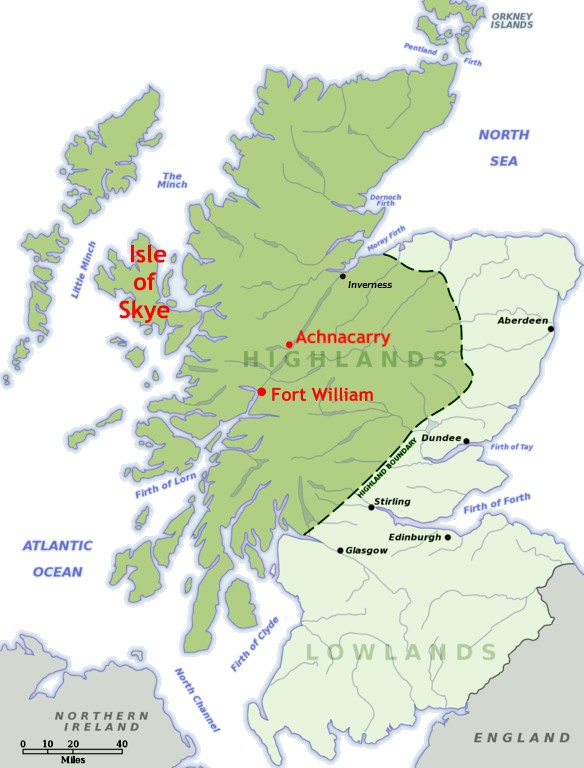
Lowland – Highland Divide. Author Jrockley Public Domain

In the last week of June this year, Nick and I headed up to the West Highlands of Scotland with our two daughters and grandson for a week at Achnacarry, a site chosen for it’s location in relation to places we wanted to visit.

Fort William within the Lochaber region of Scotland. Author Nilfanion  using Ordnance Survey data Creative Commons

The weather wasn’t particularly hot on the Saturday we drove up there – just as well, considering we had 400 miles to cover – but on our first day there everything changed and we had temperatures of over 30°C for the rest of the week. I’ve been to Scotland lots of times in summer, and never known it to be so hot – especially when weather reports told us that further south, in England, it was much cooler.

We chose to go for self-catering on this occasion and booked a sizeable apartment on the Lochiel Estate at Achnacarry (Achadh na Cairdh in Scottish Gaelic, meaning ‘field of the fish-trap/weir’). Achnacarry consists of a small hamlet, a private estate and a castle, and is located between Loch Lochy and Loch Arkaig in the Lochaber region of the Scottish Highlands (see map(s) above). The estate covers an area of 60,000 acres of beautiful and barren country with abundant wildlife including red and roe deer, foxes, badgers, Scottish wildcats pine martens and otters. Golden eagles, buzzards, peregrine falcons, merlins and sparrowhawks soar overhead and in the rivers and lochs are Atlantic salmon, trout and pike. In fact, the entire Lochaber region is stunningly beautiful, and has become known as ‘The Outdoor Capital of the U.K.

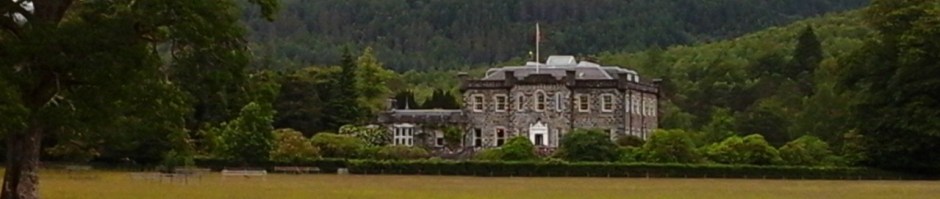
Our apartment was in the old stable block, converted into a number of differently sized apartments. We had one of the two larger ones upstairs (on the right-hand side looking at the front of the building on the first photo below).

There are also a number of holiday cottages for rental on the estate.

Achnacarry has been the ancestral home of the chiefs of the Clan Cameron since 1655. The original castle, built by Sir Ewen Cameron of Lochiel around that date, was destroyed by government forces following the Battle of Culloden, since the Camerons played a major role in the Jacobite rising of 1745. This fact is well illustrated in the little Cameron Museum on the Estate, a short walk from our apartment, which is well worth a visit. The present Chief of Clan Cameron (traditionally known as ‘Lochiel’) is Donald Cameron, who continues to live in Achnacarry.

The castle we see today was built in 1802. It is on private land and not open to the public other than organised groups, so we could only photograph it from a distance. The first of these two photos (the close-up) is from Wikepedia:

During the Second World War, the castle was used as a Commando Training Depot, not only for British Commandos but for U.S. Army Rangers and similar units from other allied nations – a total of 25, 000 men between 1942 and 1945. The extensive estate was used for some very arduous training. The Cameron family retains close ties with the Commandos and an impressive Commando Memorial can be seen at Spean Bridge, roughly 7 miles from Achnacarry. We passed it on several occasions during the week but didn’t manage to stop and take a close-up photo. This one is from Wikipedia:

The Commando Memorial, Spean Bridge near Achnacarry. Uploaded by Jmb at English Wikipedia Creative Commons

We had a brief walk around a small part of the estate on our first evening there – partly to stretch our legs but also to get a feel for the place. It was getting close to dusk by the time we got out and the light wasn’t too great for photos. But we did snap a few interesting features, in between fighting off swarms of midges! The river is the River Arkaig, which connects Loch Lochy with Loch Arkaig. The story behind the row of crooked birch trees is that  Donald Cameron (‘the Gentle Lochiel’) was planting a long row of birch trees in 1745 when news of Bonnie Prince Charlie’s landing arrived. The trees were left to their own devices and grew in odd directions:

It wasn’t until the day before we left that we took time to have a better look at this stunning estate. We had a long drive home the next day, so we decided to spend the day (another sweltering one!) enjoying the scenery and visiting the Clan Cameron Museum. The museum is only small, but interesting nonetheless, with history of the Cameron Clan, Bonnie Prince Charlie and the Jacobite uprising, the Commandos and links of the Camerons family to the royal family. The young Lady Catherine, daughter of Donald and Cecil Cameron, founders of the museum, was one of the bridesmaids at the wedding of Prince Charles and Lady Diana Spencer in 1981. Catherine is the god-daughter of the Prince of Wales and was six at the wedding.

To finish off, here are a few general views from around the Achnacarry Estate. The second set are of the stunning Chia-aig Waterfall, which features in the 1995 film, ‘Rob Roy’, starring Liam Neeson. We spent ages at this waterfall, as did a few other people that day. It’s certainly a lovely spot in which to linger.

Scarecrows at Rufford Old Hall in Lancashire

This week, Nick and I are enjoying a few days in my home town of Southport, a seaside resort on the Lancashire coast. We’ve visited a few relatives and spent time in nice places while we’ve been over here, so I thought I’d share a few photos we took at Rufford Old Hall.

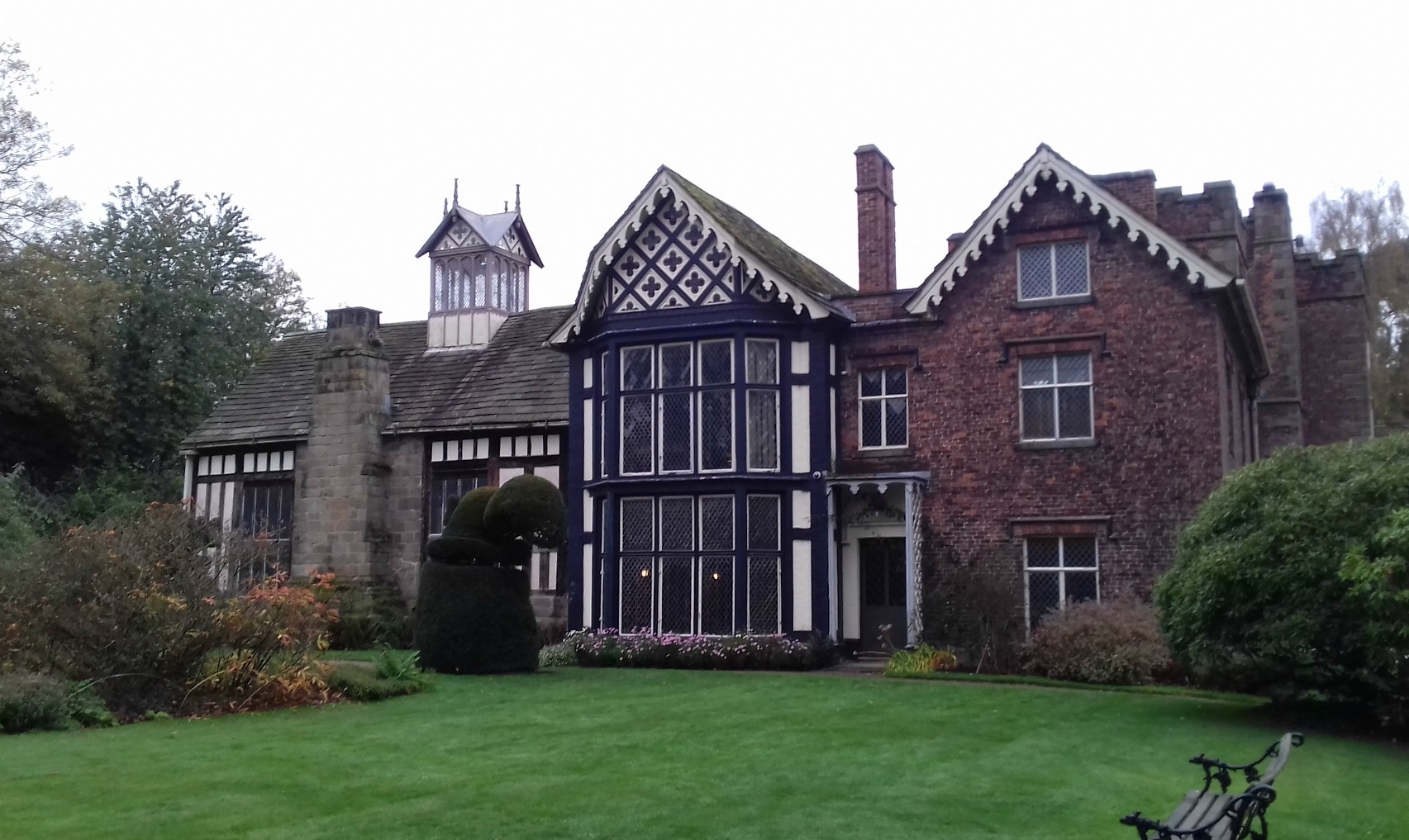
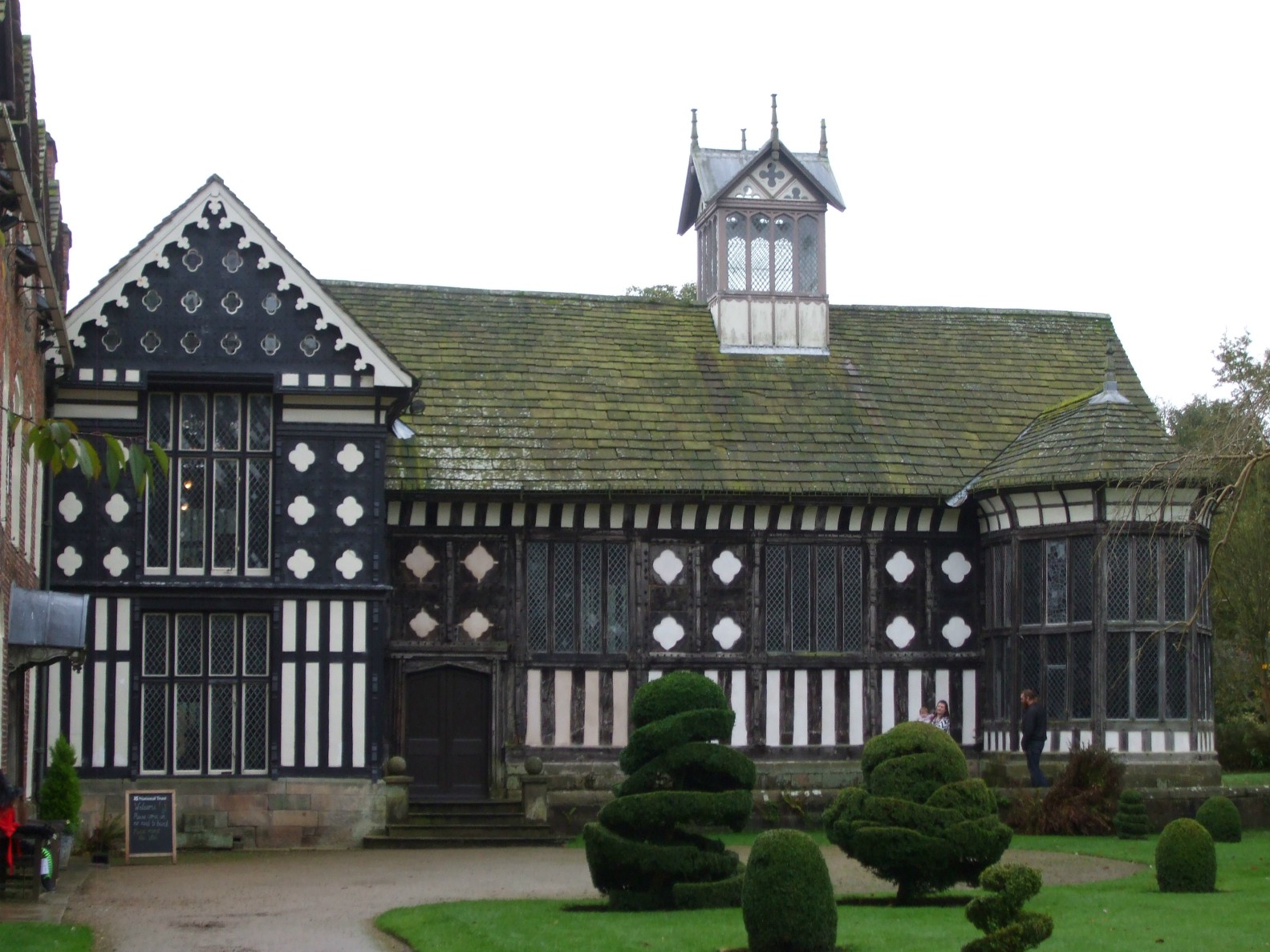
Rufford Old Hall is a National Trust property near the town of Rufford in Lancashire. It is a beautiful Tudor building, built by Robert Hesketh in the 1530s and was owned by the Hesketh family for 400 years until it was donated to the National Trust in 1936. Only the timber-framed Great Hall survives from the original structure. The Jacobean-style rustic brick east wing was added in 1662. A third wing was added in the 1820s.

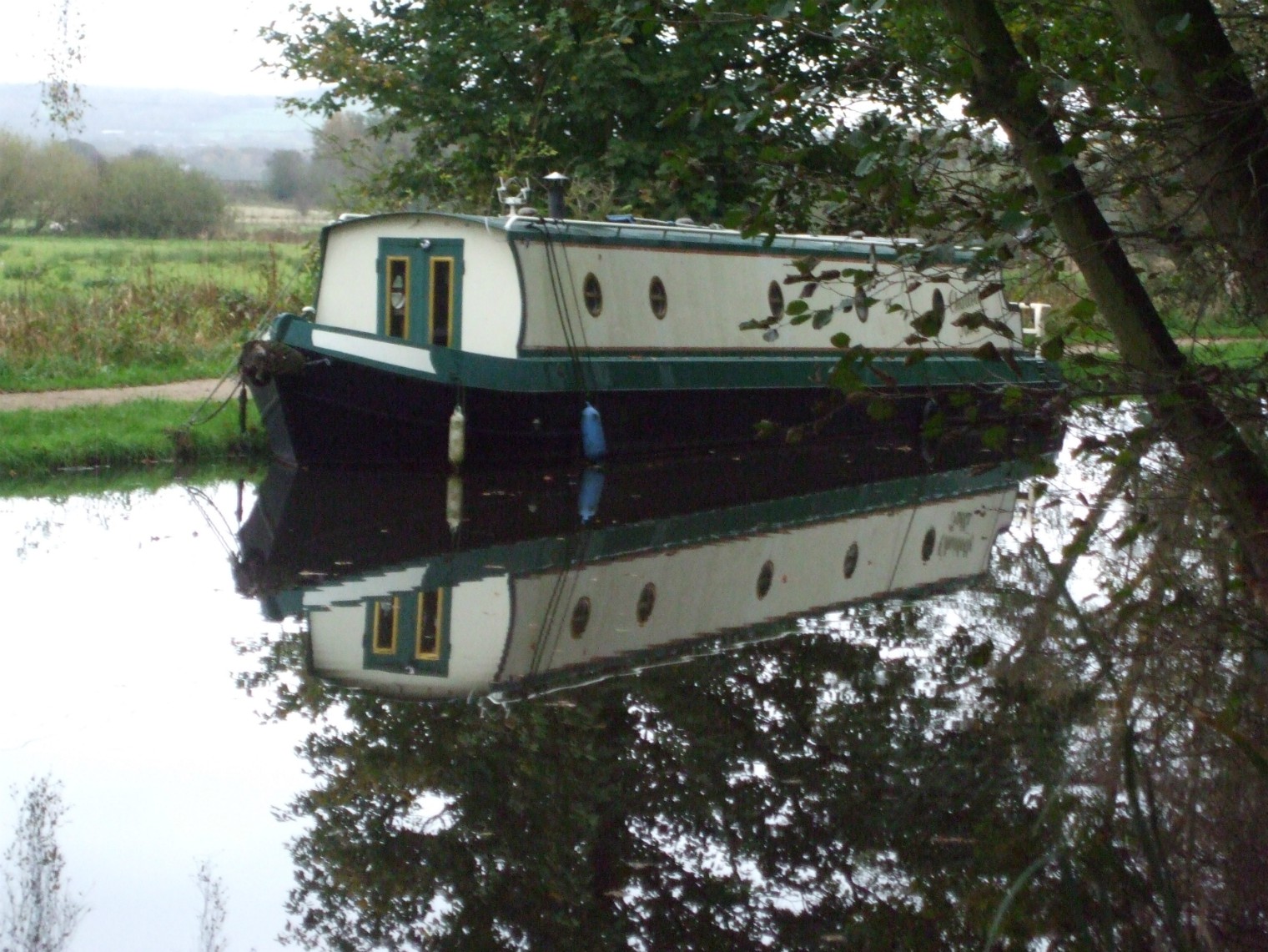
The Hall is surrounded by Victorian and Edwardian gardens and woods and flanked by a branch of the Leeds and Liverpool Canal.

We took photos of the Hall and gardens but also of fifteen scarecrows, many of which could probably be described as  unusual or even a little bit weird, placed across the grounds. One was hidden indoors, which we only found when we decided to head into the tea shop for a cup of tea.

I believe the ‘Scarecrow Event’ is held annually and the scarecrows are made by members of the local community and Rufford Old Hall staff and volunteers. Participants, mostly children – and being half-term, there were a lot of them there – are given a map with the locations marked on to help them find the scarecrows. They are also given a little bit of information about the origin of ‘scarecrows’, which I’ll summarise here:

In medieval Britain, scarecrows were originally young boys who were given the job of scaring away the birds from the corn fields (wheat, barley, oats or rye). Originally called bird ‘scarers’ or ‘shooers’, they would patrol the fields with bags of stones and chase away any bird that tried to land by waving their arms or throwing stones. The birds were mostly crows and starlings. The Great Plague of 1348 wiped out so much of the population there were just not enough boys for this job left. People started to stuff sacks with straw and carve faces in turnips to make ‘scarecrows’ they could stand against poles. Of course, wherever available, boys would continue to do this job as well, and did so until the early 1800s when factories and mines offered children better pay. Either way, life was not easy for many youngsters – but that’s another story.

I’ll say no more about the scarecrows. Here are all fifteen of them:

I’ll finish with a few more photos of Rufford Old Hall and the lovely gardens in their autumnal dress:


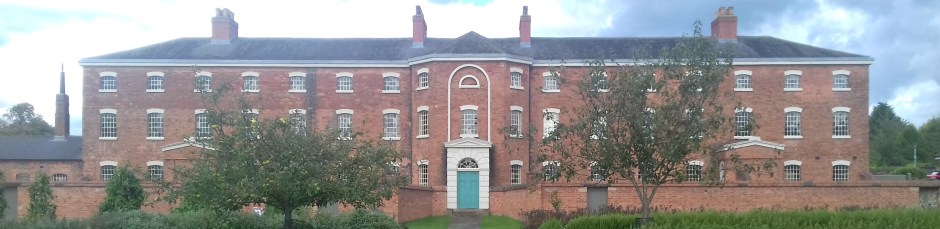
The Workhouse at Southwell

Anyone who has read Dickens will have heard of ‘the workhouse’ and the fear it struck into the hearts of some of the poorest people in society. Although the initial intentions of setting workhouses up may have been admirable, stories about just how harsh, strict, austere and, in some cases, cruel, these places were still linger today.

So what, exactly, were these ‘workhouses’, when were they set up and why?

In the early 1800s, the rising cost of caring for the poor and elderly in their own homes was unpopular with ratepayers. It was Reverend Becher in the town of Southwell in Nottinghamshire, who devised a new system to cut these costs.

A network of hundreds of specially designed workhouses, 15-20 miles apart, was set up across the country as part of the most ambitious welfare construction ever attempted in Britain: the New Poor Law of 1834. Workhouses were places where the poorest people in society had to work in return for food, shelter and medical care. Life inside was intended to be basic and dull, so that only those people in real need (paupers) could find shelter there, while those who weren’t destitute wouldn’t ask for help, knowing they’d be sent to the workhouse.

The people who set up the Poor Law didn’t intend to be cruel, only fair and efficient, yet workhouses were an odd combination of care and deterrence. ‘Inmates’ were fed, housed and clothed, but the stigma on those who went there, together with the hard, tedious work and sometimes, corrupt staff, ensured workhouses were places of last resort. They not only catered for the most poor, but also for the elderly without work, deserted wives, unmarried mothers, children without parents and those with physical and/or mental disabilities. They also took in vagrants/tramps and offered them a meal and a bed for the night. Altogether, the Workhouse at Southwell could accommodate 158 paupers.

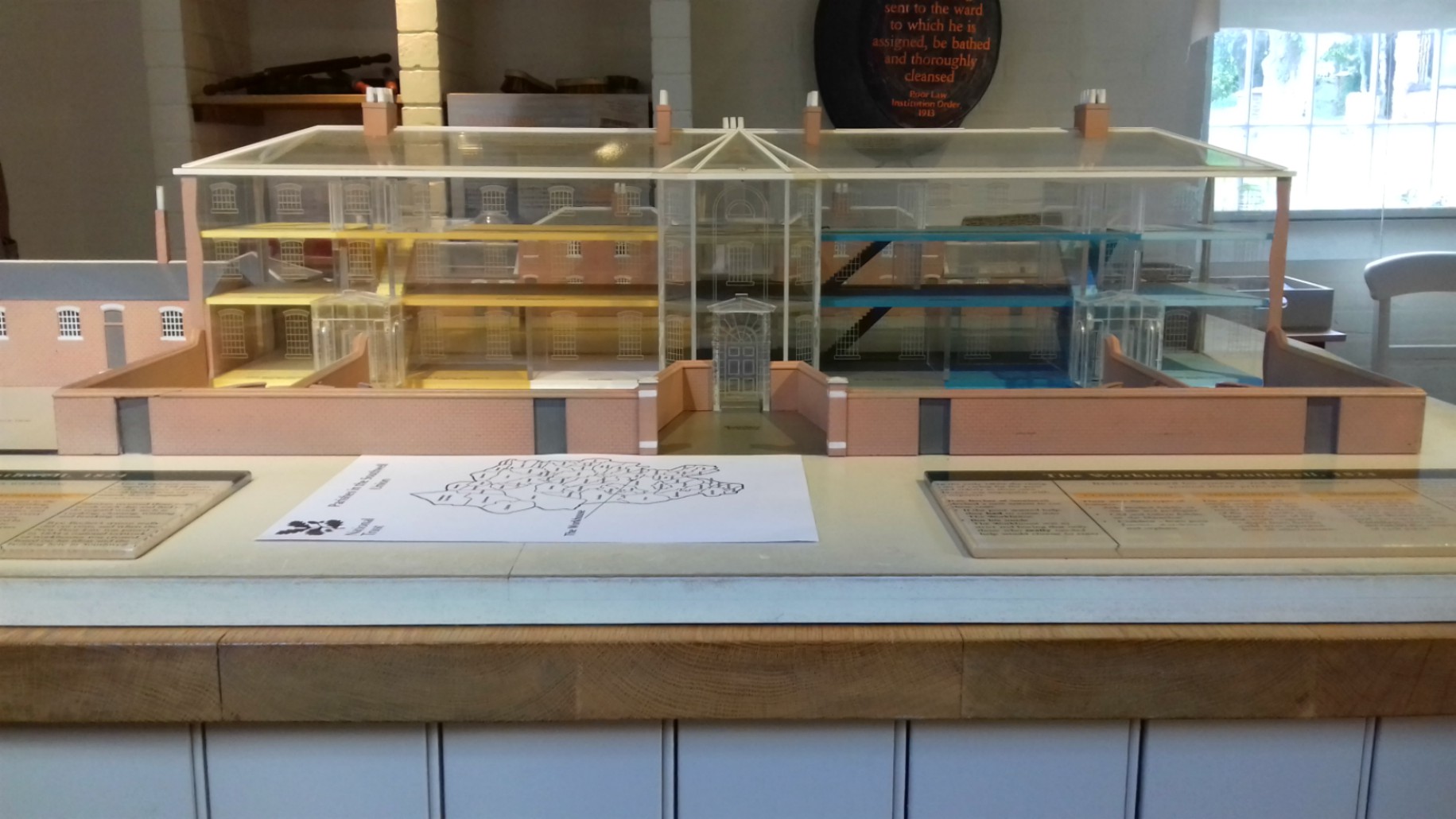
In the model of the Southwell workhouse below, we can see how the ‘wings’ to either side of the central section separated the men women and children – something so hard for most families to bear. The central area largely provided accommodation for the Master and Matron, with the children’s dormitory and schoolroom on the very top floor. Later on, a new schoolroom was built attached to the workhouse and can be seen to the far left of this model. Men were housed in the wing to the right of the front door (blue in the model) and women in the (yellow) wing to the left:

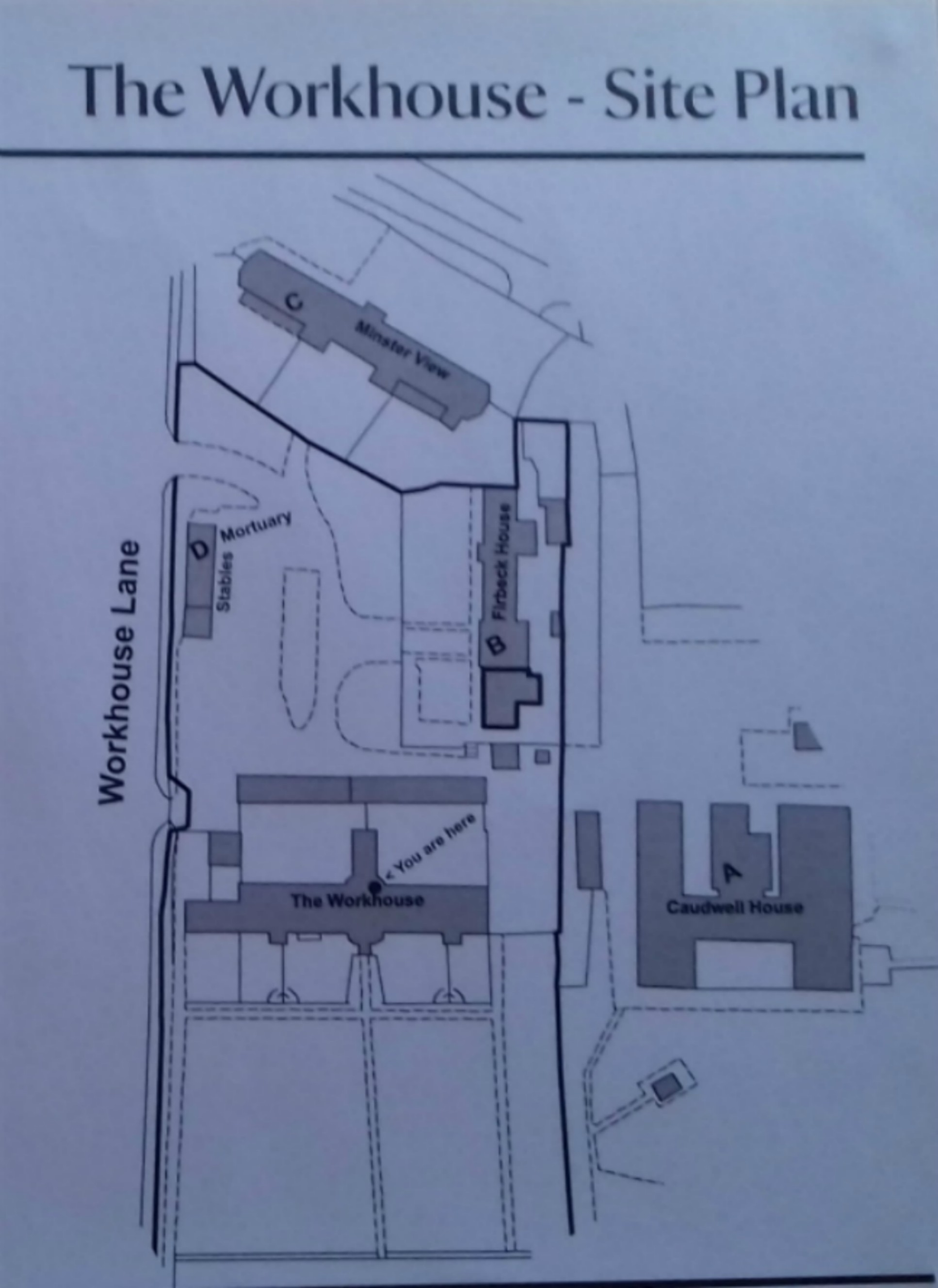
The plan below shows the layout of the site and the notes explain a little about different areas:

The workhouse staff was headed by the Master, who reported to elected Governors who were answerable to the taxpayers. The Master, who was often seen as cruel and corrupt, had responsibility for the day to day running of the house. The most important woman in the workhouse was the Matron, who would simply have been the Master’s wife in the earlier years of the system, with no formal qualifications. As nursing standards rose, things changed, and later matrons were expected to have the necessary nursing qualifications.

The Schoolteacher’s job was not an enviable one and the turnover of teaching staff was high. Schoolteacher’s were badly paid and of low status, despite high standards being expected from them by the school inspectors. It was usually a live-in job which involved supervising the children throughout the day as well as instructing them in the classroom. The Guardians abolished the Workhouse school at Southwell in 1885, and children were sent to local schools instead.

On entering the Workhouse, all new inmates were bathed and given the workhouse clothes/uniform to wear:

    Inmates were also categorised, with future treatment and daily workload in mind:
  • Able bodied (separate groups for men and women)
  • The old and infirm (also separate groups)
  • Children

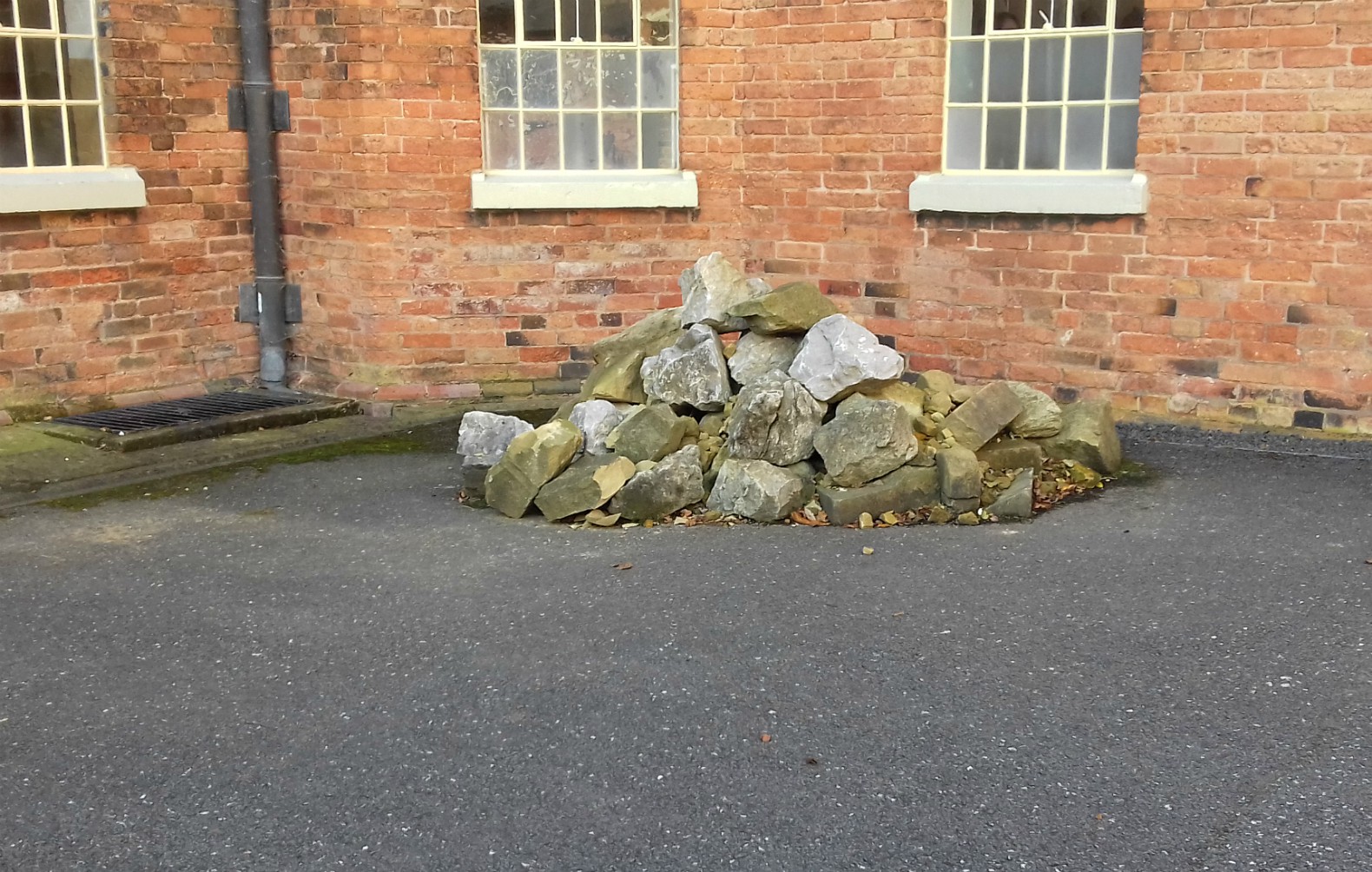
1. Able bodied men and women were called ‘idle and profligate’ or, ‘the undeserving poor’. These people were considered to be physically capable of work but were not employed due to their own idleness, incompetence or lack of training – although it was often due to the general levels of unemployment and scarcity of work and not their own fault at all! Consequently, jobs in the workhouse for these people were hard and were what gave the workhouse its name. One of the jobs for able-bodied men was splitting rocks (or old bones for fertilizer) out in the men’s  yard at the back of the workhouse. They could also be given decorating duties, turning a mill handle and digging in the gardens.

Able bodied women generally came to the workhouse due to loss of a husband, or because the husband was out of work or she and a low-paid husband could not afford to keep a large number of children. These women did all the everyday housework, including cleaning the building and scrubbing stone floors, meal preparation and back-breaking clothes washing – which was done in buckets or bowls at the pump in the yard at first, then inside the ‘wash house’ once it was built:

Women also did needlework (e.g. lace-edged doilies for selling) and knitting.

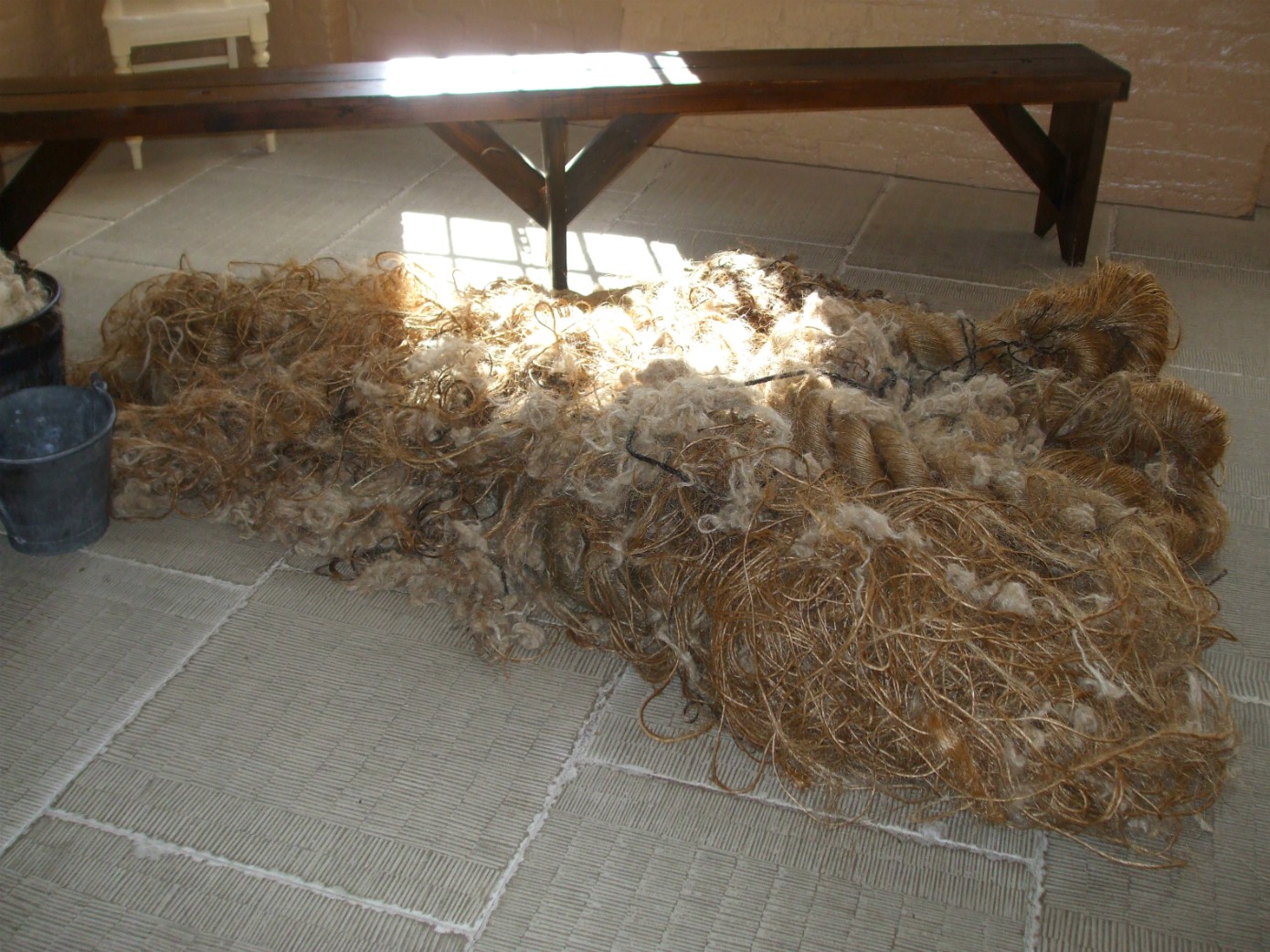
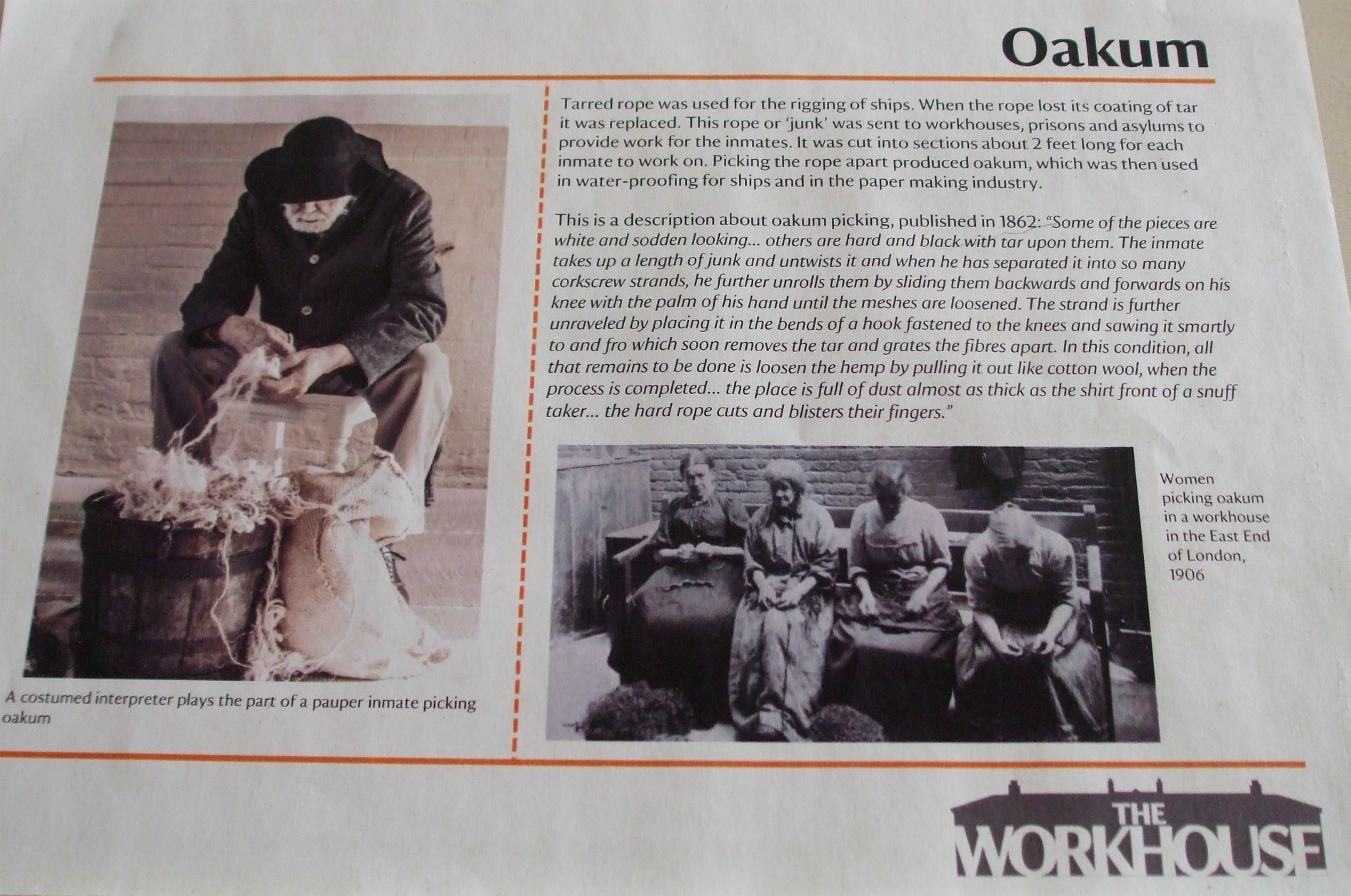
2.  The old and Infirm were also called the ‘blameless’ or ‘deserving’ poor. They were people who could no longer work due to age-related disabilities. Younger people with disabilities were also in this category. Any elderly who were able to work could be given the task of picking oakum (old tarred rope) which was then sent to be made into caulking for ships. Oakum picking was a job that any groups could also be assigned to and was very hard on the fingers.

3. While the adults were working the children would be ‘educated’, which involved 3 hours a day in the schoolroom followed by what was called ‘industrial’ work: boys often worked in the gardens while girls did needlework and cooking. Children were allowed time to play in the little playground of the schoolhouse, and a large number of hoops were recorded as being ordered. Other toys came from local benefactors.

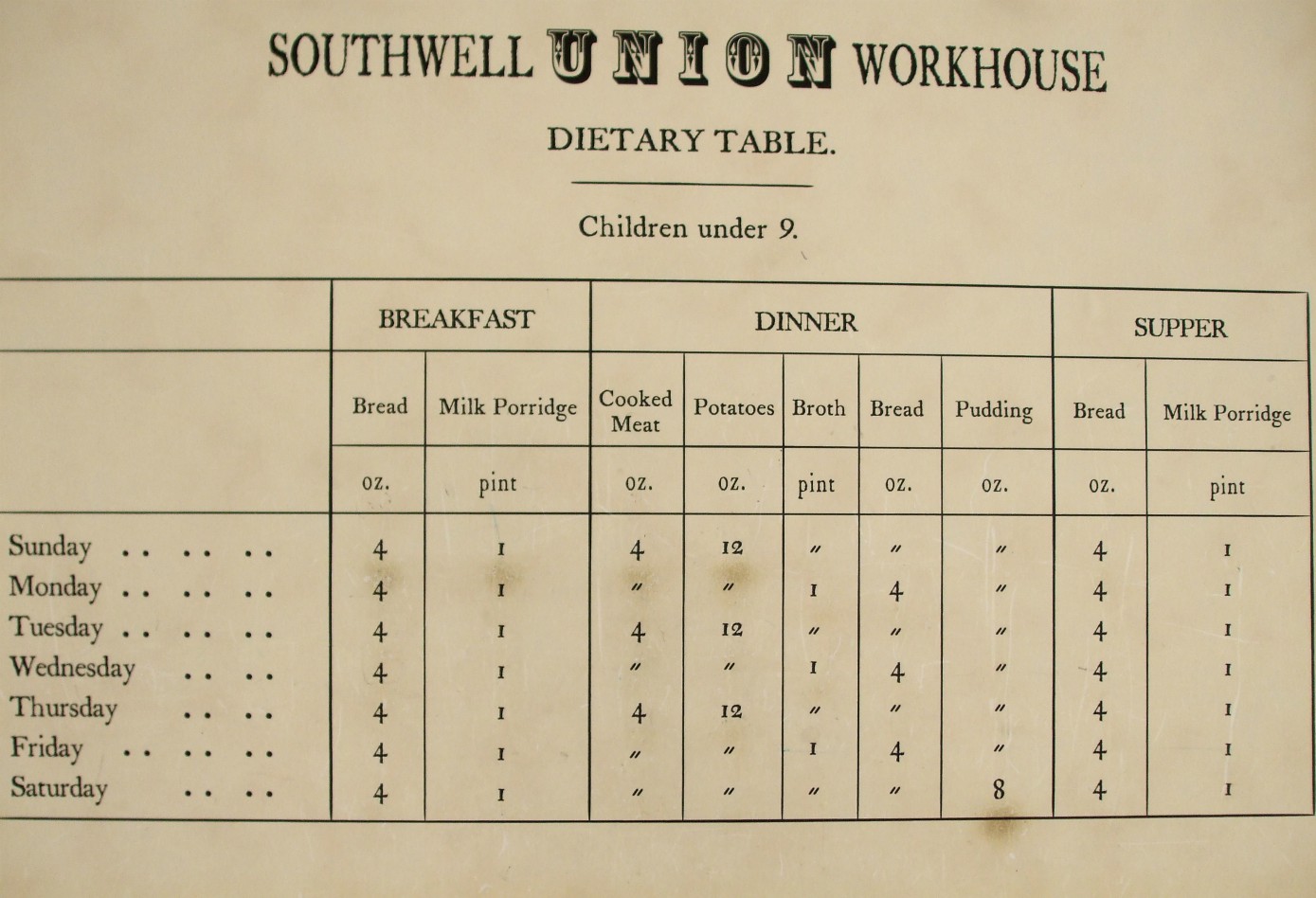
The main meal of the day at Southwell was dinner at midday, for which inmates were given one hour. This meal consisted of boiled meat, peas and potatoes on most days with soup on others. On Saturday a simple suet pudding was served. Although bland, the food was better than what these people would have had before they came to the Workhouse. Weekly and daily allowances/rations of different foods were strictly observed as lists around the kitchen areas show:

Food allowances chart 2

The Workhouse rules were strictly adhered to and anyone who broke them was punished. Punishments were different for different offences, but often involved limiting food rations, offenders typically being given potatoes, bread or rice instead of the usual meat. Repeat offenders were given solitary confinement for 24 hours and severe cases of injury to others for example, were sent to the magistrate.

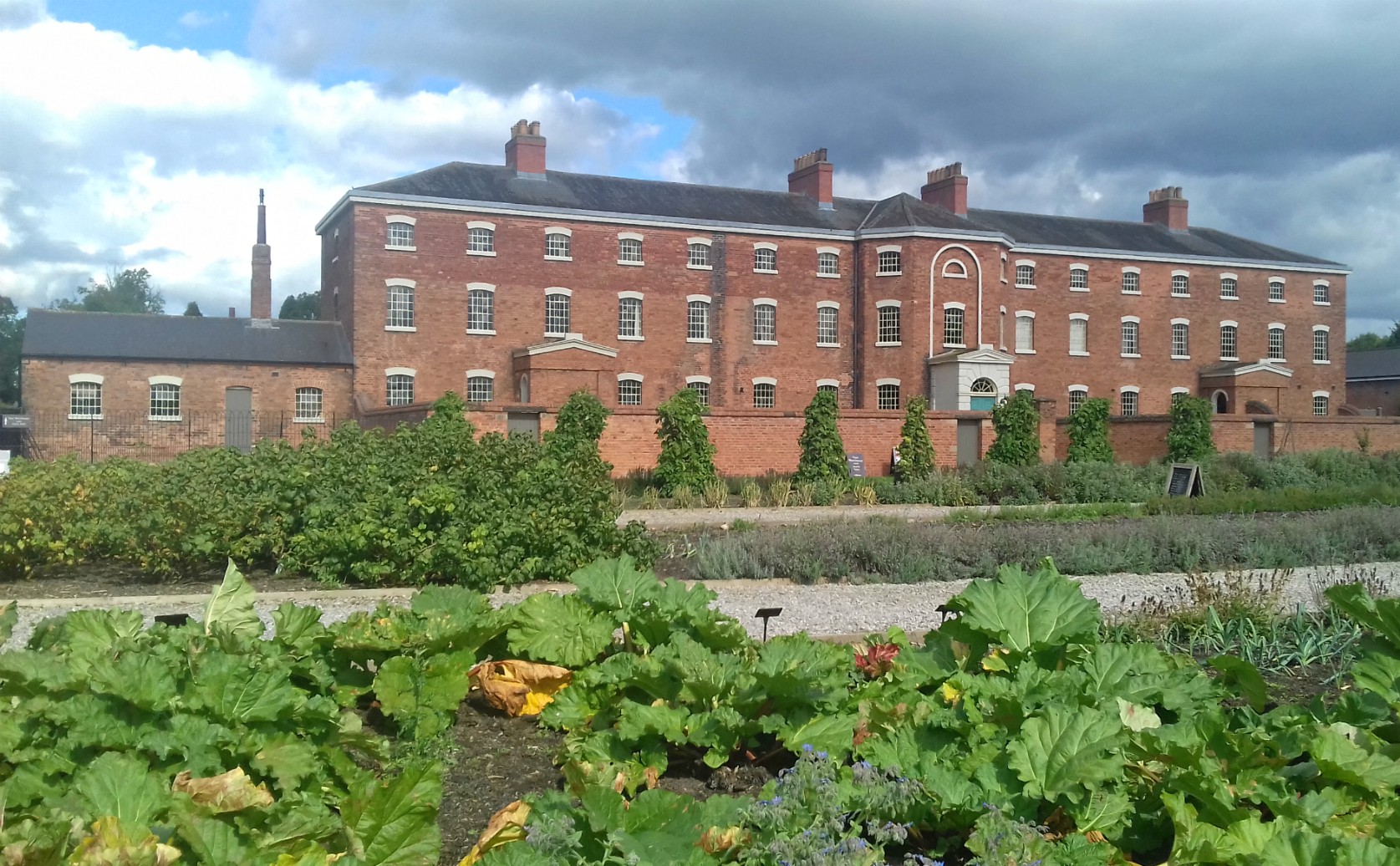
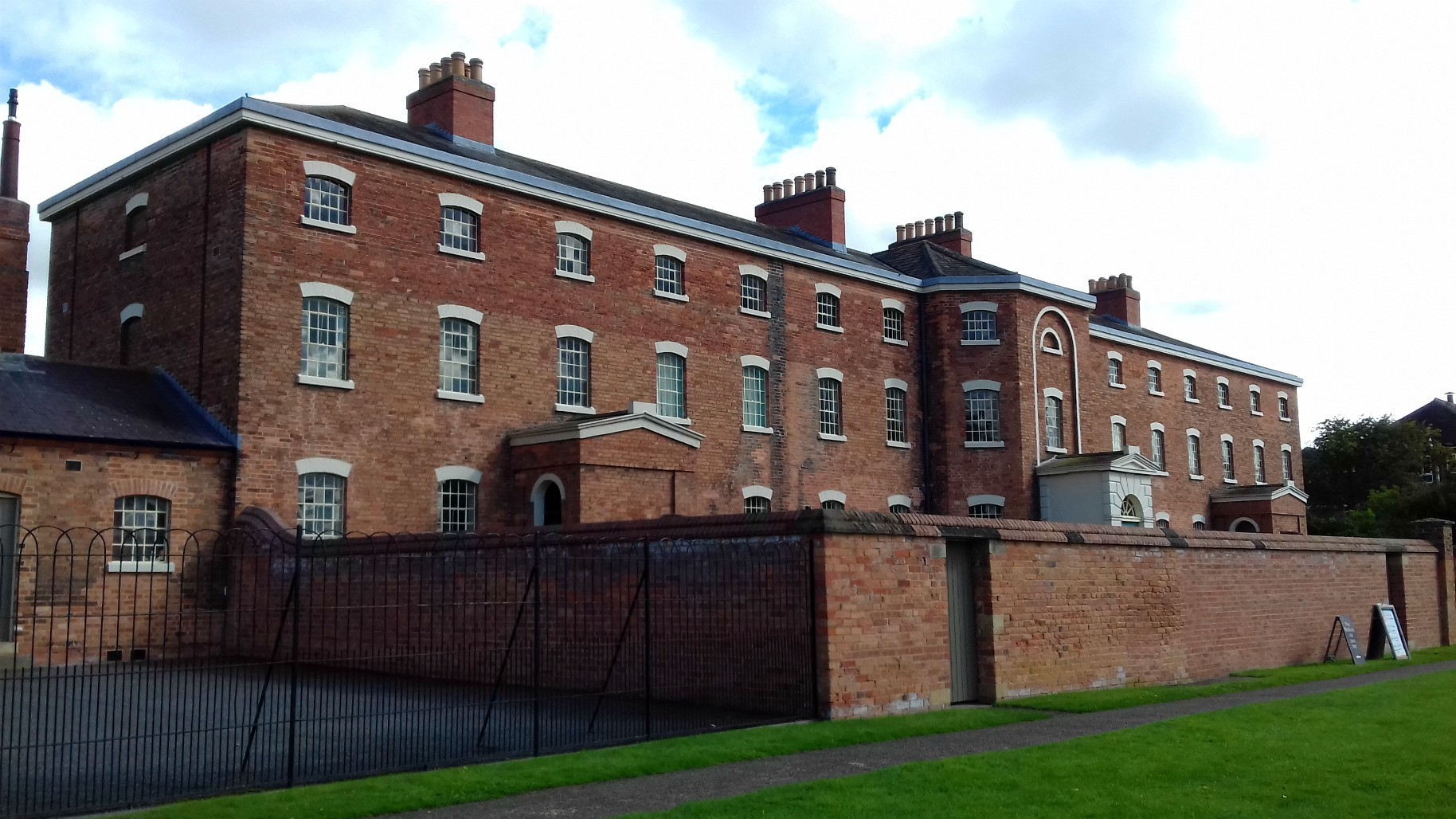
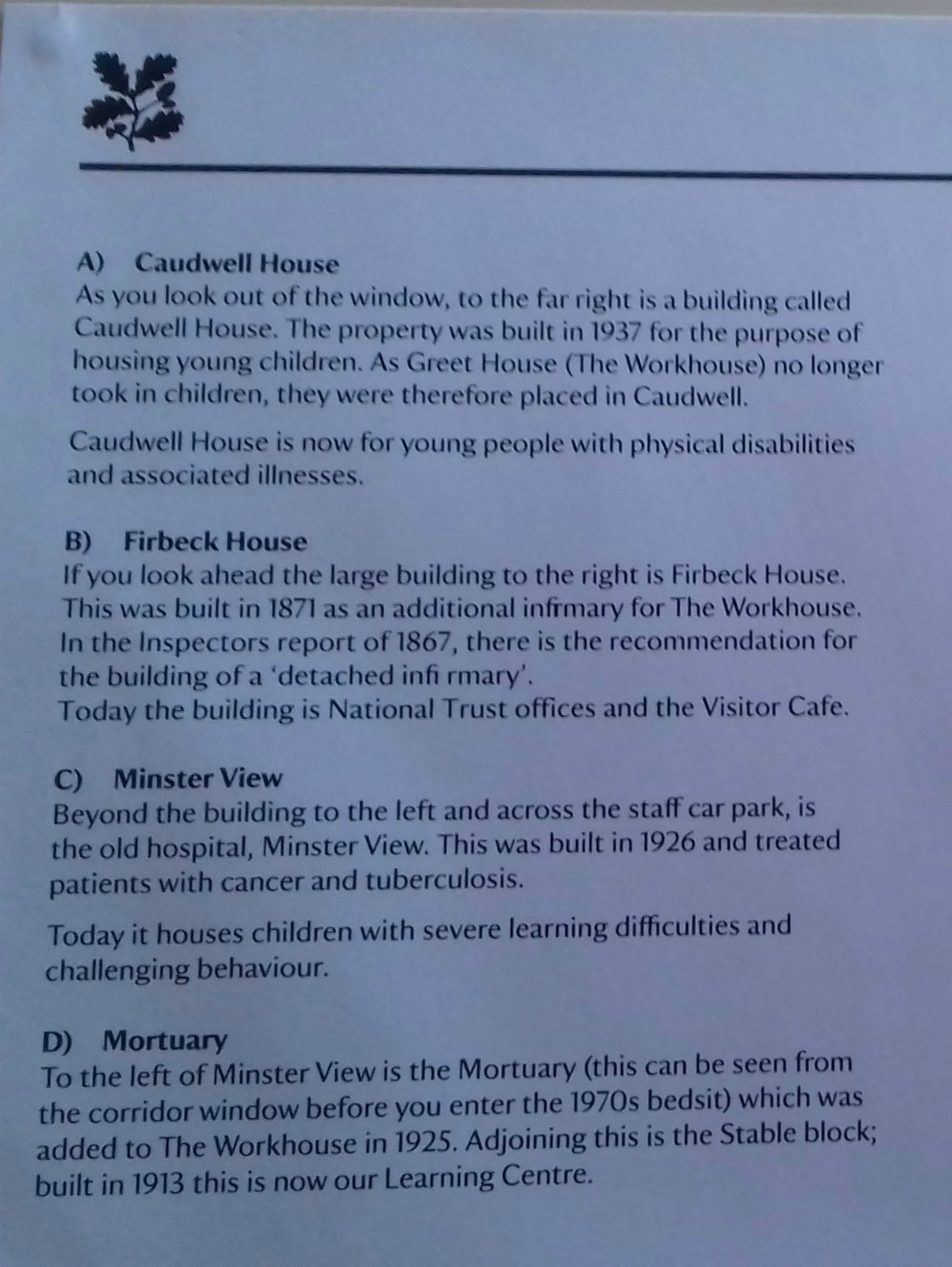
These are some of the many photos we took of different areas outside the Southwell Workhouse (including a couple taken through upstairs windows):

And these are just a few of the dozens we took inside the workhouse:

By the late 19th century the focus in workhouses had changed from that of deterring the able-bodied to providing shelter and nursing for those who could never be in work. Consequently, the numbers of  inmates and staff changed. In the earlier days at Southwell, the ratio between the two was an average of 4 members of staff to 135 inmates. By 1900 it had become fewer than 80 inmates to the 135 staff, plus a porter, a nurse and assistant nurse. Seamstresses, laundry maids cooks and gardeners soon followed – all doing jobs formerly done by inmates. New, more comfortable  furniture was brought in, chamber pots replaced earthen closets, and eventually flushing water closets. A new infirmary building was added in 1871 and  by 1905 children were being housed in separate homes or were boarded out. In 1913 workhouses became ‘institutions’, though most adopted less stigmatised names: the workhouse at Southwell, for example, became Greet House, named after the river that runs below it.

The 20th century saw huge changes in the ways the poor, the elderly and people unable to work were treated. The Welfare State, which came into being in 1948, brought financial benefits and healthcare to many people. Many former workhouses were taken over by the new National Health Service as state hospitals, and at Greet House elderly patients were moved out of the old, Victorian building into the two infirmaries – one for men, one for women – while the old building housed staff and provided kitchens for cooking residents’ food. Until 1977, the former ‘women’s wing’ of the workhouse was used as temporary ‘bed-sit’ accommodation for homeless mothers and children awaiting more permanent housing. The last residents moved out in the 1990s when a new home was especially built. This is how the ‘bedsit’ looks today:

The Work house at Southwell was left derelict for some time and fell into disrepair until 1997 when the National Trust recognised it as being ‘the best preserved workhouse standing in England and well worth saving’.

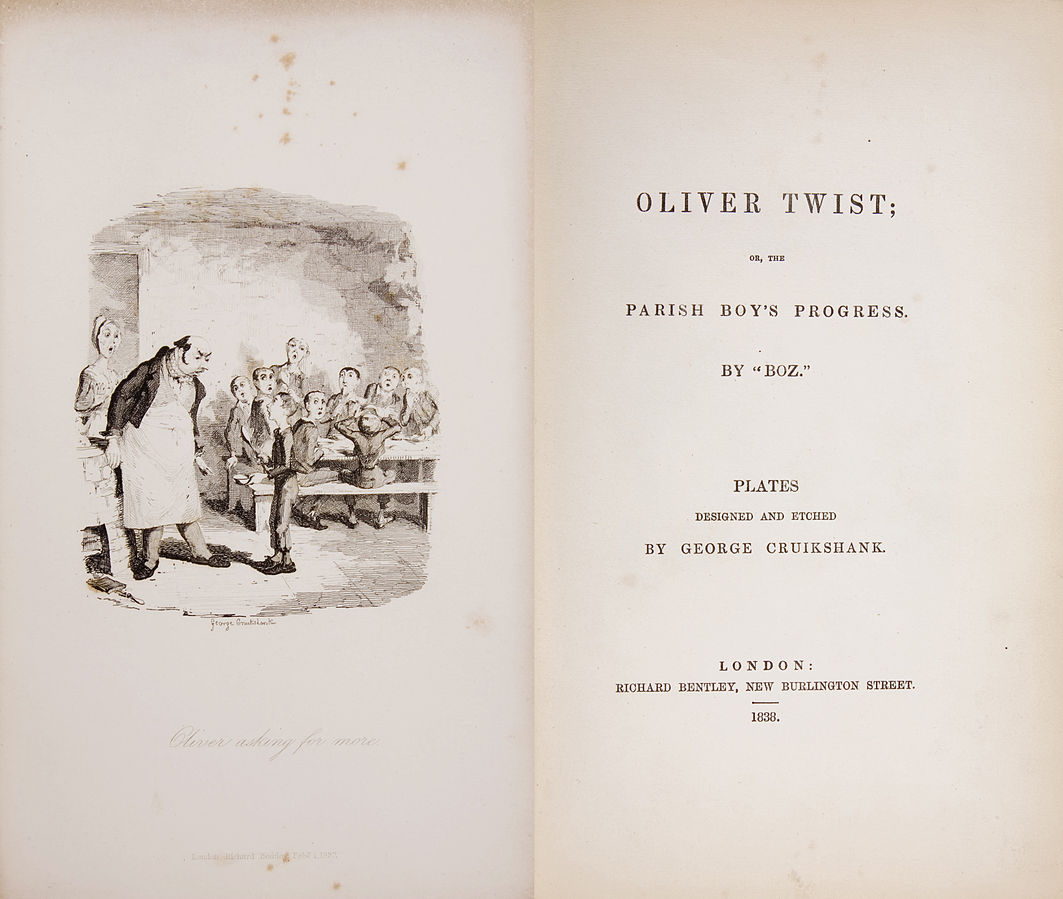
“Oliver Twist” by Charles Dickens, 1838. Public Domain. Illustration shows Oliver saying “Please, sir, I want some more”.

Refs: Most information taken from the book purchased, free leaflets and the information boards at the Workhouse in Southwell.