This is my third and last post about Warwick Castle in Warwickshire UK, which we visited in August 2015. This time I’d like to show some photos of the event we actually went to Warwick to see: the joust.
The joust is one of the seasonal attractions at Warwick Castle, the others being demonstrations of the trebuchet (pronounced treb-you-shay) in action, birds of prey shows and many others. Events do change from year to year, and not all are held in the summer holidays. During other school holidays, like half-term and Easter, several events are put on, especially ones for children (or ‘little warriors’). This year (2017) in both May and September, there will be ‘The Wars of the Roses Live’, which I’d like to try to get to! There’s also a Kingmakers Medieval Banquet in February. Here’s a link to the officials Castle Events Guide for this year.
All spectators were seated on the grass at the opposite side of the river, which is a fair way back from the action, and as none of us apart from Louise had a decent zoom on our cameras, I’m afraid the photos aren’t too wonderful. Nor did it help that people kept bobbing up in front of us, but as most of them were children, they’re forgiven. It was a fun event, made even better by the lovely sunny weather (which has to have an obligatory mention for any outdoor event in Britain!) – not to mention the handsome and chivalrous knights, who kindly made themselves available for interacting with spectators afterwards.
Here are a few more photos:
One to one!
Knight chatting to spectators
And a little head bobbed up.
Around the castle site a number of medieval siege weapons can be seen, the main ones being the trebuchet and the mangonel. The Warwick trebuchet is the biggest in the world Both of these siege engines were used for hurling a variety of projectiles/objects over castle walls as part of the attack – including rocks, burning missiles (fireballs), disease-infected carcasses of slaughtered animals, and even the heads of slain enemies. Here are a couple of photos of each:
These weapons deserve more time than I can give them here to describe and talk about. But on some days, the main event at Warwick is a demonstration of how the trebuchet works, so to finish with, here’s a 2 minute video from YouTube of one demonstration. It was uploaded by Bob Astill in 2011:
In Part 1 of this post, I wrote about the construction and design of the various buildings that have become the Warwick Castle we see today. In this post I’d like to show some of the fun activities laid on at the time of our visit in August 2015 and a few of the displays and waxworks inside parts of the castle.
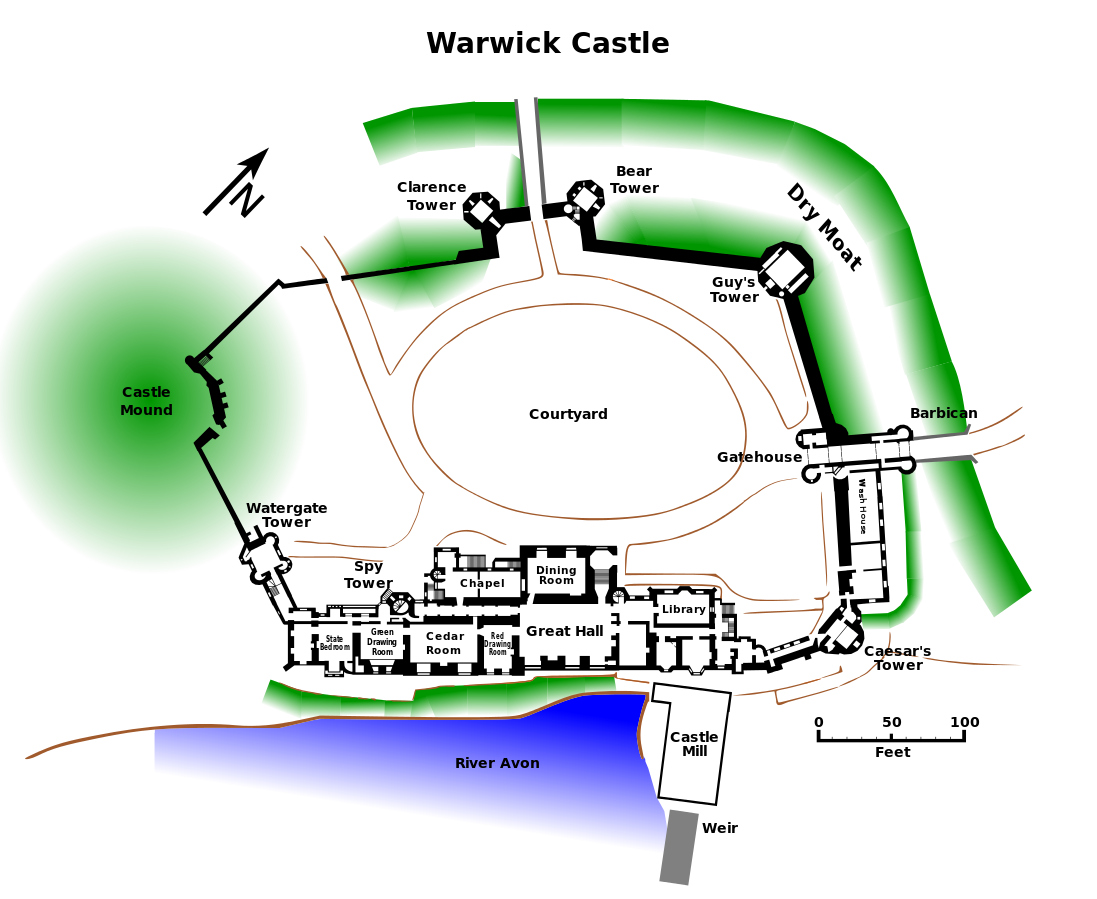
First, here’s the plan of the castle again for easy reference if need be:
The first thing we noticed on the gloriously sunny day we drove out to Warwick was the number of stalls and activities set up both in the outer ward (outside the curtain wall) and around the courtyard:
Warwick Castle was bought by The Madame Tussauds Group in 1978 and opened as a major tourist attraction. Throughout the summer holidays, fun events and activities are staged at the Castle, all aimed at attracting and entertaining families and hopefully, helping children to develop an interest in history. Entry isn’t free, nor is the castle owned/managed by either the National Trust or English Heritage, and families with several children would find it an expensive day out. In addition, there’s an extra fee for anyone wanting to enter the dungeon in Caesar’s Tower. A little about the dungeon later…
Most of the permanent displays are set out in the Great Hall, State Rooms and family apartments inside the collection of buildings along the eastern side of the castle, flanked by the River Avon. The waxwork figures are impressive, to say the least. These two photos show the inner/courtyard side of the buildings along the east side of the castle and a close-up of the entrance, which takes us into the State Rooms and many displays:
The first place we come to is the Great Hall. This was originally built in the 13th century, then rebuilt in the 17th century for visiting guests of the Earl of Warwick. It was further restored in 1871 following a great fire which left it in ruin. The displays in here are all connected with weapons and armour:
Next we headed to the rooms in the undercroft devoted to ‘The Kingmaker’, Richard Neville (1428-71). Neville was the 16th Earl of Warwick, who took command of the castle in 1449. He was a good administrator who did much to modernise and improve the castle, and in the second half of the 15th century he became the most powerful man in Britain. The exhibits describe his life and subsequent death at the Battle of Barnet. They also show his life at the castle, as well as the lives of others who lived there. Here’s a selection of the many photos we took – some of which were ruined by glary lights.
Waherwoman
Richard Neville inspiring his men.
Archers at ease in the castle
Castle smith
Arm wrestling to pass the time
Women in the castle
Armoured horse
I won’t include photos of the various State Rooms here (i.e. rooms such as the formal dining room) just a few photos taken in the adjacent family rooms, which displayed events and characters from A Royal Weekend Party. This was a party given/organised by Frances (fondly known as ‘Daisy’) Countess of Warwick in 1898. The principal guest was the then Prince of Wales, later Edward V111. It is believed that the Prince of Wales’ infatuation with Daisy was the inspiration for the song that starts:
Daisy, Daisy. give me your answer do…
The song was written by English songwriter Harry Dacre (pen-name of Frank Dean) in 1892;
Gentlemen in the ‘Smoking Room’.
Maid running a bath for one of the guests
Gentlemen in the Library
Frances ‘Daisy’ Countess of Warwick in the ladies’boudoir
Maid assisting Daisy to dress
Guest taking to Daisy in the ladies boudoir
Butler in attendance at the house party.
And this is a cute little YouTube video of the famous song, from kidsmusicshop1:
To finish this post, here’s a little bit about the gaol and dungeon inside Caesar’s Tower:
Caesar’s Tower, at the north-east corner of the curtain wall.
Caesar’s Tower, showing people waiting to enter the dungeon.
Approaching the upper levels of Caesar’s Tower from the battlements.
Entrance to the dungeon – a fun experience!
A scary reminder of what could happen to you once thrown in the dungeon!
Information about the dungeon
The rooms inside Caesar’s Tower are interesting to visit, although it was only permitted as part of a guided tour – and cost an extra £9.00 to get in. We were led round various rooms to watch a series of short dramatizations – some of which were a bit gory (all pretend!). One was in a torture chamber and another was a medical ‘operation’! Yet another was a medieval court scene whereby a judge pronounced ridiculously unjust punishments on prisoners who had supposedly committed some small crime – like stealing a cabbage. Needless to say, members of the audience were picked to play these unfortunate prisoners (my husband being one of them!). It was just a shame that photography wasn’t allowed.
Eventually we headed underground to the dungeon. This was similar to most dungeons I’ve seen elsewhere, with very little light and graffiti on the walls from prisoners of centuries ago. And awful torture chambers.
This image is from Wikipedia:
A gibbet on display in the basement of Caesar’s Tower at Warwick Castle. Author: Chensiyuan. Creative Commons
Apologies for the glary patch on this information board!
But the most interesting thing in this dungeon was this:
This grille on the dungeon floor is the opening into what is called an oubliette – a very chilling thing indeed. Any unfortunate prisoner put into to this tiny space – not even big enough for him to stand up in – was effectively forgotten and left there to die.
In the third post about Warwick Castle, I’ll eventually get round to writing about the event we actually went to Warwick to see: the joust.
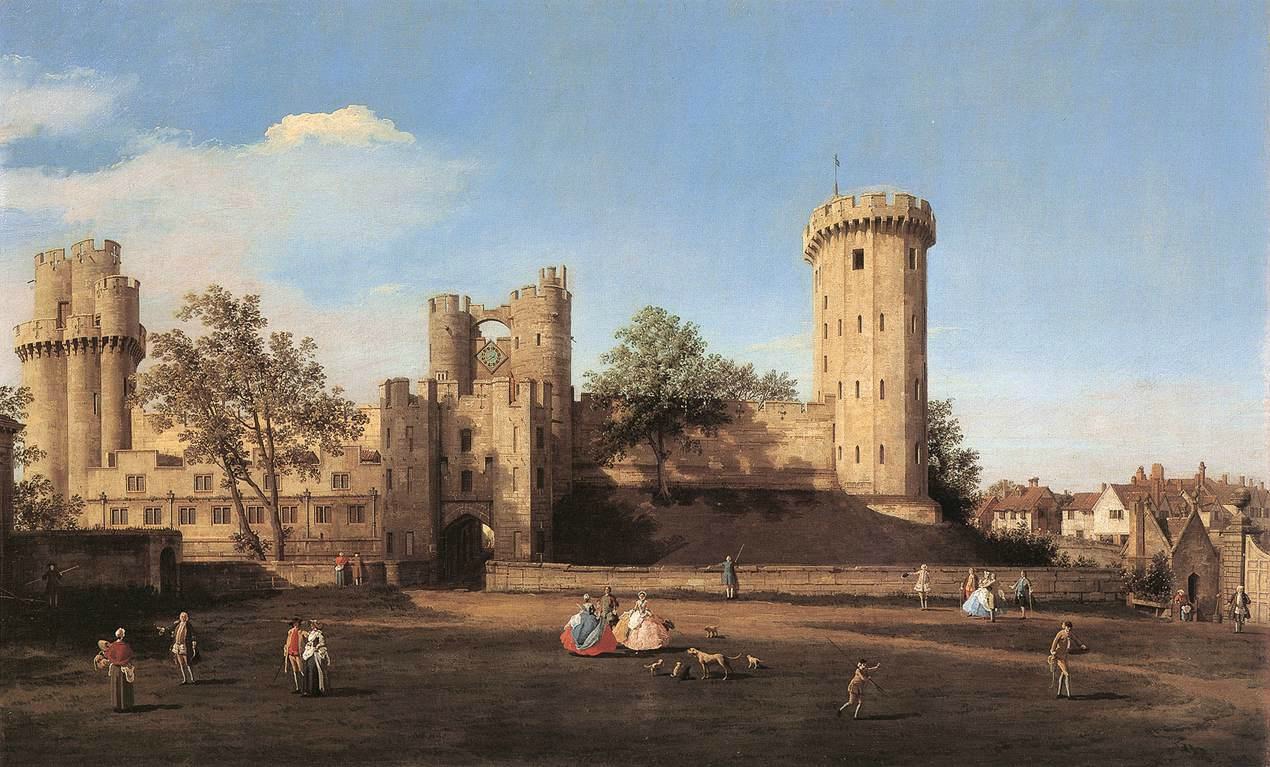
East Front from the Outer Court, 1752. Painted by Canaletto (1697-1768). Birmingham Museum and Art Gallery. Originally uploaded by Gillian Tipson at English Wikipedia. Public Domain.
I last visited Warwick Castle on a family day out in August, 2015, and have been meaning to write a post about it since then. Well, here’s the first part (it would be far too long as a single post and is likely to end up being three!). Louise – aka @afairymind – shared some of her photos from the day on her blog, ages ago. I’m just late with mine, as usual.
Warwick (pronounced Warrick) is one of the most famous and well-visited castles in England. It is also one of the most complete medieval fortresses in Britain. I’ve visited the castle several times, some of those with classes of Year 7 students aiming to decide how they’d attack and defend this great structure – and the weapons they’d choose to do it. But, I digress… so back to describing the place.
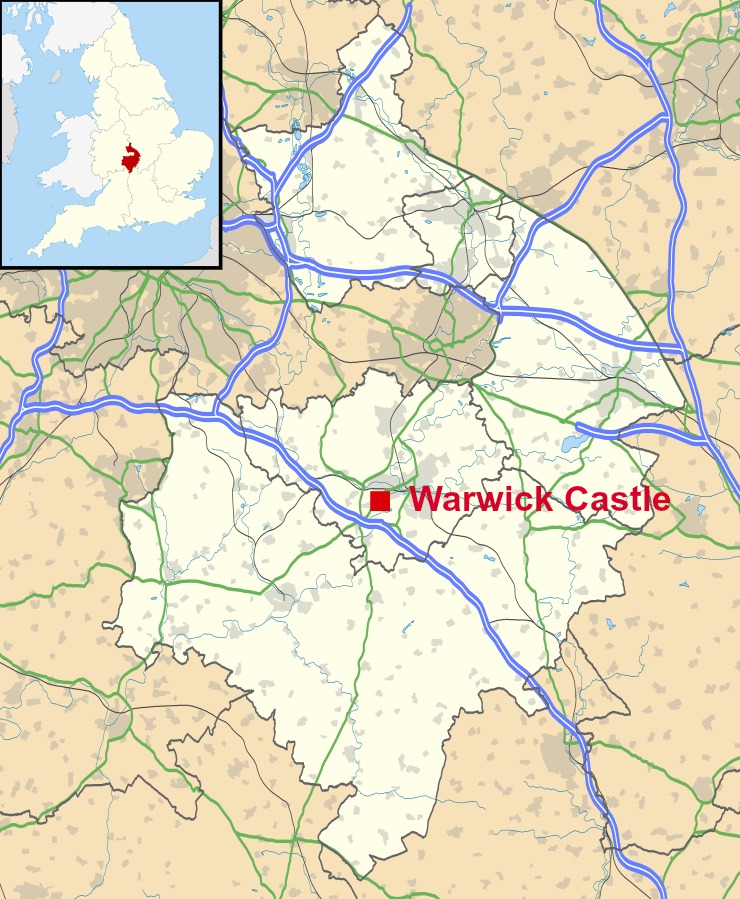
Warwick Castle is situated on a sandstone cliff along a bend in the River Avon in the town of Warwick, in Warwickshire:
The history of the castle site goes back to the time of King Alfred’s daughter, Aethellflaed /Ethelfleda who established a fortified burh* here – one of ten aimed at defending Mercia from invading Danes. But the actual castle came into existence following the Norman Conquest of 1066. In 1068, William the Conqueror ordered a motte-and-bailey castle* to be built on the site in order to maintain control of the Midlands as he advanced northwards. It can be seen on the plan below, labelled as the Castle Mound, and I’ll add a photo of it later, with other views from the Courtyard.
Here are a few photos of the castle from the outside, which you’ll probably be able to place on the map. (Photos of the mound are from the courtyard, and are show later).
The River Avon provides a natural moat to the south-east of the castle.
Gatehouse and Barbican, built in the 14th century, as part of the new defensive ramparts and towers.
Approaching the Gatehouse and Barbican.
Guy’s Tower
Bridge over the dry moat leading to entrance at the north west.
Entrance at the north west: a portcullis flanked by Bear and Clarence Towers
Eastern side outer wall, behind which are the state rooms,, viewed from across the R.Avon
Closer view of the portcullis between Clarence and Bear towers.
Dry moat
Caesar’s Tower outside view
A word about the Gatehouse and Barbican…
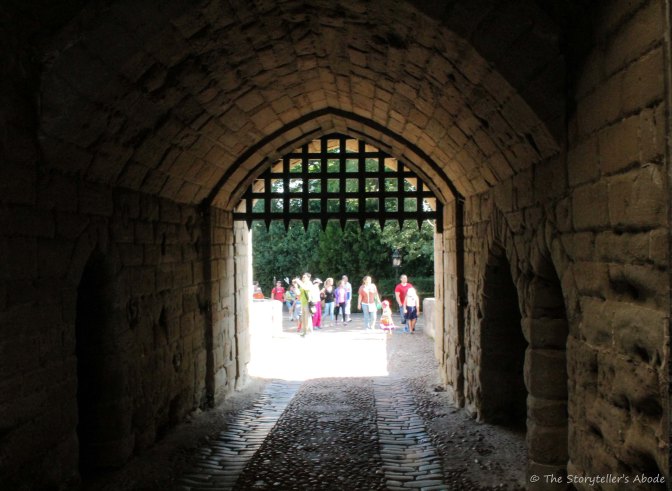
The entrance to a castle was usually the main target for attacking forces, so it stands to reason that this should be as heavily fortified as possible. At Warwick, the barbican* (definition below and shown on the above plan) was the ‘Killing Zone’. If attackers managed to get through the outer gateway – a drawbridge in earlier days, plus the portcullis, they would have to face an iron portcullis and a heavy door at the inner end as well. Once trapped in there, usually by the crush of their own men piling in from behind, defending soldiers would fire arrows and pour boiling liquids down on them through the ‘murder holes’ above. This is a photo taken inside the barbican, looking out through the outer portcullis. It’s from Louise’s collection (thestorytellersabode) from our day out. My photos were far too glary, so Lou kindly offered me hers.
Following Norman times, the castle has a long history of ownership, rebuilding and extension. Although it’s interesting, I don’t intend to go into it all here! In this post (Part 1) I want to show some photos of the castle itself. The main displays to be seen in the State Rooms, and the events on that day, will be in Parts 2 and 3.
Here are a few views of inside the castle taken from the Courtyard:
The motte and bailey castle built by William the Conqueror. The original keep was repalced in the 17th century, and is the one that can be seen today.
Outside of the State Rooms along the R. Avon
Coats of arms decorating the curtain wall close to the main entrance
Crowds around the entrance to the castle dungeons. Caesar’s Tower behind.
Guy’s Tower, added to the curtain walls in the 14th century (as was Caesar’s Tower – the earliest tower to be added.
Entrance to the dungeon – a fun experience!
Prisoners Walk – along which prisoners would walk o their way to the gaol and dungeon.
And here are some of Guy’s Tower – a twelve sided, 39m high, five-storey structure built into the curtain walls in 1395 (Caesar’s Tower, the first to be added to the walls, was built in 1350).The tower contains a sitting room and two side rooms – a garderobe (toilet) and probably a bedroom. During the Civil War, Warwick Castle was held by parliamentarians and the towers were used to house royalist prisoners. The exhibits in Guy’s Tower are mostly armaments connected to this period:
Approaching Guy’s Tower along the walkway
Small cannon
Information poster in Guy’s Tower
Guy’s Tower outer view
To finish off, here are few views taken up in the towers or along the battlements. Some are of the town of Warwick beyond, others are views of the inner courtyard and buildings around it.
****
Burh An Old English fortified settlement
A motte-and-bailey castle consists of a mound – on which usually stands a keep or tower – and a bailey, which is an enclosed courtyard.
“A barbican is a fortified outpost or gateway, such as an outer defence to a city or castle, or any tower situated over a gate or bridge which was used for defensive purposes.” Definition from Wikipedia.









 Millie Thom

