I’ve decided to participate in Mondays Finish the Story. This is a challenge which involves a photograph and an opening sentence to be finished within 100 – 150 words.
So here is my first offering!
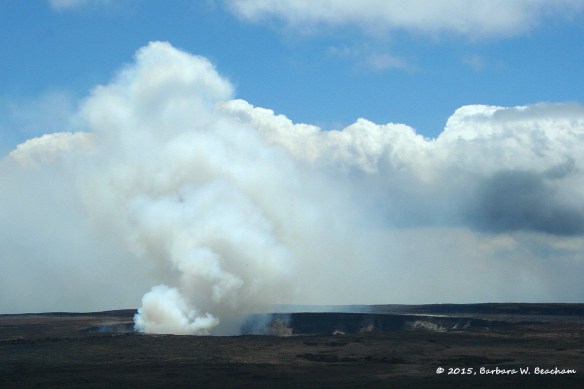
Finish the story begins with: “Racing down into the atmosphere, the unidentified object crashed, leaving behind one heck of a huge crater and a plume of smoke that could be seen from miles around.”
Mrs Jenkins stopped the DVD, her stern gaze sweeping the class over the top of her spectacles.
‘Tell me what we’ve just watched.’
Fifteen-year-old Michael cringed as her eyes rested on him and he took a steadying breath. ‘Something crashed into the earth . . .’
‘And what did you think it was?’
He shrugged. ‘It came too fast.’
‘Hmm,’ Mrs Jenkins murmured, her steely eyes still on him. ‘Have a guess.’
‘A flying saucer?’
The teacher’s lips pursed. ‘What else could have come from outer space?’
Michael knew what it could have been but not what it was called. ‘A huge rock,’ he broached.
Sarah’s hand shot up. ‘A meteorite,’ she chirped cockily. ‘Or perhaps just a fragment of one. We can’t tell how big the crater is.’
‘Good. So tonight’s homework is: What are meteorites? In by tomorrow.’
Michael groaned. His mother was the worst teacher ever.
During this past week many bloggers have written about New Year resolutions. Several, I note, have decided not to bother with any at all since they profess an inability to keep them. Probably a wise decision, then.
I rarely make resolutions, myself. Not that I don’t admire the determination of those who do – however long that determination may last for. I’ve got as far as telling myself I’ll do this or that in the coming year, but it’s always been a half-hearted gesture. I suppose I’m fortunate in not needing to lose weight or give up smoking. I’ve never smoked in my life and, according to my husband, I need to put a good stone on! But I know there are lots of other things in which I could show real resolve.
This year I have made one big resolution: to finish the last book of my trilogy. With Book 2 now on Amazon, I need to concentrate on getting Book 3 completed. Then I’ll start on something completely new, although it will still be historical fiction (something I am addicted to!).
Starting a blog on WordPress just over five months ago was one of the best things I did in 2014. I’ve met so many lovely people and have been nominated for two awards, though I’ve still to put my Sisterhood of Bloggers Award on display. I haven’t managed to blog very often, however. I aimed for once a week at first and over Christmas, after finishing Book 2, I managed to do a few extra posts. But I’ll never make a power blogger! My writing time is precious to me, so I just fit in whatever else I can.
Two of my fellow bloggers have reviewed my first book, Shadow of the Raven on their blogs, and I am really grateful to them for that. Both of these people have lovely blogs, with lots of great photos as well as informative posts on a variety of subjects.
The first was in November by the wonderful JF on his blog PURSUIT OF HAPPINESS. He also mentioned my book again yesterday, in his summary of 2014. Thank you JF!
Today came a second review by a lovely Australian lady, Christine J. Randall, on her blog, Christine R. Thank you, Christine, for the really thorough job you made of it!
I can’t thank these two people enough for the kind things they say about my book. My offer of a free copy of Shadow of the Raven in exchange for an honest review still stands. Two other bloggers have also taken up the offer. My email address is on this page. Just let me know whether you need an ePub or Mobi file, or even a pdf.
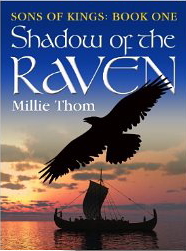
Since JF reviewed the book in November, I’ve changed the cover to the one now shown here. Here are the two different covers. The old one is the very blue one. I’ve also added a couple of much-needed maps to both Book 1 and Book 2, Pit of Vipers.
Well, next week things will really get back to normal. Most schools here open again on Monday or Tuesday, so that’s holidays over until half-term at the end of February. The weather has been cold again today. (I’m English, so bear with me whilst I wallow in the nation’s preferred topic of conversation.) After having sunshine and 9°C a few days ago, yesterday was miserably grey, and it poured down before brightening up by late afternoon to give very clear skies – which revealed an amazing full moon and a cloudless sky. Naturally, temperatures plummeted to -5°C and it continued to be freezing all morning. It’s always pretty, though, to see sunshine glistening on the frost.
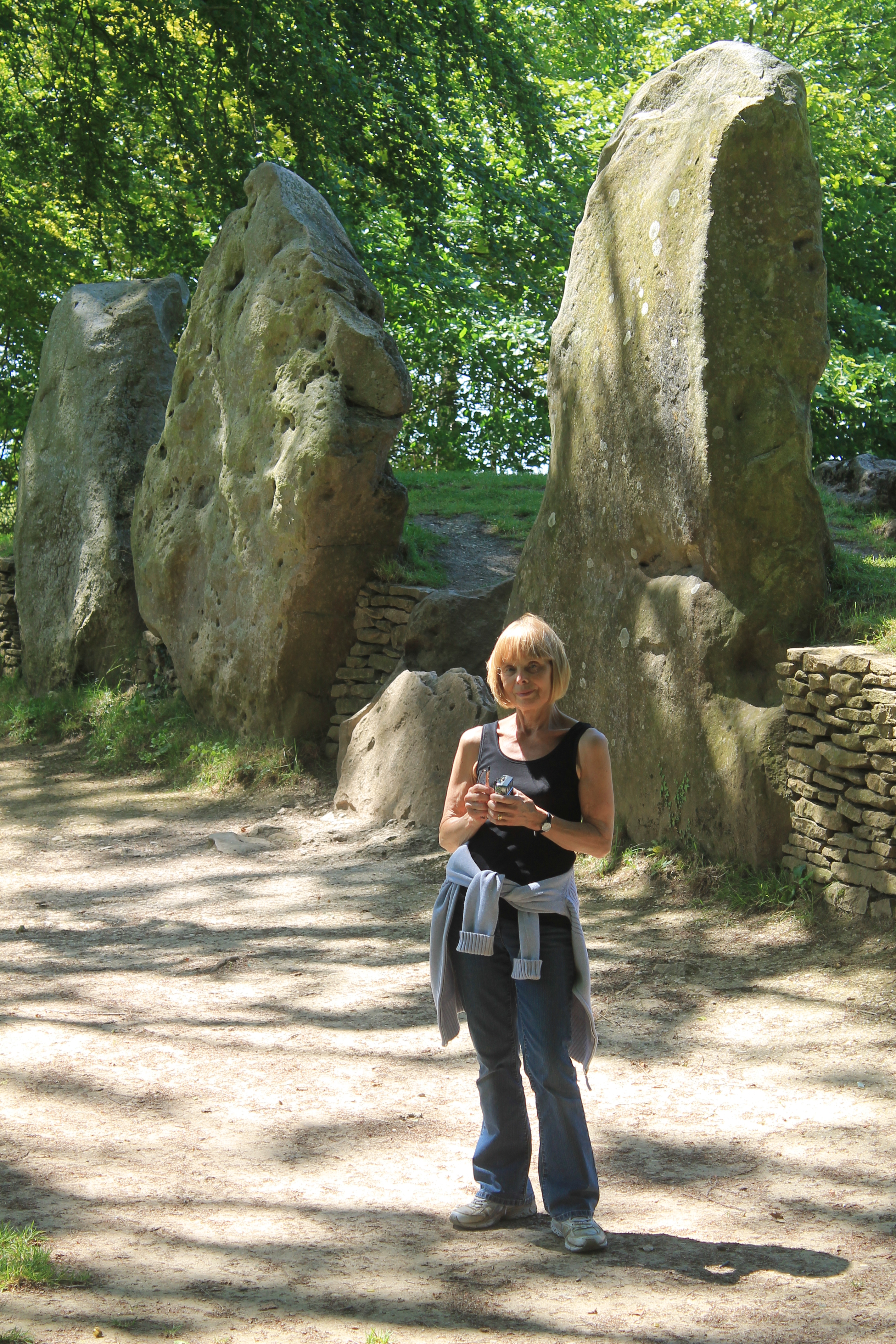
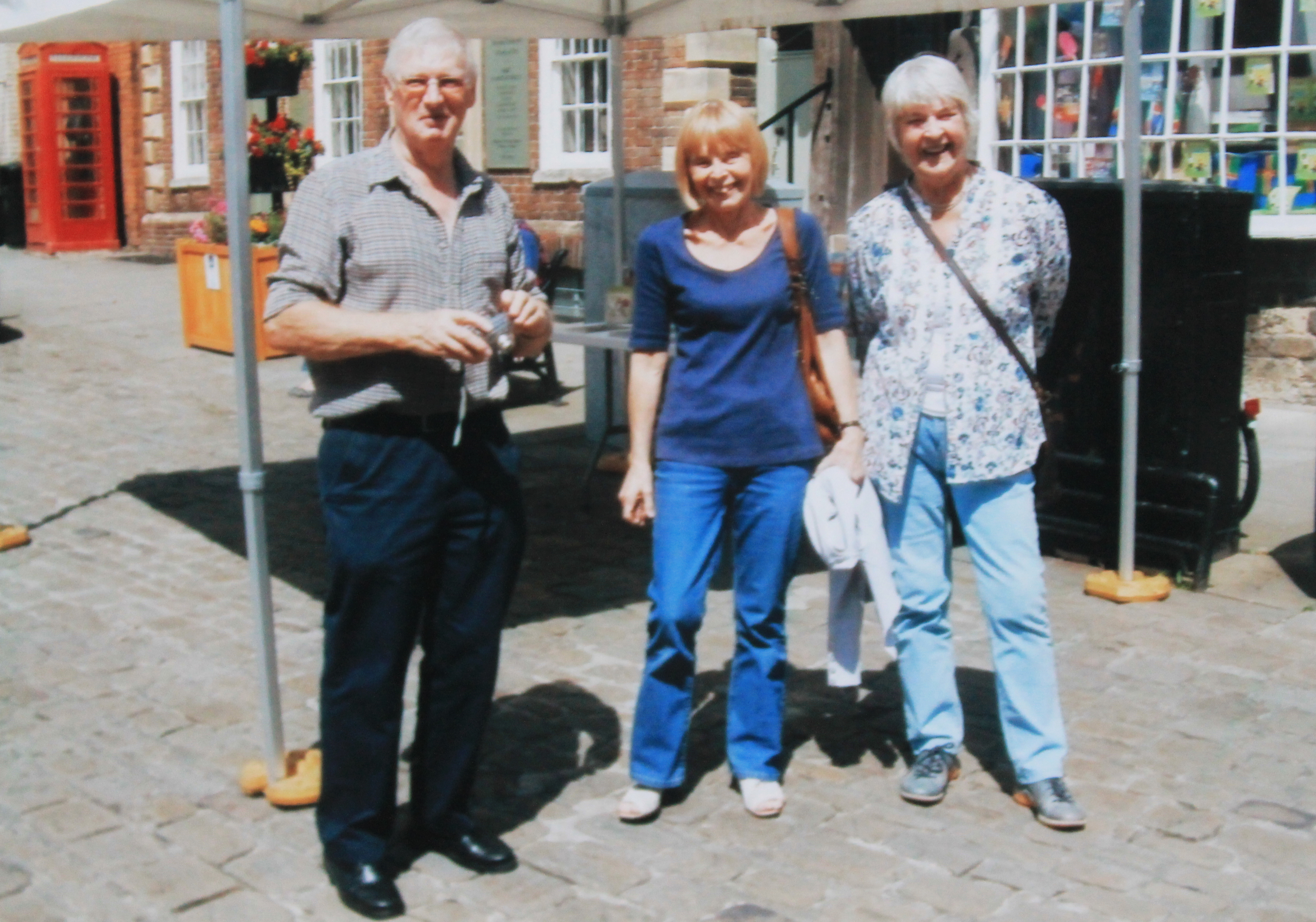
But I still prefer to be warm! The first picture of me was taken at Wayland’s Smithy in Oxfordshire in June, and the second one in Lincoln (left) with husband, Nick, and Auntie Joan in August. They show how I like the weather to be:
Life in Britain can never be truly boring. We always have the weather to talk about – fickle as it is.
Dreams about flying seem to be quite common. Perhaps it’s the fact that we humans simply can’t do it without the use of an aeroplane that causes them. We simply envy the birds, and in our dreams we allow our innermost desires to come true. I don’t know, but I’m sure there are people who could explain it! Anyway, here’s a short dream sequence from my book:
Ulf seemed to be flying. He laughed as he glanced at his outstretched arms, a joyful sound that welled up from somewhere deep inside before rushing from his lips to be carried away on the wind. This must be what total freedom felt like. Beside him a flock of starlings swooped and spiralled in their exotic ritual, and he shared their sheer delight of the open skies. Then uncertainty hit, and he squinted into the blindingly blue expanse beyond the hazy, translucent clouds. Why was he flying? Was he now dead, not a solid body at all, but a spirit rising towards heaven? A woman’s voice reached his ears, passing by in its ascent. ‘Do not grieve for me. I am free of the cares of this world now.’
Far to the west the sun was sliding behind the Welsh hills, splashing shades of vermilion and purple haphazardly across the blue. Above the landscape he soared, over fields of grazing cattle, corn ripening with the season’s warmth, and winding blue streams. Soon he was hovering over the edges of a dense forest and instinctively he knew that it was Bruneswald. This beautiful, green land was Mercia: his home.
Then he realised it was not summer at all and he was not home. His mind grew angry and cast the scene away.
This sequence is really a continuation of the post of a couple of weeks ago, To sleep, perchance to dream . . . In my book, Shadow of the Raven, this dream comes only a few minutes after the last. Eadwulf (Ulf at this stage, and still a thrall/slave) has been seriously concussed, knocked senseless by Bjorn – for his own good, as is revealed in the story. Following the period of concussion he falls in and out of dream-filled sleep. This one takes him to his beloved homeland across the Northern Sea – the Anglo Saxon kingdom of Mercia.
Once I’d finished writing my first book, and revised and edited it to death, I was in two minds whether or not to send it to a professional editor. Would it be at all beneficial? On the one hand, I supposed it couldn’t do any harm to have someone else’s opinion. (I must add that at this stage, no one else had read a single page of my sacred book. Not even my family. I’d certainly jabbered on about it – probably bored them to tears with it. But read it? NO! I didn’t want effusive praise simply because they felt obliged to give it. After seeing my devotion to my book, I know they wouldn’t have had the heart to criticise.)
So sending it off to an editor could be a good idea . . .
But, on the other hand, I was absolutely certain that after all my own editing, I had no mistakes. My spelling, punctuation and grammar were perfect, my plot was well paced and my characters did not act inappropriately. In short, I really couldn’t see the point of shelling out good cash for someone to tell me I had no mistakes.
Where had this idea of such perfection come from? Of course, then the inevitable doubt set in.
I knew very well there was more to a ‘good’ book than perfect spelling, punctuation and grammar. I needed someone to tell me whether the storyline was interesting, the characters sufficiently intriguing, the plot well paced and so on. So, after a careful scan online I selected the Jacqui Bennett Writers Bureau. This agency offers a variety of services, from actual writing courses to different critique and editing packages. They deal with a variety of genres, including non-fiction, and their prices compare favourably with some better known agencies.
My editor’s name is Doug Watts and he’s an absolute gem – for so many reasons:
Firstly: he made me believe in myself and my writing – something every first-time writer needs so badly. His praise meant the world to me and helped brush away any self-doubt that had set i
Secondly: Doug has a hawk-like ability to spot a spelling, punctuation or grammatical error from at least a hundred paces. I’m even wary when emailing him for fear he’ll send it back corrected.
And I soon learned what he thought about the overuse of exclamation marks and italics. I also make the odd typo (which I fail to notice because my spell check has a nasty habit of cutting out less than half way through my books. Because of all the Anglo Saxon and Danish names, the malicious little programme virtually tells me I can’t spell and abandons me. And since I’ve no idea how to reinstall it, it stays off. I know – I fully admit to being a computer ignoramus.)
Thirdly: Doug not only edits line by line, but appraises and critiques every two or three chapters. I really like this because if there’s anything to amend, it can be done in stages. Of course, I get an overall critique at the end as well. His appraisal of different scenes, and to what degree they work in the plot, is invaluable. He’s also on the lookout for plot holes and other inconsistencies in plot, character or dialogue and is always ready to comment on sections that need a little more detail, as well as those that may need tightening up.
Oddly enough, I found it was sometimes a little more he wanted in some scenes – which I should probably explain. When I edited the book myself, I cut out a lot of what I decided was unnecessary detail. I’d read that agents frown upon books from new authors that are much over 80,000 words and at that time my book was still over 150,000. So I decided that some serious cutting was called for. By the time I sent the manuscript to Doug, I’d got it down to around 85,000 words. Fortunately, I’d kept everything I cut out in a ‘Deleted’ file, and simply put some of these sections back in when called for! Admittedly, I did have a couple of extra bits to add to as well.
Fourthly: I always feel that Doug is there for me. Not only does he give me tremendous support and encouragement, he is happy for me to email and ask for advice at any time. I really can’t praise him enough. One of the things he says to me is, ‘Believe in yourself . . . because I do.’ How heartening is that?
The names we choose for the characters in our novels may come to us in a blinding flash . . . or we could spend days, weeks, or even months dredging them up from the bottom of the fish pond. Alternatively, we might have already chosen our main characters’ names before we even start writing the book. Then again, we might have known for years we would write about a particular character or characters.
How do we actually go about the name-choosing process? For example, why did we call the pretty and very feminine young lady ‘Daisy,’ or ‘Poppy’ – or any such flowery name – whereas, for the older strait-laced woman we opt for Gertrude, Beatrice or Penelope?
You may call me Miss Gertrude Ramsbottom.
Of course, the abbreviated form of these formal-sounding names (e.g. Gertie) could be used for a less prim and starchy figure.
Often, we pick names we feel suit the characters so well, or even their professions. Or perhaps, the name is so inappropriate to the character that it’s comical – which is, undoubtedly, the author’s intent. How many times has a tall, brawny man acquired the nickname of ‘Tiny’?
There seem to be a whole list of things to take into consideration, including ethnic origin of the character(s) and/or where the story is set. Then there’s simply that gut feeling that the name is just right.
Certain names are definitely more prevalent than others at particular periods. Many names used in novels set in the Victorian era include names we associate with that time. A few examples could be Albert, Ernest and Frederick, and Minnie, Florence and Bertha. Many Victorian names have had a big ‘come-back’ in recent years, although many tend to use the shortened versions – Sam for example, and not the complete, Samuel. My mother’s name, Millicent, is now used quite a lot for girls in the UK, but generally as Millie (or Milly).
When writing historical fiction, unless the complete cast of characters is fictional, many of our characters’ names are predetermined. We can hardly call Henry VIII, Julius Caesar or Alexander the Great anything other than those names. Right?
Just call me Fred
“What’s in a name? That which we call a rose
By any other name would smell as sweet.”
-William Shakespeare, Romeo and Juliet
My books are set in the mid 9th century, and one of my two protagonists is King Alfred of Wessex (later known as Alfred the Great). Alfred is an easy enough name to get your tongue around (although it was originally in the form of Aelfraed, which oddly enough means, ‘Elf counsel’).
Statue of King Alfred of Wessex in Wantage – reputed to be his birthplace
But most Anglo-Saxon names are extremely difficult to pronounce, and to spell. There seem to be letters stuck in places which look quite out of place to us. For example, Alfred’s grandfather was called Ecgberht. What’s with the extra ‘c’ and ‘h’? For pronunciation they mean little; we simply say Egbert.
I can’t change real historical people’s names. In my book, I have lots of Anglo-Saxon and Danish/Viking names, but the A.S. ones are the most confusing. Alfred himself is one of six children, their father being King Aethelwulf of Wessex. Like Aethelwulf himself, five of his children have names beginning with the prefix ‘Aethel’. Only Alfred is different, which is quite convenient, really! Even Alfred’s only sister is called, Aethelswith.
Perhaps readers could just drop the ‘Aethel’ part and just remember the last syllable. It would be easy to think of Aethelstan as Stan, or Aethelberht as Bert!
Confusing names can put people off – but what can the poor historical fiction author do about it? I have a list of characters at the front of the book and hope readers will use it. And I don’t really think that pronunciation matters so much, as long as a reader knows which character is which. One reviewer on Amazon.co.uk said that they enjoyed my book once they’d got used to all the difficult names. An honest opinion, and obviously valued as such. But I could name many novels with difficult-sounding names – many fantasy novels, in particular.
Anglo-Saxon place names are equally difficult, in many cases they are nothing like the names of English towns today. I know that some authors have used these A.S. names and added a list at the back/front giving their modern equivalents. I decided to call the towns and villages in A.S. England by their modern names, simply not to complicate things further. It’s easy enough for anyone to find a webpage of comparative lists.
A few interesting quotes about names:
“Now you people have names. That’s because you don’t know who you are. We know who we are, so we don’t need names.” -Neil Gaiman, Coraline
“Emilie. A beautiful name for a beautiful girl.” -Marissa Meyer, Scarlet
“Fate tried to conceal him by naming him Smith.” -Oliver Wendell Holmes, Jr.
This week I’ve been following a discussion on The Online Book Club regarding whether or not dream sequences should be used in novels. As with most things, opinions vary greatly. Some people see dreams as a useful method of imparting additional information about a character or events, whereas others proclaim they should be avoided at all cost.
In my novel, Shadow of the Raven, I have one short scene in which my protagonist, Eadwulf – Ulf at this stage in the book – experiences a great tragedy in his life. The dream is a result of events too traumatic for him to bear. Here it is:
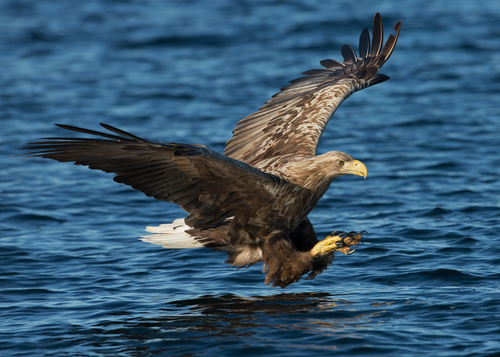
Ulf was aboard the Sea Eagle, sailing north towards the beguiling Lofoten Islands. The heavy sail flapped and seabirds wheeled and screeched, guillemots, gulls and kittiwakes amongst them. Waves slapped the hull, sunlight glistened on the blue-grey water and the salty breeze ruffled his hair. Coastward, the green-swathed Norwegian mountains, intersected by steep-sided fjords, almost took his breath away. Colonies of black and white puffins with brightly coloured beaks perched on their nests along the cliffs and cormorants stretched, drying their wings in the sun. A sea-eagle swooped to inspect the ship to which it had given its name before plucking a fish from beneath the brine. Whilst seaward, foam-white sea-horses played on the water’s surface and whiskered seals bobbed. The massive bulk of a silver whale shot great spouts of water high into the air, to cascade down again, rainbow colours of light dancing in their midst.
Somehow Ulf knew he was dreaming; yet he refused to wake up. His mind was cushioned by this sense of peace, taking him to where he wanted so much to be: this place out at sea with Bjorn and his crew, where he was valued, respected for what he was. He inhaled deeply, savouring the aroma of salty air. But the smell gradually lessened, evolving into the sharp tang of spices, mingled with the earthy smells of vegetables.
His eyes shot open . . .
Any opinions regarding the use of dreams in fiction would be very welcome.
I’ve been mulling over this question for a while now. Most of us use word contractions in our everyday conversations – how stuffy our chatting would sound without them? Imagine saying to a best friend, ‘Let us go for a walk now the rain has stopped.’ Wouldn’t we be more likely to say, ‘Let’s go for a walk now the rain’s stopped’?
Perhaps not something you’d say to your best friend, anyway, but I hope you get my meaning.
So what can we say about the use of contractions in novel writing?
Personally, I think the same thing applies to written fiction as to everyday speech. Surely, a book written without the commonly used contractions, especially in speech, would be dull and extremely stilted. (There are several definitions of this word, the following amongst them: stiff or artificially formal; wooden; pompous.)
So, how can we apply this to historical fiction?
Someone who read and reviewed my book on Goodreads (very favourably with an excellent, 5 star rating) messaged me privately to say that she wasn’t sure about the use of contractions in a novel set in the ninth century . . .
Well, I was a little thrown by that at first, although I’ve read many historical novels that do use contractions. So I consulted my editor, a very experienced professional. His immediate reaction to my suggestion of removing contractions from my current work-in-progress was one of almost shock-horror!
Then he added, ‘Don’t even consider taking out the contractions, if only for my sake!’
Everything comes down to the changes in language over the centuries and how it is used. The language used in ninth-century Britain would have been as different to modern English as Russian is today. And who’s to say whether or not people contracted their words in bygone days? I imagine they would have done, and an interesing article I found on the Historically Irrelevant website supports that belief.
Even Shakespeare used a contraction in the title of his play, ‘All’s Well That Ends Well.’ Admittedly, that was several hundred years later than the ninth century – but I still hold to my point.
These are the key things I understand from all this:
A fiction writer obviously needs to make a story interesting. In an informal/colloquial setting, stilted speech is out of place, and would probably not endear the character to the reader (unless we are purposely creating a stiff, pompous kind of person).
In formal writing, language should not be littered with contractions. In informal writing, contractions seem to be acceptable.
The use of contractions in historical fiction should not be seen as incorrect – unless the author particularly chooses to write in a more formal way.
When it comes to the nitty gritty, like most things in life it’s all a question of personal preference.
Did you know. . .?
The commonly used word, ‘Goodbye’ is a contraction of the old phrase, ‘God be with you’? A more detailed look at this can be seen here.
Most word contractions use only one apostrophe. But here are a few double contractions, with two apostrophes to think about (although, I must admit, I’ve never seen the third one with two apostrophes before. I know it’s made up of two words, shall and not, but it’s usually just written as shan’t . . . isn’t it?):
Image from the ‘about education’ website
Note: Header image, ‘Contractions’, is from k-3teacherresources.com
Like most writers I’m a voracious reader. I’ve read all my life and have no intention of stopping now – unless my eyesight suddenly packs in. Then, of course, there are always audio books . . .
So what’s the problem?
Well, the problem is that if I get into a really good book, I just want to read until I’ve finished it. Not a good thing when my second novel is sitting there, just waiting for the last couple of chapters to finish it off.
I’ve just had a great holiday in Malta, as my last post showed, doing all the things I enjoy. I love the sunshine and swimming aspects of holidaying in warmer climes, but what I don’t like is inactivity. I’m one of those people who simply must be doing something. Lounging around sunbathing I can tolerate only in very short bursts, and then only with a book to read – which in itself means an overhead canopy (so no sunbathing because I can’t read in sunlight, with or without sunglasses).
But reading is never boring to me. I read three books whilst in Malta, though they weren’t great, marathon tomes, I admit.
To get back to my main issue: should a writer spend time reading when his/her own book is in progress?
My own thoughts on this . . .? Well, yes and no.
Yes . . . because we all need some leisure time away from our work. And that is what my writing has become – a substitute for my ‘paid’ employment since retiring. I love to write, pay or no pay. And I love the theme of the trilogy I’m in the middle of. My problem arises when I have an urge to read when I should be pounding the keys on my laptop.
No . . . for obvious reasons, already touched on above. Turning to my reading when I should be writing is simply putting off focusing and applying myself to the more important or pressing task. And to be honest, I know I only do so when I hit a section of the narrative that demands a great deal of thought and application.
One final point concerns the type of books an author should read in the middle of writing – whether the author is still at the ‘would be’ stage or already published. I write historical fiction and also love to read that genre, along with some crime novels now and then. I choose to read many books in these genres while I’m writing . . . except other novels set in the same Viking period as my own .
Now, I love Bernard Cornwell’s writing in particular, and have read many of his books set in a variety of periods. I really enjoyed his Arthur series. But I won’t read his books about King Alfred until I’ve finished my own trilogy – also about King Alfred and the Danes. I certainly don’t want influencing by his storylines, as brilliant as I’m sure they are. There are bound to be overlaps in some of the events during Alfred’s life, but how they are told is unique to each author.
Can’t wait to read Bernard Cornwell’s ‘Warrior Chronicles’!
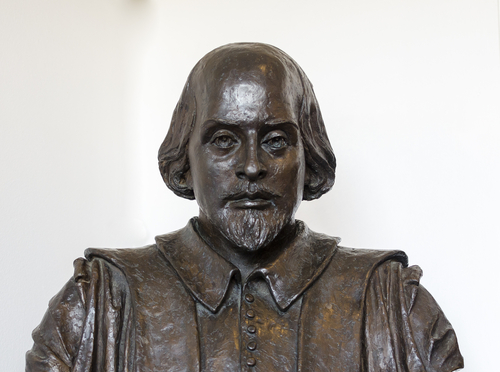
And I wonder what this man would have said about all this . . .?
William Shakespeare
A last thought from Roald Dahl:
Two hours of writing fiction leaves this writer completely drained. For those two hours he has been in a different place with totally different people.
Time for him to read something else, perhaps . . .? (What a great writer he was, too.
The style of language to adopt when writing historical fiction is a topic that keeps authors continuously arguing. Readers, too, have their own strong opinions as to whether a novel’s language is suited to the period in question. The main issue, of course, is whether or not the words sound too modern for the time. We hear comments like, ‘People in sixteenth century England would not have used those words.’ And in some cases, they are correct. We only need to check the derivation of the word to find out.
It’s very easy with everyday items. We all know, for example, that cars, trains and planes should not make an appearance in the sixteenth century. Nor washing machines, duvets or a million other things that we take for granted today. Not to mention electricity pylons across the countryside!
An sight unknown on the ancient landscape
But when it comes to general word use in a story, things are not as simple as that. Language is constantly evolving. New words are added as technological advances are made. Other words become obsolete. And, of course, populations evolve. Immigration and emigration are nothing new. The English language is basically composed of a mixture of Celtic, Latin, Anglo-Saxon, Norse, and Norman. But during the last seventy years in particular the massive scale of immigration into Britain, for example, has added many other words to the language – as indeed it has cultures. I know the United States can claim the same.
When all’s said and done, novelists are out to tell stories – and those stories must be accessible and interesting to readers. A novel set in Tudor times littered with thees,thous, wilts, hasts and forsooths and so on, would soon become . . . well, in my opinion, absolutely comical. We have many TV comedy sketches to back that up.
Naturally, this doesn’t mean that the writer should resort to phrases such as, ‘What yer playin’ at buster?’ or, ‘Henry looked a right charlie in that hat.’ Gross exaggerations, of course, just to make a point, but such phrases would look no more out of place in a novel about Henry VIII than a string of egads and forsooths.
Old language must be translated to be understood
What I believe most writers of historical fiction aim for is something close to a happy medium. A sprinkling of skilfully placed authentic historical terms will not appear ridiculous, whereas too many would do. Perhaps it’s all a question of style. A writer must set the correct tone for the period yet still move the story along in an engaging manner that modern readers can relate to.
Some years ago I read a short article by Michael Jecks, who’s written many historical fiction novels, many of them murder mysteries. Most are set in the Middle Ages. In the article, Jecks discussed criticism he’d had from reader(s) who considered the language used in his books to be inaccurate for the time. His answer was excellent. He simply pointed out that in the Middle Ages, the language used was totally different to that of modern times (basically Anlglo Saxon with a sprinkling of Celtic, Latin, Norse etc: in other words, Middle English) which today, only scholars of the period would understand.
More recently I found a YouTube presentation by Michael Jecks on the same theme. Here’s the link for anyone interested.
I’m sure that most historical fiction authors already do work along the lines Jecks outlines here. I know that I have tried to do so in my own two novels, Shadow of the Raven and the soon to be completed, Pit of Vipers.
One of the funniest things I’ve read on this subject was in a ‘Writing’ magazine back in the nineties. The author of the article was an editor, who told of the worst example of historical inaccuracy he’d ever come across in a work submitted to him in hope of publication. The novel was about Mary Queen of Scots. Although my wording may not be absolutely accurate (I read it a long time ago) it is certainly very close. In this scene, Mary supposedly says to her husband, Darnley:
‘Darnley, honey, let me fix you a chicken sandwich.’
Any comments on this fascinating subject would be very welcome.
When night’s dark shadows bow deference to the burgeoning dawn, the dreams will come. She can no more prevent them coming than she can stop the sands of Time from flowing. It has always been thus, since the Beginning. Her destiny is to know; to remember what has been and envision what has yet to come.
The sweet smell of honeysuckle suffuses the cave and her face assumes the serenity of one accustomed to the way of things. Her consciousness is immersed in colour: a vortex of dazzling hues, entwined in fierce embrace. She waits, motionless, for the tones to unravel, the images to form . . .
Green is first: verdant forest and meadow, rippling in the breath of a soft summer breeze; downy hills rolling to the distant horizon. Blue follows soon: cobalt seas that dance at the touch of golden sunbeams, the sky a vastness of azure splendour. The woman sighs, humbled by such beauty.
Then red erupts and she gasps, loath to remember. Scarlet hurtles through the valleys and befouls the streams. Women in Roman garb scream in panicked flight from blue-painted warriors intent on their slaughter; mutilated shapes ooze scarlet amidst Andredsweald’s great oaks.
Centuries slip by and scarlet intermittently ebbs and flows. The present races past and the future is suddenly upon her. Black ravens fly, and scarlet is again in full spate.
But honey-gold stands ready.
Some time before I came to my senses and realised that the story of Alfred the Great didn’t lend itself too well to fantasy, I wrote the whole of my now historical fiction novel (Shadow of the Raven) as historical fantasy. The ‘she’ in the scene above is an immortal being – which you’ve probably already gathered. I won’t bore you with her role in the story, but it was a fairly major one.
Imagine how long it took to take out all the fantasy parts. As with the battle scene I posted recently, it’s all still in my deleted file . . .















 Millie Thom