A Treasured Friend – Flash Fiction for Aspiring Writers

Flash Fiction for for Aspiring Writers is a writing challenge hosted by Priceless Joy. It asks us to write a piece of fiction from the photo prompt provided in around 100-150 words – give or take 25 words. It encourages us to comment, constructively, on other entries, so supporting each other’s writing. If you’d like to join in with this challenge, follow the above link to see what to do. The challenge runs from Tuesday to Tuesday every week.

Here is this week’s prompt, kindly provided by Dawn M. Miller:

wpid-photo-20150823123622187

And this is my story, which is a little more ‘outside the box’ than usual this week:

A Treasured Friend

We were born opposites, you and I: you, the cosseted only child of an affluent family, and I, a simple labourer’s son. I often saw you as we grew, though never with friends of your own. I caught the look of longing in your eyes as you passed my happy group on our way to the local comprehensive. You were tucked inside your chauffeur-driven Rolls, en route to that costly private school. On Saturdays, I’d occasionally see you with your fur-clad mother, heading into those expensive boutiques. How glum you looked…

But you smiled at me sometimes, generating a radiance that lit up my world. I often wondered what it was like to be so rich, and yet so alone … cut off from the company and friendship of others. We were miles apart, you and I, with no means of spanning the distance between.

Attending the same university afforded the bridge across which our two worlds could meet. That bridge has been our treasured friend these past fifty years.

Word Count: 170

*

If you’d like to view other entries, click the little blue frog below:

*

As this week’s prompt has a bridge as one of its prominent features, I thought I’d do something historical about bridges. I decided just to focus on one!

So, for anyone interested, here’s some information about one of the U.K’s most famous bridges: the Iron Bridge. This is a photo we took a few years ago:

DSCF0316

The Iron Bridge crosses the River Severn in Shropshire, England …

800px-Shropshire_UK_location_map.svg
Shropshire, UK, location map. Source: Ordnance Survey OpenData. Author: Nilfanion. Commons

… and was the first arch bridge in the world to be made of cast iron. It has become Britain’s best-known industrial monument, giving its name to the wooded gorge which was once an industrial powerhouse and has become known as the birthplace of the Industrial Revolution:

Downstream of the Iron Bridge. Author: Jon M. Commons.
The Iron Bridge (aerial) by James Humphreys - Salopian James. Commons
The Iron Bridge (aerial) by James Humphreys – Salopian James. Commons

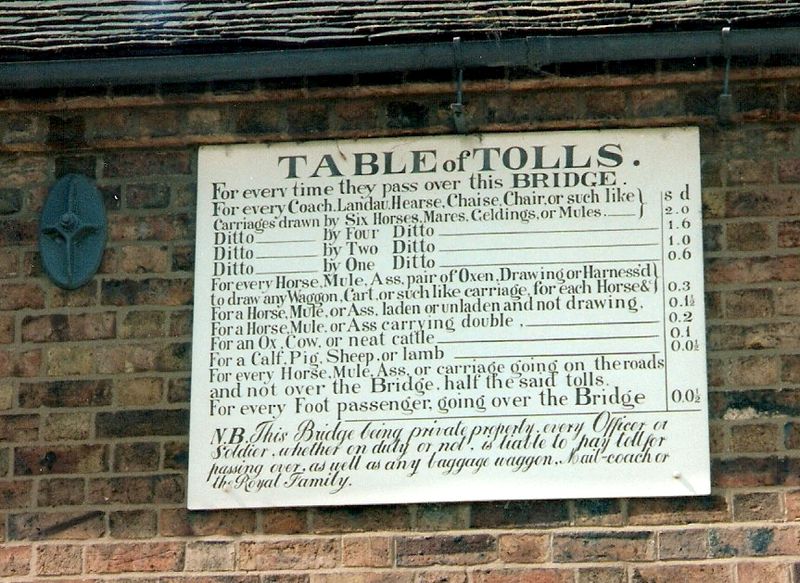
Construction on the bridge began in 1779 and it was opened in 1781. In 1934 it was designated a Scheduled Ancient Monument and was closed to all vehicles. Tolls for pedestrians were collected until 1950:

The brick tollhouse at one end of the bridge. Author: John M. geograph.org.uk. Commons
Ironbridge Tolls by Rodhulandemu. Commons

At the beginning of the 18th century, Abraham Darby I pioneered the process of using coke made from local coal to smelt local iron ore. But industrial expansion was hindered by the lack of a bridge across the Severn – which had to be a single span to allow for barge traffic. An iron bridge was first suggested by Thomas Pritchard, who designed a single bridge of 30 metres long, but died just as work began. The project was taken over by Abraham Darby III (grandson of Abraham Darby I) and the bridge was cast in his Coalbrookdale foundry. It used 378 tons of iron and cost £6,000.

Painting of the bridge by William Williams, artist. Public Domain.

Today, the Iron Bridge is a great place for starting a tour of the Gorge’s many museums and attractions. The area is now far from industrial: the factories have long-since gone and the Gorge has been restored to its natural beauty. It is now a maze of footpaths, bridleways and country lanes. One of my favourite places to visit in this area is Blists Hill Victorian Town – an authentic reproduction of a Victorian town, complete with shops, public houses and a bank.

The Ironbridge Gorge, together with the town of Ironbridge and the Iron Bridge is now a World Heritage Site.

Pedestrians crossing the Iron bridge with Ironbridge in the background. Author: Boerkevitz at nl.wikipedia. Commons.

References: Wikipedia, English Heritage, Virtual Shropshire.

*
A Nice Pair of Coconuts – Flash Fiction for Aspiring Writers

Flash Fiction for for Aspiring Writers is a writing challenge hosted by Priceless Joy. It asks us to write a piece of fiction from the photo prompt provided in around 100-150 words – give or take 25 words. It encourages us to comment, constructively, on other entries, so supporting each other’s writing. If you’d like to join in with this challenge, follow the above link to see what to do. The challenge runs from Tuesday to Tuesday every week.

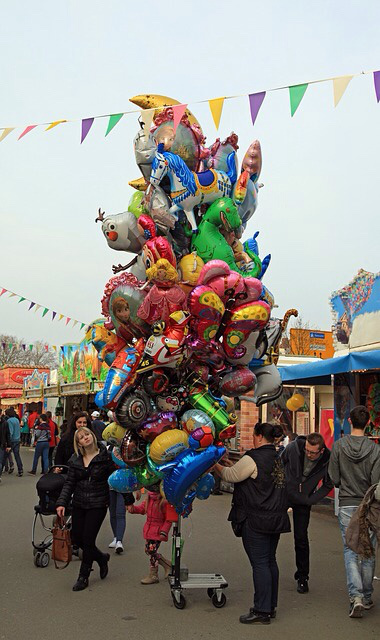
Here is this week’s prompt, courtesy of Pixabay:

wpid-photo-20150816175959521

And this is my story, for which I’ve resurrected the pair of incorrigible rogues, Fred and Harry, who haven’t made an appearance in my flash fiction for a while now. I’ve added a note about the Yorkshire dailect below:

*

Harry Hobson squinted at the many colourful stalls and gave a loud belch.

‘Grand fair,’ he said, glancing at his equally inebriated drinking buddy. ‘I think I’ll get one of them there balloons t’ tek home ter missus. Might stop ’er rantin’ about me bein’ in pub too long.’

Fred pulled a face. ‘Yer’ve tried that tactic afore, mate. An’ look where it got yer … sleepin’ on sofa for a week.’

‘Can’t blame me fer tryin’, Fred. Anyways, I like balloons meself. Might buy a couple … yer know: ‘His an’ Hers’. Women go all gooey over that kind o’ stuff.’

‘Your Nora goes ‘gooey’ ’bout nowt, Harry, except mebbe Bingo on Wednesday nights wi’ my Doreen.’

‘A man’s got t’ try ter be a good ’usband,’ Harry replied, fishing his wallet out of his pocket and scowling at its meagre contents. ‘P’raps I’ll leave the balloon buyin’ ’til next week, Fred. I need me last few quid ter have a go on that coconut shy yonder…

‘Nora’d like a nice pair o’ coconuts…’

Word Count: 175

*

For anyone not familiar with the Yorkshire dialect, here’s a note about it:

1. Many words have either the first or last letter missing – a form of lazy speech:

Her has the first letter dropped (e.g. ‘look at ’er’) as does the word about (e.g. ‘It’s ’bout time, too!’) Sleeping has the last letter dropped (e.g. sleepin’) as do the words being (e.g. bein’) and ranting (rantin’.)

 2. Some words have more than one letter missing:

‘Come with me’ becomes ‘Come wi’ me’. Perhaps becomes ‘p’raps’.

To is often written just as a t (e.g. ‘Fish ‘n’ chips t’ tek away, please.’ In that sentence the and is also reduced to just the middle letter n.

3. Completely missed out words are often open to guesswork:

‘Lets’ go fer a walk in woods’ – instead of ‘a walk in the woods’.  And ‘I’m off to the pub’ becomes ‘Im off t’ pub.’

4. Some words are simply down to Northern pronunciation:

For becomes fer. (e.g. ‘It’s a present fer Nora.’) To becomes ter (e.g. ‘I’ll give the balloon ter Nora.’) Nothing becomes nowt. ( e.g. ‘It’s nowt to do wi’ me!’) Take becomes tek. Before becomes afore. Maybe becomes mebbe.

*

My ‘extra information’ was again too long to attach to this post, so I’ve made it into a post of its own. For anyone interested, it can be found here.

*
If you’d like to view other entries, click the little blue frog below:


Besieged – Flash Fiction for Aspiring Writers

Flash Fiction for for Aspiring Writers is a writing challenge hosted by Priceless Joy. It asks us to write a piece of fiction from the photo prompt provided in around 100-150 words – give or take 25 words. It encourages us to comment, constructively, on other entries, so supporting each other’s writing. If you’d like to join in with this challenge, follow the above link to see what to do. The challenge runs from Wednesday to Wednesday every week.

Here is this week’s prompt, a beautiful picture, kindly provided by Sonya:

wpid-photo-20150808193532549

. . . and this is my story:

Sir Robert de Baux peered over the battlements, wary of revealing himself to the archers below. Fires of the enemy encampment encircled the castle – as they had done every night for the past six months.

Today, a determined assault on the castle had begun. Mangonels had hurled rocks at his outer walls and rams pounded the eastern and western gateways. None had met with success – but the trebuchets were almost constructed and the assault could go on for weeks. And food supplies were already dangerously low.

In the welcomed silence of the nightfall, he headed for the Eagle Tower, where his young wife would be waiting for news of earlier negotiations.

‘What says Sir Hugh, my lord?’ Alys asked eagerly as he entered their quarters.

‘My elder brother still claims the castle is rightfully his and that Father unlawfully disinherited him for siding with King John. The assault will continue until we surrender.’

Alys gave a wan smile. ‘The pigeon I sent out returned today. My father’s forces should be here within the week.’

Word Count: 174

*

My ‘extra information’ was too long on this occasion to attach to this post, so I’ve made it into a post of its own. For anyone interested, it can be found here.

*

If you’d like to view other entries, click the little blue frog below:


Rainbow Colours of Light – Flash Fiction for Aspiring Writers

Flash Fiction for for Aspiring Writers is a writing challenge hosted by Priceless Joy. It asks us to write a piece of fiction from the photo prompt provided in around 100-150 words – give or take 25 words. It encourages us to comment, constructively, on other entries, so supporting each other’s writing. If you’d like to join in with this challenge, follow the above link to see what to do. The challenge runs from Wednesday to Wednesday every week.

Here is this week’s prompt, a beautiful picture, kindly provided by Etol Bagam:

wpid-photo-20150724122215416

. . . and this is my story:

Lost in his memories, Richard stood on the bridge that spanned the river as the tour guide delivered his spiel about the awesome falls. He’d been saving for this trip for two long years, and now their wedding anniversary had arrived.

Claire had always loved waterfalls. ‘There’s something magical about them,’ she’d said, so many times. ‘Imagine standing so close, small and insignificant in the drenching spray, whilst rainbow colours of light dance over the swirling plunge pool.’

Thirty years of married life had passed by in a haze of hard work and raising children. Now the four had flown the nest, leaving Richard and Claire alone.  So happy together …

The illness had taken her from him, just six months before their anniversary. Towards the end, Claire had made him promise not to cancel their holiday.

‘Just look at that rainbow, Richard!’ Claire’s joyful voice sounded inside his head.

Richard focused on the vibrant colours, blinking back the teardrops that threatened to flow like the cascading waters of the falls.

Word Count: 171

Rainbowbywaterfall. Licenced under Public Domain.
Rainbowbywaterfall. Licenced under Public Domain. This rainbow is in Iceland, but they are common in the water vapour /spray around many waterfalls.

*
If you’d like to view other entries, click the little blue frog below:

*********

Today’s prompt brought to mind a waterfall that I’ve looked at in geography lessons with Year 8 on several occasions. I don’t know whether the picture is of the Angel Falls or not, but there’s a definite similarity. I’ve never seen a photo showing a bridge, however, so it could well be somewhere else.

For anyone interested, here’s a little bit of information about the Angel Falls,  mostly from Wikimedia, but other snippets from various sites.

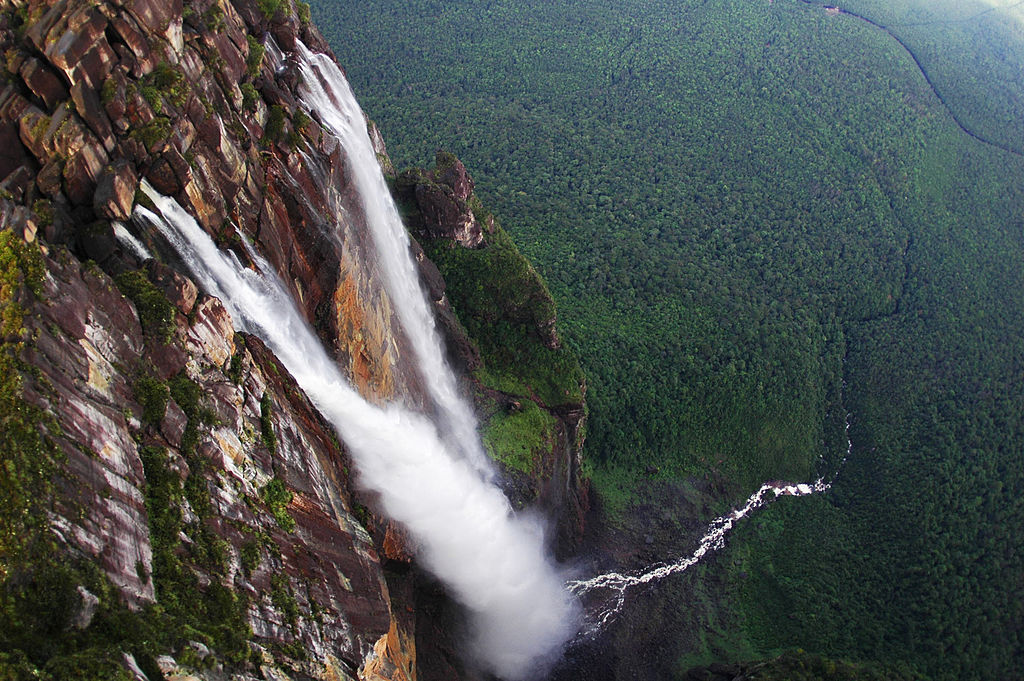
View of Angel Falls in National Park, Canaima, Venezuela. Author: Paulo Capiotti, uploaded by Slick-o-bot. Commons

Angel Falls is situated in the Canaima National Park in Venezuela (South America) and is a UNESCO World Heritage Site. It is on the Guaja River (sometimes called the Kerep River or Kerepacupai). It is the highest uninterrupted waterfall in the world, dropping almost a kilometer (979 meters/3212 feet) from a cleft near the summit of table top mountain, Auyán-tepu, into Devil’s Canyon below. It is five times higher than the  Niagara Falls and three times as high as the Eiffel Tower in Paris.

During the rainy season, the waterfall splits into two:

1024px-Angel_Falls_in_Venezuela
Angel Falls, Venezuela, in the rainy season. Author: Luis Carillo. Commons

In the dry season (December -April) it looks like this:

Salto Angel in the dry season. Author: Tomaszp.  Commons
Salto Angel in the dry season. Author: Tomaszp.
Commons

 Angel Fall was named after the American airborne gold prospector, Jimmie Angel. In 1933, he flew over the falls in his Flamingo monoplane in search of a valuable ore bed. In 1937 he returned with his second wife, Marie, on board, along with acquaintances Gustavo Henry and Miguel Delgado. Although landing successfully at the summit of the falls, the plane’s wheels became stuck in the mud and they had to walk 12 miles through the jungle, which took 12 days. News of their adventure spread and the waterfall was named Angel Falls in his honour. The common Spanish name for the waterfall, ‘Salto Angel’, was first published on a Venezuelan government map in December 1939.

The plane remained marooned at the top of the mountain until 1970, when it was taken down by a helicopter. It  can usually be seen at the Aeronautics Museum of Maracay.

1024px-JimmieAngelPlane
Jimmie Angel’s aircraft, exhibited in front of Bolivar airport. Photo uploaded by Yosemite. Commons

Angel Falls is one of Venezuela’s top tourist attractions, though a trip out to it is a quite a complicated one, as the falls are located in isolated jungle. It requires a flight out to Canaima camp, followed by a boat or jeep ride to the falls. Tourists have only been permitted to visit since 1990. The first visitors stayed at Boulton Camp (now known as Campamento Canaima).

These Falls also inspired the setting of the Disney film Up in 2009, although it was called Paraduse Falls. It was also seen briefly inthe Disney film Dinosaur, as well as the 1990 film Arachnaphobia.

800px-Angel_falls_panoramic_20080314
Panoramic, partly clouded, view of Angel Falls. Author Jlazovskis. Commons

Echoes of Misery – Flash Fiction for Aspiring Writers

Flash Fiction for for Aspiring Writers is a writing challenge hosted by Priceless Joy. It asks us to write a piece of fiction from the photo prompt provided in around 100-150 words – give or take 25 words. It encourages us to comment, constructively, on other entries, so supporting each other’s writing. If you’d like to join in with this challenge, follow the above link to see what to do. The challenge runs from Wednesday to Wednesday every week.

Here is this week’s prompt, kindly provided by TJ Paris:

wpid-photo-20150720132321474

. . . and this is my story:

Amelia withdrew to her bedchamber, leaving Edward to his business affairs. Through the open window she watched the seagulls wheeling over the blue-grey water, their mournful dirge echoing her own misery. During their first year of marriage, she had seen little of her husband, whose business focused on London, so far away.

Bequeathed to Edward by his grandfather, the house had been built eighty years ago, in 1756, in place of a dilapidated keep, and was encircled by the castle’s towering fortifications. Enveloped by the sea, storms utterly terrified Amelia, as malevolent waves battered the defences like some ancient foe firing deadly cannon.

Despite numerous servants, she felt so alone; no babe yet swelled her womb.

Edward was suddenly beside her. ‘Amelia, I think we should move to London…  We can afford it now, and in London you’ll be close to your family –’

Amelia threw her arms round his neck, sobbing her relief.

‘We’ll spend more time together,’ he whispered, ‘raise a child or two…  And bequeath this house to the nesting gulls.’

Word Count: 174

birds-173695_640

If you’d like to view other entries, click the little blue frog below:

I usually add a little bit of ‘extra’ information connected to the topic of my story every week. Today I thought this information was a little too long, so I’ve made it into a separate post. If you would like to read it, you can find it here.

Dance of the Swan – Flash Fiction for Aspiring Writers

Flash Fiction for for Aspiring Writers is a writing challenge hosted by Priceless Joy. It asks us to write a piece of fiction from the photo prompt provided in around 100-150 words – give or take 25 words. It encourages us to comment, constructively, on other entries, so supporting each other’s writing. If you’d like to join in with this challenge, follow the above link to see what to do. The challenge runs from Wednesday to Wednesday every week.

Here is this week’s prompt, kindly provided by Sonya at Only 100 Words:

wpid-photo-20150714061449959

. . . and this is my story:

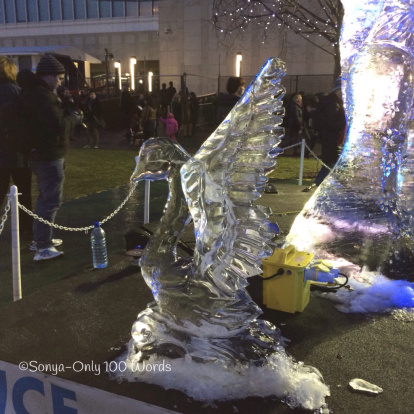
Alexei surveyed the solid ice block before him, considering the shape he was about to sculpt. He knew every curve of the slender neck, every line of the beautiful face. He’d marvelled at her exquisite elegance as he’d watched her glide effortlessly from one position to the next.

As the ice took on its overall shape, Alexei deftly used his little ice knife and small, flat chisel to create the finer features. He imagined those intelligent, dark eyes, gazing back at him. How close the two of them had become in such a short while. He’d never imagined he would lose her.

‘But I must go to Moscow, Alexei!’ Katerina had exclaimed at his feeble requests that she stay. ‘My life would be nothing without the Ballet. I shall be Odette, the beautiful swan. And I shall return to you once we close.’

So long ago…

Now a prima ballerina, Katerina had chosen the adoration of millions over Alexei’s love. To him she had become a beautiful, icy swan, destined to just melt away…

Word Count: 174

*

If you’d like to view other entries, click the little blue frog below:

***

For anyone interested, here is some information about The History of Ice Sculpture. from various sources:

Ice sculpture is the art of carving shapes out of ice, ranging from small table decorations to entire towns of ice seen at winter festivals all over the world. The origins of ice scupting are credited to both China and Russia:

In the 1600s, hunters and fishermen of the Chinese province of Heilongjiang, on the border of Russia, designed ice lanterns. They filled buckets with water to make ice, then slid it out and put a candle in the hole to make a lantern. People started hanging decorated lanterns from homes and parading them in carnivals. Here’s a pictute of an ice lantern I found that looks bucket-shaped, and how I imagine those made in China might have looked:

Islykta
Lantern of Ice. Uploaded by Eric Sylwan. Commons

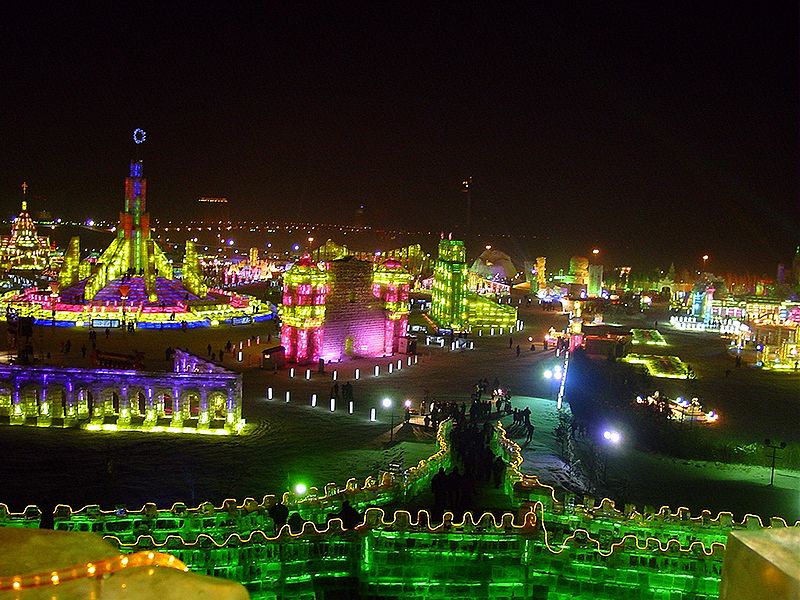
In 1897, the Trans Siberian Railway was extended through the small Chinese fishing town of Harbin in Heilongjiang. Increased traffic resulted in Harbin growing into a cosmopolitan city. With below freezing winds from Siberia, and ice from the frozen Songhua river, Harbin became the home of the annual International Ice and Snow Sculpture Festival. Currently, this festival features the work of thousands of artists from all over the world and holds the Guinness World Record for the largest snow sculpture. The sculpture, entitled “Romantic Feelings”, measured 115 ft tall and 656 ft long.

Harbin Ice Festival. Originally uploaded by LiYan.  Commons
Harbin Ice Festival. Originally uploaded by LiYan. Commons

The first historical occurrence of ice sculpture in Russia was in 1740 when the Empress Anna Ivanovna commissioned the building of an ice palace in St. Petersburg. The palace was intended to be an elaborate joke, but to the empress it was meant as something darker. She delighted in humiliating nobility, and Prince Mikhail Galitzine had annoyed her by insisting on marrying an Italian Catholic. After the death of this first wife, the empress forced him to marry her ugly, elderly servant woman. The ice palace was built as the stage for the wedding. Following the church ceremony, the couple were fastened inside an iron cage on the back of an elephant and paraded toward the palace in a procession of horses, camels, wolves and pigs. They were then forced to spend the night inside the frozen mansion, with guards posted outside to ensure they stayed there.

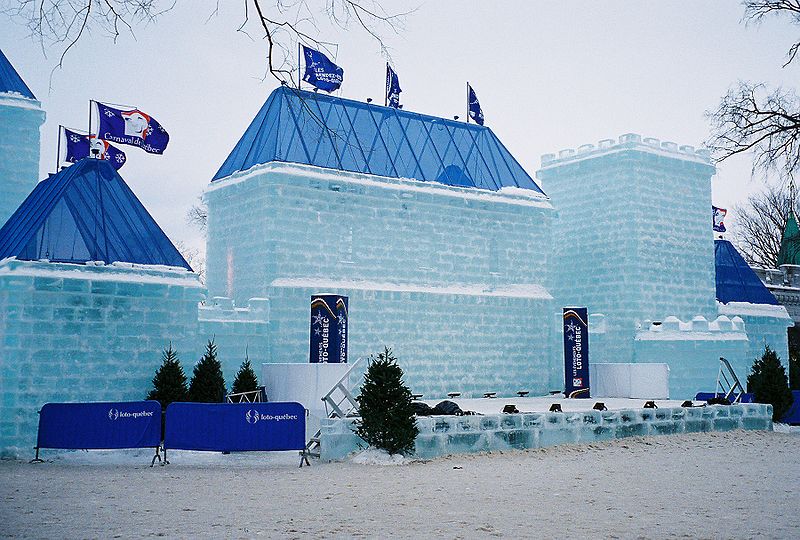
Today, there are a number of ice festivals around the world. Other than the one at Harbin, China, they include those in Japan, Canada, Alaska (USA), Belgium, Sweden, Russia and the UK.

800px-Carnival_1
Ice castle during the Quebec Winter Carnival of 2009. Uploaded by Shapiros 10. Commons


Ai Weiweis Ice Sculpture in Stockholm, Sweden, 2014. Uploaded by Frankie Fouganthin (own work).


Shattered Dreams – Flash Fiction for Aspiring Writers

Flash Fiction for for Aspiring Writers is a writing challenge hosted by Priceless Joy. It asks us to write a piece of fiction from the photo prompt provided in around 100-150 words – give or take 25 words. It encourages us to comment, constructively, on other entries, so supporting each other’s writing. If you’d like to join in with this challenge, follow the above link to see what to do. The challenge runs from Wednesday to Wednesday every week.

Here is this week’s prompt, kindly provided by Vanessa Rodriguez.

wpid-photo-20150704120546349

. . . and this is my story:

‘You realise this is the end, don’t you? After all we’ve worked so hard to achieve…’

René took his tearful wife into his arms, knowing she was right, but wanting so much to ease her distress. The vineyard had been their hope for the future… for themselves, their children, and grandchildren yet to be born. Now they faced a future of hardship and regret.

‘Another hurdle, Françoise, not the end,’ he said, instilling a positive note into his voice. ‘This is 1887 after all, and the wine industry can deal with crop diseases nowadays. We’ll see no profit this year, but –’

‘Not just no profit, René! We’ll have nothing to cover the year’s production costs … including the new wine presses we bought, and employees’ wages.’

‘Phylloxera is a new disease, ma chérie, and ways will be found to eradicate these sap-sucking insects. By next year, we’ll be back to normal.’

Françoise shook her head, unconvinced. ‘I’ll remind you of your prediction in two years time when we’re begging on the streets of Paris.’

Word Count: 175

*

My story this week is based on the phylloxera outbreak in France in 1887 (often called the ‘Great French Wine Blight’). I’ve written a little about it at the end of my ‘exta’ piece below.

If you’d like to view other entries, click the little blue frog below:

***

For anyone interested, here’s some information I’ve put together about the history of wine production:

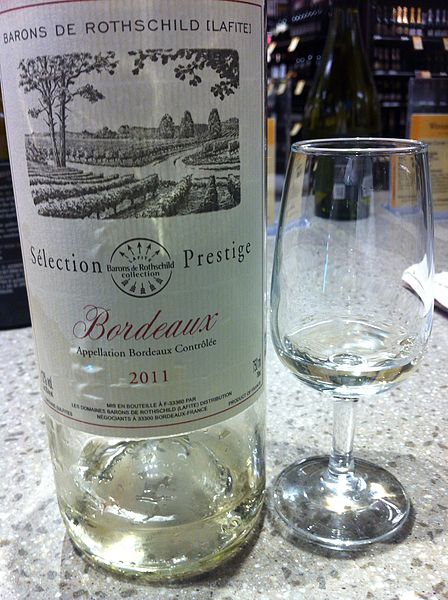
Rothschild_white_Bordeaux
Rothschild dry white Bordeaux. Author: Agne27, Commons

The earliest evidence of a fermented drink based on grapes is in China, 7,700 – 6,600 years BC.  It gradually became more widespread and we soon find evidence of it in the Near East. The grapevine and the alcoholic drink produced from it were important in Mesopotamia and Egypt and were essential aspects of Phoenician, Greek and Roman civilisations.

Grape cultivation and wine making in ancient Egypt. Author: Agyptischer Maler in the 1500s. Public Domain.
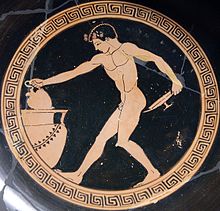
Boy  drawing wine from a crater. His nudity shows that heis serving as a cup bearer at a symposium or banquet.at a Greek symposium or banquet (
Boy drawing wine from a crater. His nudity shows he is serving as a cup bearer at a Greek symposium or banquet. Artist: Cape Painter. Public Domain

Wine was an integral part of the Roman diet and wine making became a widely spread and precise business during the time of the Roman Empire. Most of the major wine producing regions of Western Europe today were established during that time. Wine-making technology improved during Roman times, as did the number of varieties of grapes and cultivation techniques. The design of the wine press advanced and barrels were developed for the storage and shipping of the wine.

The most famous Roman wine was Falernian, due to it high alcohol content! Anyone who has read the brilliant Falco books by Lindsey Davis (set in ancient Rome) will recognise this wine as one of Falco’s favourites. Wines were also mixed with herbs and minerals for medicinal purposes.

Throughout history, wine has often been associated with religion. The Greeks worshipped Dionysus (god of wine) and the Romans carried on his cult, calling him Bacchus. Wine has been in Jewish culture since Biblical times and has been part of the Eucharist commemorating Christ’s Last Supper in the Christian Church.

Monastic cellarer tasting wine. From a French manuscript. late 13c. Public Domain

Although Islam generally forbids the production and consumption of alcohol, during the Golden Age (8th-13th century) alchemists such as Geber pioneered wine distillation for medicinal and industrial processes (e.g. producing perfume).

In the medieval period, wine was the common drink of all classes in the south of Europe where grapes were cultivated. Further north and east, where few grapes were grown, beer and ale were the usual beverages. Wine was exported to these regions but was expensive, so was only consumed by the upper classes. Because it was used in the Catholic mass, a supply was crucial. Benedictine monks became one of the largest producers in France and Germany, followed closely by Cistercians and various other Orders.

Wine production increased dramatically from the 15th century onwards as part of European expansion. By the 18th century, the wine trade had soared, especially in France, where Bordeaux became the preeminent production.

Bordeaux wine Region. Author: Trainspotter. Commons
Bordeaux Wine Region of France. Author: Trainspotter. Commons

In the New World (America) the first successful wine production was in Ohio in the 19th century. In Australia, too, wine production began about that time. In the Old World at this time, Champagne was established as a favourite luxury drink and fortified wines like sherry and port became increasingly popular in Britain.

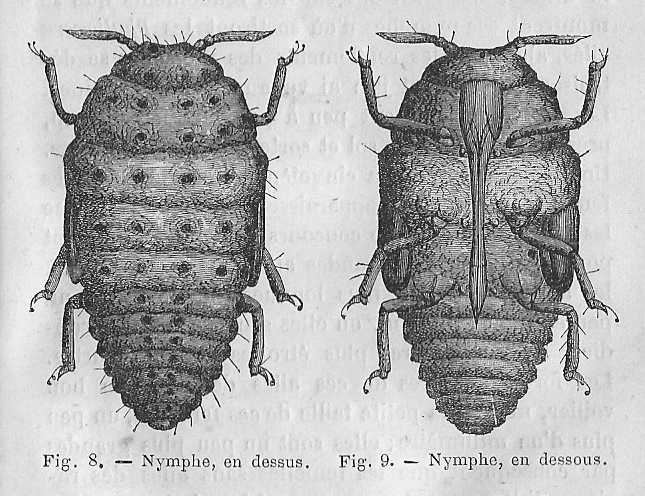
Vineyards everywhere were badly hit in 1887 by a disease called phylloxera (often grape phylloxera)  which was caused by the infestation of almost microscopic, pale-yellow, sap-sucking insects related to ahpids.

Phylloxera nymphs. Author: maurice Girad. Public Domain.
Phylloxera nymphs. Author: Maurice Girad. Public Domain.
800px-Phylloxera_cartoon
Phylloxera cartoon from ‘Punch’, 1890. The caption with it reads: ‘The phylloxera, a true gourmet, finds the best vineyards and attaches itself to the best wines.’

It is possible that it originated in North America and was carried across the Atlantic in the 1850s (although this is still debated). France was the worst country to be hit but other European countries were also affected. It was dealt with by grafting European vines to the resistant American rootstock that was not susceptible to phylloxera. It proved effective, but the ‘Reconstitution’ of the French vineyards – as it was called – was a very slow process. There are still a few vineyards in Europe that inexplicably remained unscathed and exist today as they did before the disease arrived.

***

A Fresh Cadaver – Flash Fiction for Aspiring Writers

Flash Fiction for for Aspiring Writers (FFfAW) is a writing challenge hosted by Priceless Joy. The challenge asks us to write a piece of fiction from the photo prompt provided in around 100- 150 words – give or take 25 words. It encourages participants to comment, constructively, on other entries, so supporting each other’s writing. If you’d like to join in with this challenge, follow the link to see what to do. The challenge runs from Wednesday to Wednesday every week.

Here is this week’s prompt, kindly provided by Sonya:

wpid-photo-20150620103848224

. . . and this is my story:

A pale moon cast just enough light to stop Charlie from tripping over Bert’s feet as they traipsed along the narrow path through Lord Harcourt’s estate. Why he’d let himself be talked into this, he didn’t know. It had seemed a good idea at the time – after a few pints at the ‘Duck and Goose’.

‘Light the lamp,’ Bert hissed over his shoulder. ‘We’re almost there.’

The lamplight threw an eerie glow over the small graveyard as they dug rapidly down to the coffin of his Lordship’s recently interred son. Charlie’s heart pounded as he thought of the consequences of being caught in the act of body snatching. Imprisonment would likely be the death of him.

‘Let’s hope old Jacob’s still awake,’ Bert whispered, as they lugged the body back to the horse and cart on the nearby lane. ‘We paid him enough to keep watch, for Gawd’s sake.’

‘Evening, gents’, one of the blue-clad Peelers intoned as they reached the lane. ‘Pleasant night for a spot of digging.’

Word Count: 170

Note: ‘Peelers’ was the name given to the earliest policemen in the U.K. The name comes from that of Robert Peel, the person responsible for the Metropolitan Police Act of 1829  which provided permanently appointed and paid Constables to protect London as part of the Metropolitan Police Force. The earliest ‘Peelers’ wore blue tail-coats and top hats and each carried a truncheon, handcuffs and a rattle to raise the alarm. Rattles were later replaced by whistles. Later on the Peelers’ nickname was replaced by ‘bobbies’ – the shortened name/nickname for Robert.

If you’d like to view other entries, click the blue frog below:

For anyone interested, here’s some information I put together about body snatching, mostly from Wikipedia:

443px-Body_snatchers_at_work,_Old_Crown_Inn,_Penicuik
Body snatchers at work – painting on the wall of the Old Crown Inn, Pinicuik, Midlothian, Scotland. Author: Kim Traynor. Commons

Body snatching is the secret disinterment of corpses from graveyards. The people who practised body snatching were often called ‘resurrectionists’ or ‘resurrection men’, and in the UK  during the 18th and 19th centuries, they were commonly employed by anatomists to exhume bodies of the recently dead for either dissection or use in anatomy lectures in medical schools.

506px-Cruelty4
Tom Nero’s body is dissected after her has been hanged. Author: William Hogarth, 1697-1764. Public Domain

Before the Anatomy Act of 1832, the only legal supply of corpses for anatomical purposes were the bodies of those condemned to death and dissection by the courts. Those sentenced to dissection were often guilty of harsher crimes. Such sentences did not provide enough corpses for medical purposes, and with the expansion of medical schools at least 500 cadavers were needed yearly.

Execution_of_William_Burke_Wellcome_L0001668
Burke was hanged for mudering the poor, lost and lame of Edinburgh and supplying their bodies to anatomists for dissection. Credit: Wellcome images (operated by the Wellcome Trust, UK). Commons

Interfering with a grave was classed as misdemeanour at common law – not a felony, so only punishable with a fine and imprisonment, rather than transportation or execution. It was a lucrative enough business to counter the risks of detection. Burke was hanged because he actually murdered his victims.

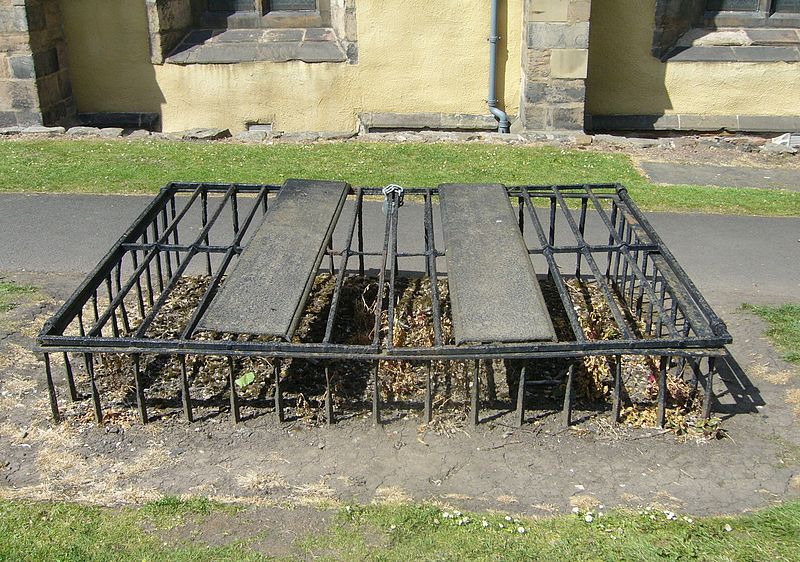
Body snatching became so frequent that many relatives and friends of the deceased kept watch over the body before and after burial to stop it being violated. Sometimes, graves were protected by a framework of iron bars, or iron and stone devices, called mortsafes.

800px-Mortsafe,_Greyfriars_Kirk
One of two specimens of mortsafe in Greyfriars Kirkyard, Edinburgh. Author: Kim Taylor. Commons
Banchory_Devenick_mortsafe
A motsafe near Aberdeen, Scotland. Author: Parrot of Doom. Commons

***

The Pearl Diver – Flash Fiction for Aspiring Writers

Flash Fiction for for Aspiring Writers is a writing challenge hosted by Priceless Joy. The challenge asks us to write a piece of fiction from the photo prompt provided in around 100- 150 words – give or take 25 words. It encourages participants to comment, constructively, on other entries, so supporting each other’s writing. If you’d like to join in with this challenge, follow the link in the title of PJ’s, blog: Beautiful Words to see what to do. The challenge runs from Wednesday to Wednesday every week.

Here is this week’s prompt, kindly provided by Sonya:

wpid-photo-20150604190751019

. . . and this is my story:

At fifteen, Baktu was the best pearl diver in the village. Everyone said so. He loved the ocean, and once submerged, he became one with its cushioning depths. He could hold his breath far longer than the other boys, and knew exactly where to search for the pearl oysters his people craved …

‘Look, Grandpa,’ Joti said proudly, rousing Baktu from his memories as he surfaced and dropped his harvest into the bucket hung over the side of the little boat. ‘It’s almost full!’

Baktu smiled, and the boy dived again into the shallow water, landside of the reef. Edible oyster beds were plentiful here, and there was little threat of sharks – unlike beyond the reef where village boys still dived for pearl oysters in the deeper waters. Just as Baktu had once done …

‘Shark, Baktu!’

Baktu grabbed the side of the boat, but too late…

He was eighteen when the shark had taken his right leg, ending his diving days. But Baktu would never forget the sensation of the ocean’s cushioning embrace.

Word Count: 175

If you’d like to view other entries, click the little blue frog below:

***

For anyone interested, here are a few points about oysters, pearls and pearl diving from several sources including Wikipedia:

Oysters are bivalve molluscs found in temperate and warm coastal waters in all oceans. But not all species of oysters produce the shiny, costly pearls. True oysters are found naturally in shallower waters, very close to the coast, and have been cultivated for food for over 2,000 years. Pearl oysters are found in deeper water. Pearls form inside oysters from the accumulation of nacre (mother of pearl) the material lining the oyster shell. Pearls formed inside edible oysters are lustreless and of no value.

Pinctada_margaritifera_MHNT.CON.2002.893
Inside shell of Pinctada margaritifera. Two views of the same shell. Photographer: Didier Descouens. Commons

Many thousands of years ago, humans probably discovered the first pearls along the seashore, while they were searching for food. It is also probable that they wouldn’t have taken long to realise that the gems had come from the sea.

Before the beginning of the 20th century, the only way of obtaining pearls was by divers gathering large numbers of pearl oysters or mussels from the ocean floor, lake or river bed. These were brought to the surface, opened up and the tissue searched. More than a ton of them were searched in order to find 3-4 pearls. Pearl divers were trained to stay under water for at least 90 seconds, often descending to depths of over 125 feet in a single breath.  Many tied baskets or nets to their bodies to collect their harvest.

Pearl diving has been practised for over 4,000 years, from the Persian Gulf to the Indian Ocean, the South China Sea and the Sea of Japan. Native Americans also harvested freshwater pearls from lakes and rivers like the Ohio, Tennessee and Mississippi, while others obtained them from the Caribbean and waters along Central and South America. In the time of colonial slavery in northern South America (along the coasts of Columbia and Venezuela) an occupation among slaves was that of pearl diving. In shark-infested waters this was extremely perilous, but any slave who discovered an extra large pearl could buy his freedom.

In Japan, pearl divers were traditionally women called Ama, which means ‘sea women’. Women are considered better pearl divers by many because they conserve heat better in the severe cold of the ocean.

In the early 1900s as pearls became harder to find, new pearl diving techniques were developed. Diving suits and breathing apparatus allowed for deeper and longer dives. It is estimated that 2000 people worked as pearl divers at this time.

448px-Waterclothes
Old Kuwaiti dress used during pearl diving. Author: Kuwaitsoccer. Commons

Mother of pearl was used to make buttons for shirts.

Today, pearl diving has largely been replaced by cultivated pearl farms, although a few island nations undoubtedly still continue the practice.

*****

It Happened Like This – Flash Fiction for Aspiring Writers

Flash Fiction for for Aspiring Writers is a writing challenge hosted by Priceless Joy. The challenge asks us to write a piece of fiction from the photo prompt provided in around 100- 150 words – give or take 25 words. It encourages participants to comment, constructively, on other entries, so supporting each other’s writing. If you’d like to join in with this challenge, follow the link in the title of PJ’s, blog: Beautiful Words to see what to do. The challenge runs from Wednesday to Wednesday every week.

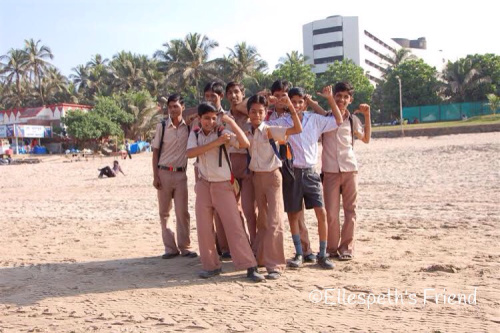
Here is this week’s prompt, kindly provided by Ellespeth’s friend:

wpid-photo-20150601211633962

. . . and this is my story:

Hot sun, golden sand, warm sea…  What more could a guy want for a week with a gorgeous blonde who just oozed sex appeal? Those curves were enough to send any man crazy.

And ‘crazy’ just grabbed hold of me – and I grabbed Doreen a little too amorously as we frolicked in the surf.  Her bikini top somehow came undone, and pink polka-dots were suddenly floating out to sea.

Doreen’s shrieked profanities needed no amplifier and, not satisfied with that, she proceeded to hammer me with her fists!

Jeers and hoots halted her swings. Belatedly overcome with modesty, Doreen bobbed down, neck-deep beneath the brine. I stared at the group of school lads, their muscles flexed, mocking our one-sided brawl.  But their eyes were fixed on Doreen, waiting to ogle her wading to shore.

Realising her predicament, Doreen’s rage soared. Another swipe knocked me senseless before she swam after her polka-dot top.

The lads were my saviours that day – and I never saw Doreen again.

My bruises faded in a couple of weeks.

Word Count: 175

 If you’d like to view other entries, click the little blue frog below:

***

For any one interested, here are a few facts I found ( mostly from Wikipedia) about the bikini:

A bikini is a woman’s two-piece swimsuit. The design is simple: two triangles of fabric for the top and two triangles for the bottom. The size of the bikini can range from full pelvic coverage to a revealing thong or g-string design.

shutterstock_14874769

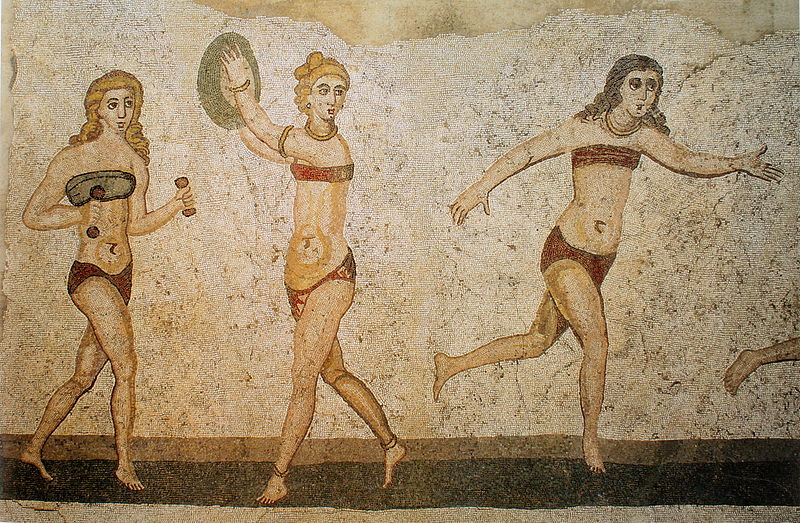
Although we think of the bikini as a relatively recent design,  two-piece swimsuits actually existed in classical antiquity:

Mosaïque_des_bikinis,_Piazza_Armerina
Bikini girls mosaic, Villa del Casale, Piazza Armerina, Sicily, Italy. 4th century CE. Author unknown. Photographer Yann Forget. (Considered the most valuable image on Commons)

The modern design first attracted public attention in Paris in 1946, although a fuller, two-piece swimsuit was not completely unheard of prior to this time:

Jane_Wyman,1935
Jayne Wyman in 1935. Los Angeles Times. Public Domain

The actual term, bikini, was coined by Lois Réard, a Parisian mechanical engineer who took over his mother’s lingerie business. He named it after Bikini Atoll, where the testing of atom bombs was taking place. Due to the controversial design, the bikini was slow to be adopted in many countries and was banned from beaches and public places. The Holy See declared the design sinful, but it became part of popular culture when film stars like Brigitte Bardot, Raquel Welsh and Ursula Andress began wearing them on beaches and film sets. I’m sure most of us know of, or have seen, Raquel Welch in One Million Years BC and Ursuala Andress in the James Bond movie, Dr. No.

OCT 9 1977, MAR 21 1980, JUL 23 1995 Below, Frankie Avalon and Annette Funicello as they were during the Beach Party era. Right, Elleen Mintz, one of seven Annette look-alike contestants, screams as the audience votes her the winner.
Frankie Avalon and Annette Furnicello at Beach Party in the 1960’s. Annette Furnicello was not permitted to show her navel. Public Domain.

By the 1960s, the bikini design had become common in most western countries as beachwear, swimwear and underwear. By the late 20th century it was also used as sportswear, e.g. in beach volleyball and body building.

Semi final of Women's beach volleyball at the Beijing Olympics. Author Craig Maccubin. Commons
Semi final of Women’s beach volleyball at the Beijing Olympics. Author Craig Maccubin. Commons

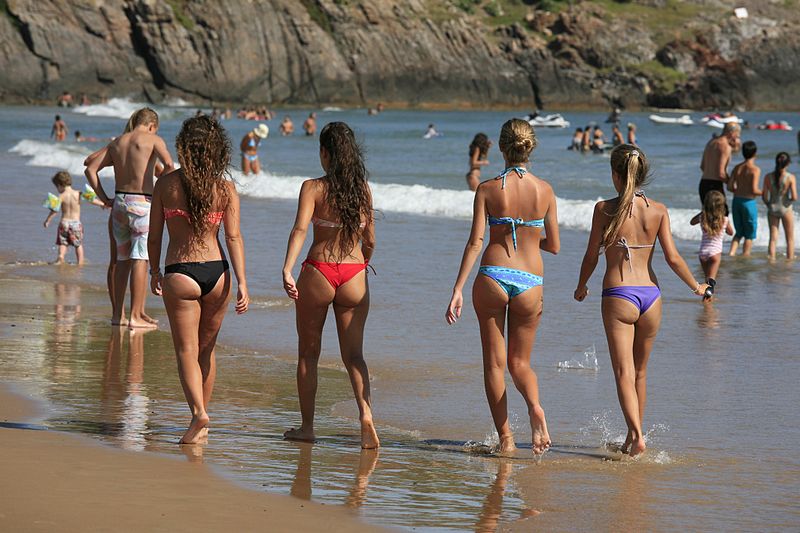
Various styles are common today, from skimpy thong designs to fuller, skirted ones. It’s not unusual on beaches worldwide to see women wearing them with pride – whatever their size.

800px-Strutting_(5364339653)
Strutting: Women on the beach in bikinis. Author: Priomos, Sydney, Australia. Creative Commons