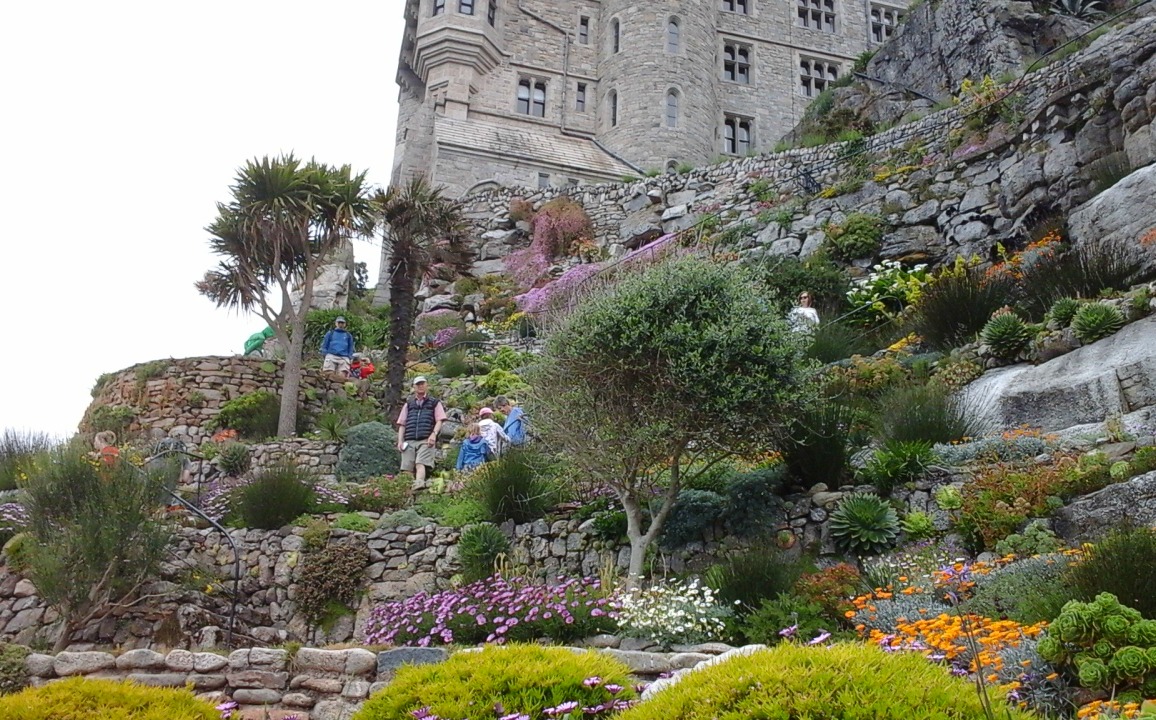
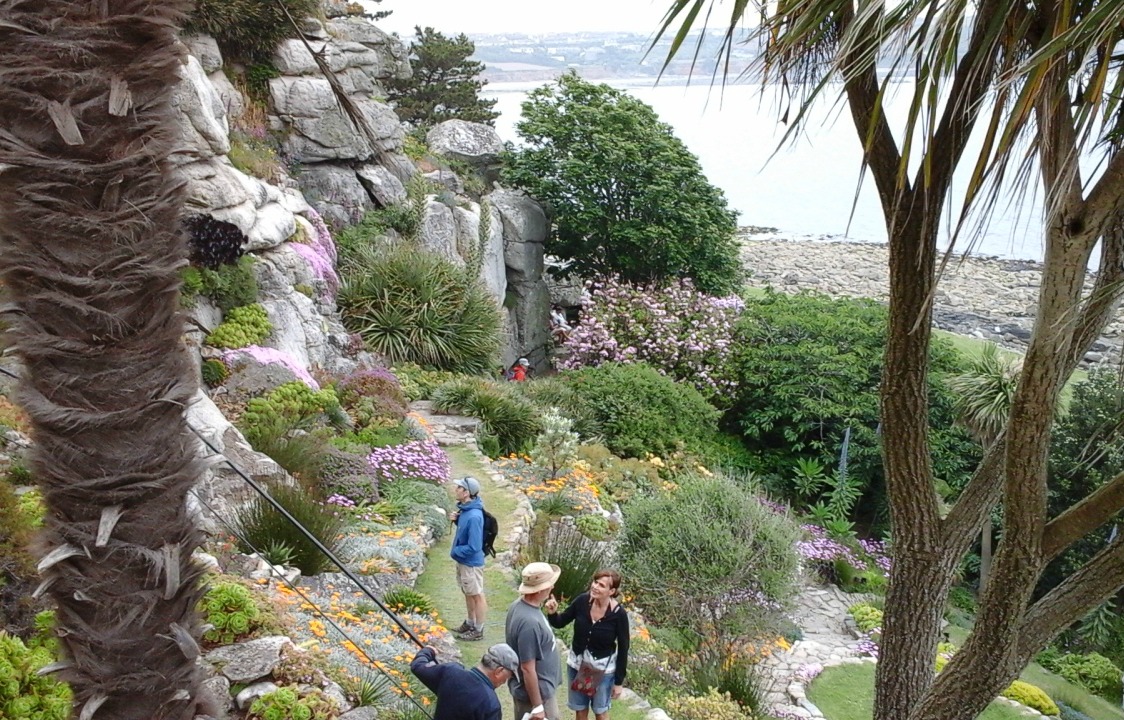
The Terrace Gardens at St Michael’s Mount adorn the steep granite slopes on the south-eastern side of the island. Today the gardens attract 65 thousand visitors a year from April to September – the number of days they’re open being restricted to safeguard them from too much erosion. The gardens are carefully and lovingly tended by the head gardener, Lottie Allen and her team of three.
To many visitors, it may seem strange that these beautiful gardens exist at all in such a location. The steep granite cliffs, with the sea thrashing against the shore beneath and the brisk, salty winds and harsher gales – make it an unlikely place for any type of garden. Yet that is far from the truth. Gardens cover 12 of the island’s 21 acres.
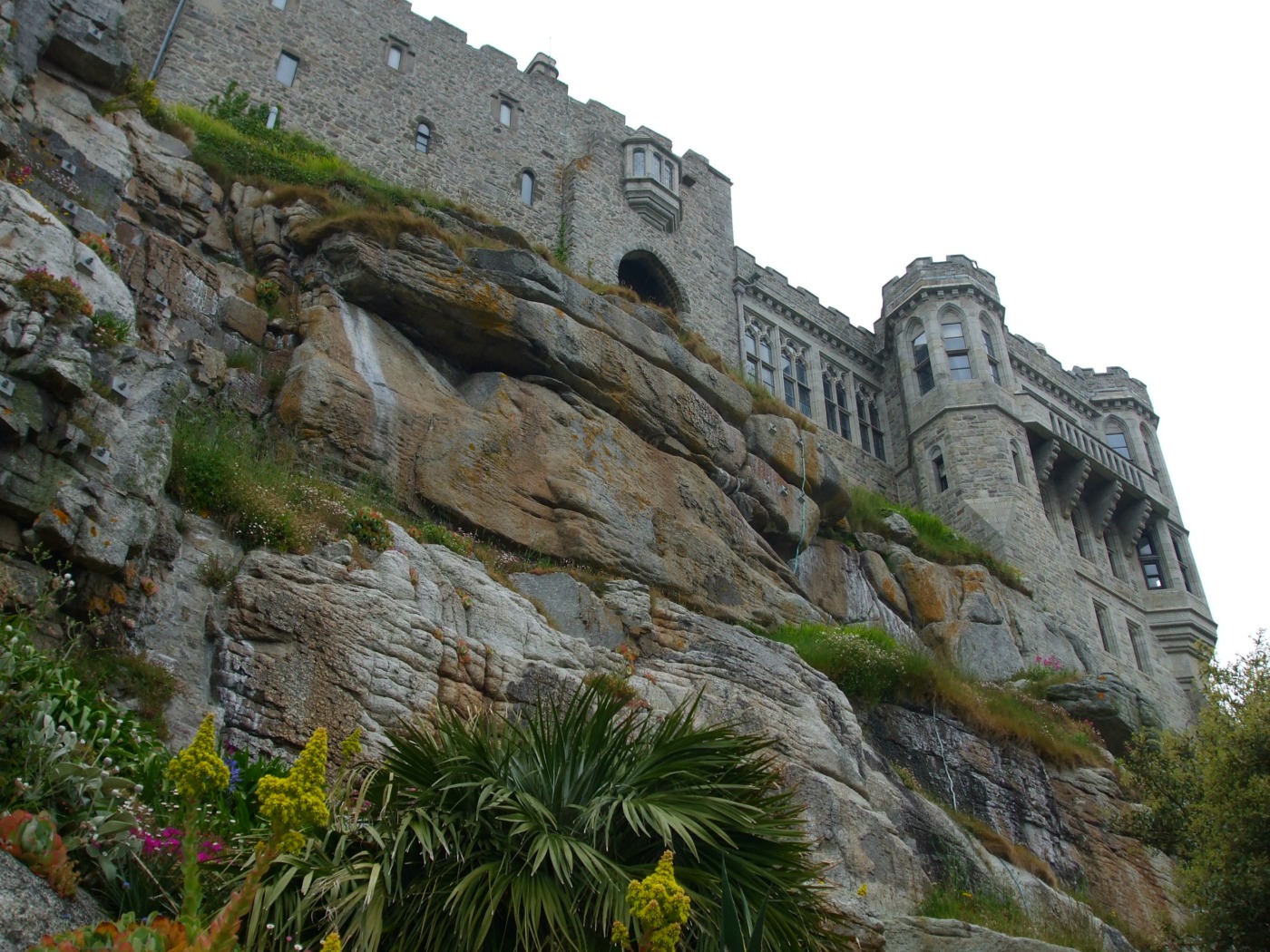
The waters of the Gulf Stream moderate the climate so that frosts are rare and the granite rocks of the cliffs act like a great radiator, absorbing heat during the day and releasing it at night:
Bare granite cliffs of the isle
This creates a micro climate in which a variety of plants flourish. Abundant blooms and exotic plants have thrived here since 1780: aloes, agapanthus, puya, agave, rosemary, cornilla and lavender – amongst a whole host of others – fill the gardens with texture, shape and colour. Winding paths and stone steps lead visitors on a wonderful journey of exploration along which cameras continuously click. As did ours.
So how did these unusual gardens come about?
As I mentioned in Part 1 of this post yesterday, the castle has been owned by the St Aubyn family since 1659. It is thought that, in 1780, the four Misses St Aubyn of that time initiated the building of the Walled Garden, a delightful and relatively sheltered space for the family to enjoy. Today it is positioned between the East and West Terraces, which were created during the Victorian and Edwardian periods. The gardens as we see them today were designed in 1987 by Michael Paul Harvey along with Lord St Levan, who died in 2013. (Lord Levan was grandfather to the current castle resident, James St Aubyn.) The development of the gardens are still under the guidance of Michael Paul Harvey.
These are a few more of the dozens of photos we took that day.
Naturally, all visitors are advised regarding the safety aspects of visiting the gardens. As it says on the leaflet, ‘A guide to the Gardens‘:
There are steep drops from the lawns down to the rocks below as well as significant drops within the garden. The paths and steps are steep, rocky and uneven and in some places there are no handrails…. Sensible footwear is essential…. Please see that children are supervised at all times… Please do not handle the plants or pick the flowers as some may be hazardous to health… Dogs are not allowed in the garden… People with limited mobility or significant health problems will find the terrain challenging…
Much of that information may seem like common sense to most people, but I think the warnings are excellent and an important reminder to those about to embark on a walk round these wonderful gardens.
There is so much more I could have said about Saint Michael’s Mount, as even two posts haven’t really done it justice. All I can say is that we enjoyed our visit immensely and learned a lot about this lovely isle.
On the third day of our week in Cornwall in June 2o16 we decided to visit Saint Michael’s Mount, which has been described as ‘the most famous of Cornwall’s landmarks’ (National Trust). I have to admit it’s a great place to visit. It’s a lovely walk up to the castle and there’s plenty to see inside it once you get there, with fabulous views out across Mount’s Bay from the roof terraces. The Church of St Michael and All Angels, built in 1135, also stands on the North Terrace. For visitors more interested in gardens, the terrace gardens that adorn the steep island slopes are a delight and full of colourful and exotic blooms.
From Newlyn (near Penzance) where we were staying we had a relatively short drive, compared to our drive up to Tintagel the previous day. That meant we could get there nice and early.
Wikipedia tells us that the Cornish name for St Michael’s Mount is Karrek Loos yn Koos, which means hoar rock in woodland, or literally the grey rock in a wood – an appropriate description for a granite crag that rises 221 feet above sea level (not including the buildings at the summit).Wikipedia also tells us that St Michael’s Mount is one of 43, unbridged, tidal islands that people can walk to around mainland Britain.
Located in Mount’s Bay, the isle is just 500 metres from the mainland and linked to the town of Marazion by a causeway which is passable between mid-tide and low-water. It is managed by the National Trust and the castle and chapel have been the home of the St Aubyn family since around 1650. The island also had a population of 35 in 2011. Part of the island was designated a SSSI (Site of Special Scientific Interest) in 1995 because of its geology.
We left the car at the car park in Marazion and headed along the beach path towards the causeway:
The car park at Marazion
Walking along the beach towards the Causeway
We had planned to walk across to the island, but if the tide had been in we’d have taken the boat. As it was, the tide was on the ebb, so we just had a short wait on the causeway until it went out. As to be expected, some people couldn’t resist paddling as the water became shallower but, not wanting to spend the rest of the morning in soggy jeans, we waited.
People wading across the Causeway before the tide was completely out.
Eventually, the tide ebbed and we approached the island.
The granite cobblestones/setts of the causeway continue along the pathway onto the island and up to the castle:
To greet visitors on the island are a number of buildings, including the Island Café…
… a couple of shops and of course, the loos. There is also a picnic area. This is a plan of the island, which can be enlarged by clicking on it: The black line from Point 9 (Ticket Office) is the pathway leading up to the castle:
There’s a lot of history to find out about on the island – from Neolithic and Bronze age times to the more recent medieval period, the Civil War in the mid 17th century and through Victorian times to the present day. It is possible that the isle may have been the site of a monastery in the 8th century, but we know that by the time of the Norman Conquest of 1066 it was in the possession of the monks of its sister isle in Normandy, Mont Saint Michel: another tidal island with a conical shape, similar, though smaller, to Mount Saint Michael:
The church and priory at St Michael’s Mount were built in the 12th century but the priory was destroyed by an earthquake of 1275 and rebuilt in the late 14th century. The priory’s association with the abbey at Mont St Michel ended in the 15th century during the war in France in the reign of Henry V. The priory was later given to the Abbess and Convent of Syon in Middlesex and the building still forms the heart of the castle today.
There is also some fascinating folklore and legend connected to the island, including that of an 18 foot giant called Cormoran who lived in a cave at the top of the rock with his ill-gotten treasures and terrorised the people.
The Giant Cormoran circa 1820, Source: Victorian chapbook. Author unknown. Public Domain
The first building we came to after leaving the ticket office at the start of our trek uphill was the Victorian Dairy:
Along the cobbled path towards the dairy.
The Victorian dairy. For 25 years until 1909, a small herd of Jersey cows were kept on the Mount to supply the isanders’ needs.
The next few photos were taken at various points on our way up to the top:
The beginning of the climb up to the castle
Granite cliffs along the route
Looking down at the harbour with Marazion across the bay
Granite outcrop
Lookout tower with views of Marazion
Cannons along defensive wall
Inside the house there are several rooms to view, all with lots of history behind them. The Wars of the Roses and the Civil War feature strongly but there are pieces of furniture and a whole host of artefacts from various periods. I can’t possibly do justice to the many interesting pieces or the different rooms here so I’ll just share a few of the photos. The coat of arms is in the Entrance Hall.
The St Aubyn coat of arms in the entrance hall
Arms displayed in the entrance hall
Chevy Chase, originally the refectory for the priory and still a dining room for the family.
Chevy Chase ceiling. The name, Chevy Chase, refers to the hunting scenes in the plaster frieze
The library
The library
Civil War armour
Grandfather clock. A tidal clock in St John’s Room
I’ll finish this part of the post with a few photos taken on the North Terrace as we came out of the castle…
Along the North Terrace
Entrance to the Church
The Church of St Michael and All Angels
Eroded lion on the North Terrace
Harbour, Causeway and Marazion from the North Terrace
… and these from inside the Church of St Michael and All Angels:
This slideshow requires JavaScript.
I’ll share some photos of the exotic terrace gardens in another post later on.
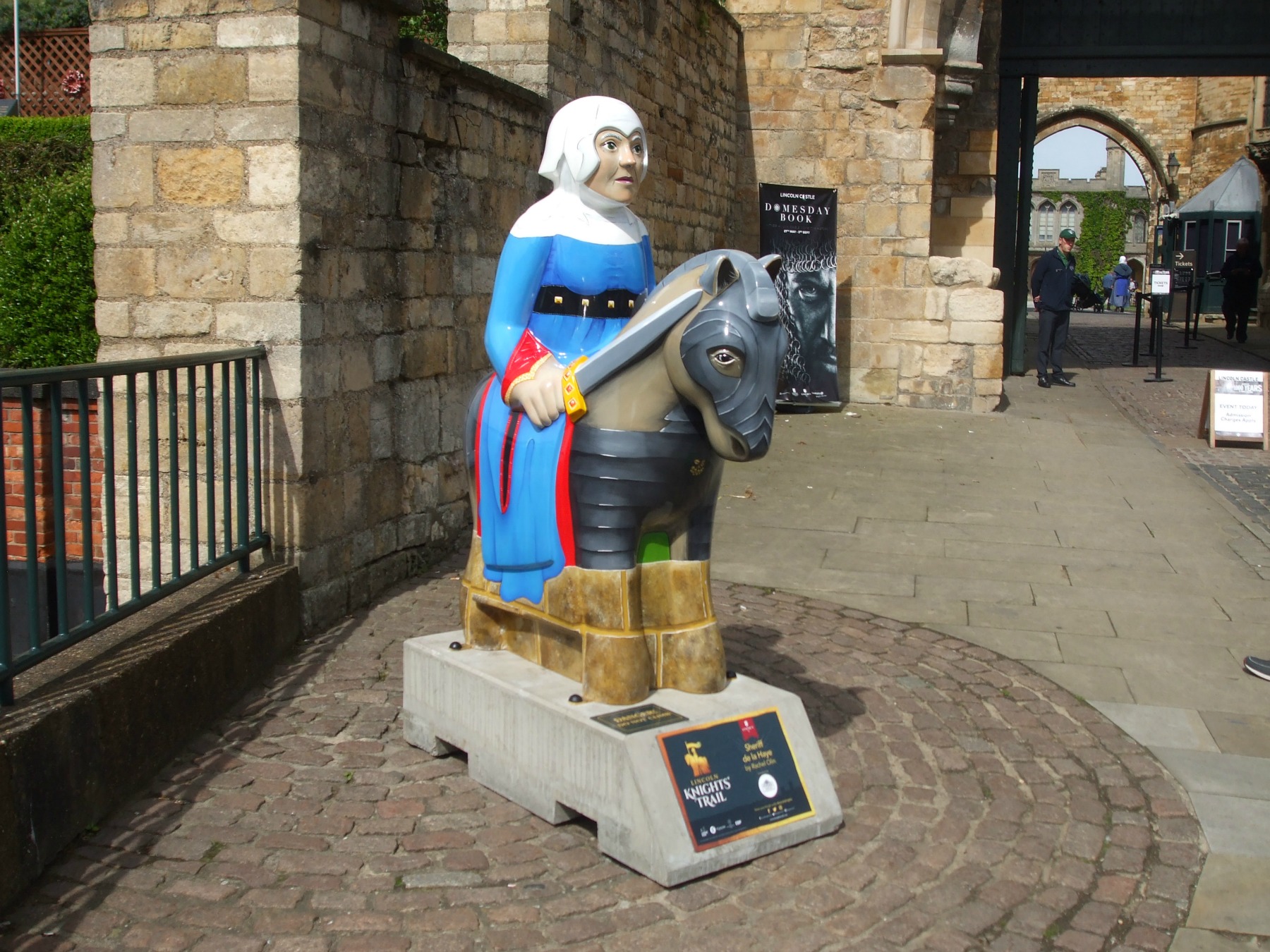
On Sunday we headed into Lincoln to finish photographing the 37 models of mounted knights displayed around central areas of the city for people to find. The activity is primarily aimed at children and is basically the same idea as that of the Barons’ Trail of 2015. Participants collect an entry form and location map from the Information Centre near the castle. On locating each knight they must examine it to find the hidden green shield and identify the word written on it from the key given with the map. Completed entry forms are returned to the Information Centre in exchange for a prize. With the Barons’ Trail, the prize was a bag of chocolate ‘coins’. On this occasion the prize is a badge and a voucher to buy a copy of the specially commissioned book about the Battle of Lincoln for £1.50 instead of £3.50.
Well, needless to say, we didn’t bother looking for hidden shields but we saw lots of children enjoying the task:
The Knight’s Trail is part of the celebrations of the 800th anniversaries of two events that took place in 1217: the Battle of Lincoln Fair and the Sealing of the Charter of the Forest by the nine-year-old king, Henry III (or more likely, his regent William Marshal). This hugely important charter is currently on display with the Magna Carta at the castle.
The Trail is a Wild in Art event and has been organised by Lincoln BIG (Business Improvement Group) in support of the Nomad Trust, a charity that “provides welfare services in the city of Lincoln for those who are homeless or otherwise in need”. The event is sponsored by different businesses and concerns and many of the knights are designed by local artists. Later this year the knights will be sold at auction to raise money for the Nomad Trust.
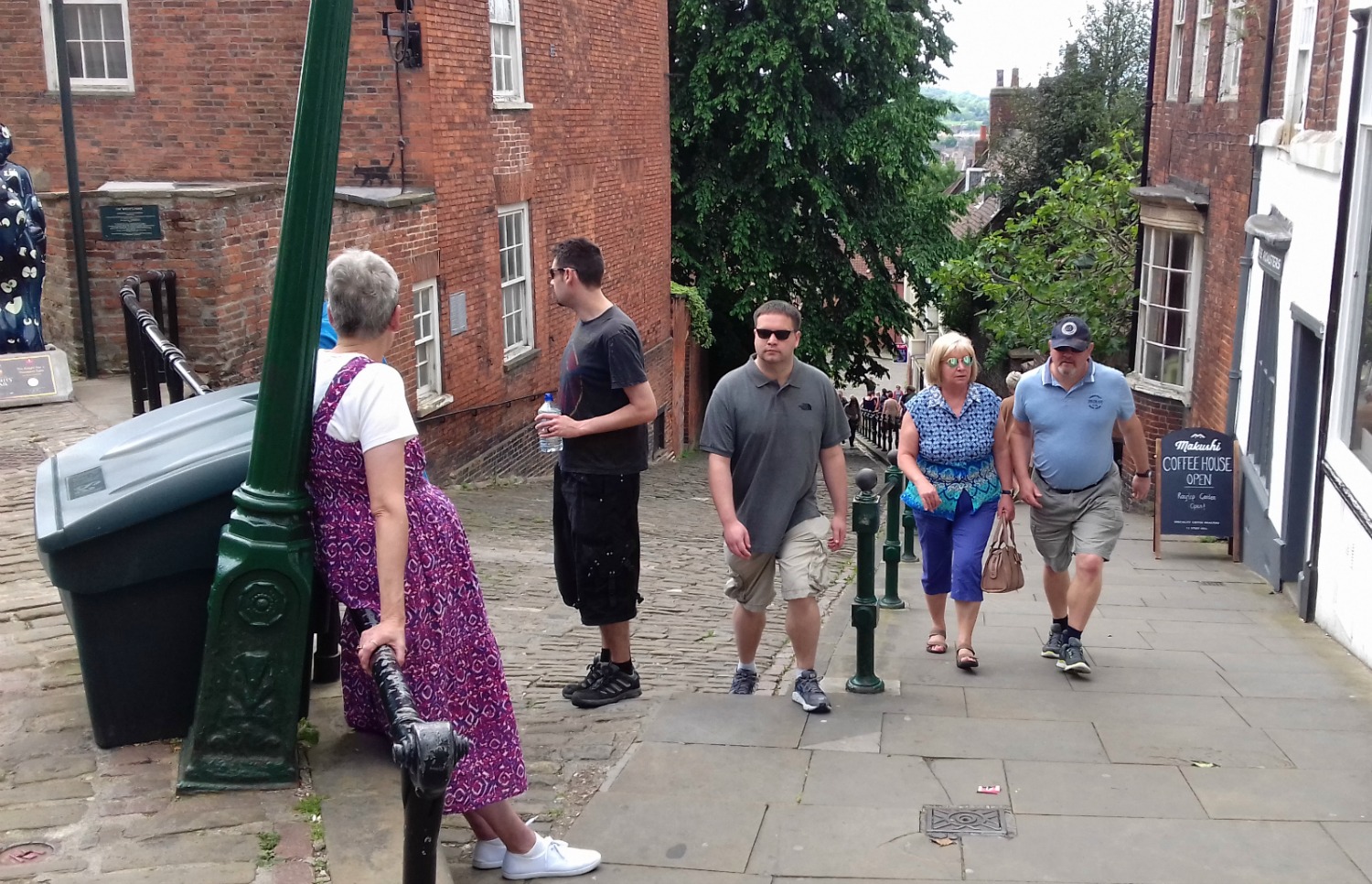
The knights are placed in both uphill and downhill locations, which – if the task is to be completed in one go – requires a nice, invigorating walk up Steep Hill. In fact, a few of the knights are along Steep Hill. This hill may not look too steep in photos, but it is a fairly lengthy hill and I’ve seen lots of people stopping, out of breath and in need of a rest.
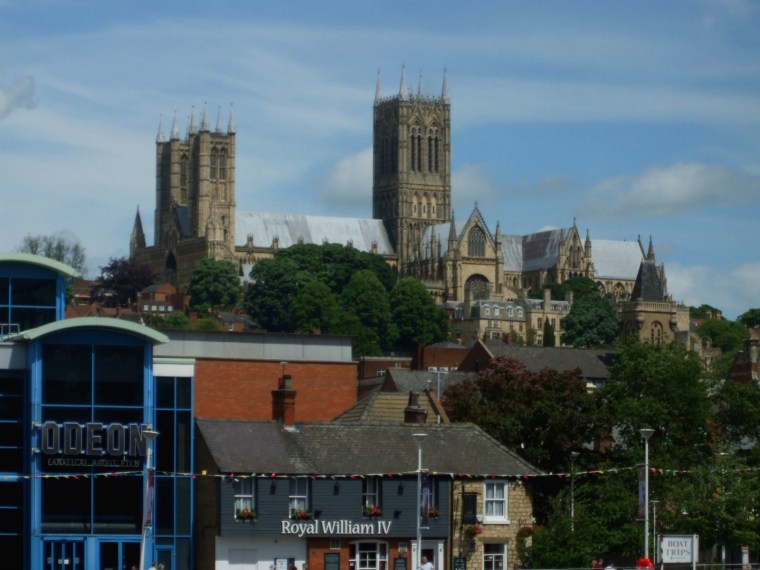
Lincoln is a city in two distinct parts: uphill and downhill. My first photo of this post shows a view from downhill Lincoln towards the cathedral uphill. The following photo is of the Brayford Pool, which is downhill (around which a few knights were lurking) with some of the university buildings in the background. So these knights were not exactly all in a cluster:
The following gallery shows the 35 knights just waiting to be found:
The missing two are numbers 10 – the Lincoln City Knight (referring to Lincoln City Football Club) – and 37 (the Poet Laureate Knight, which is a miniature belonging to the University of Lincoln and is housed in the Uni’s Minerva Building). These two extras are simply classed as Bonus Knights.
Knight 10, the Lincoln City Knight
Knight 37, the miniature Poet Laureate Knight
Close up of Poet Laureate Knight
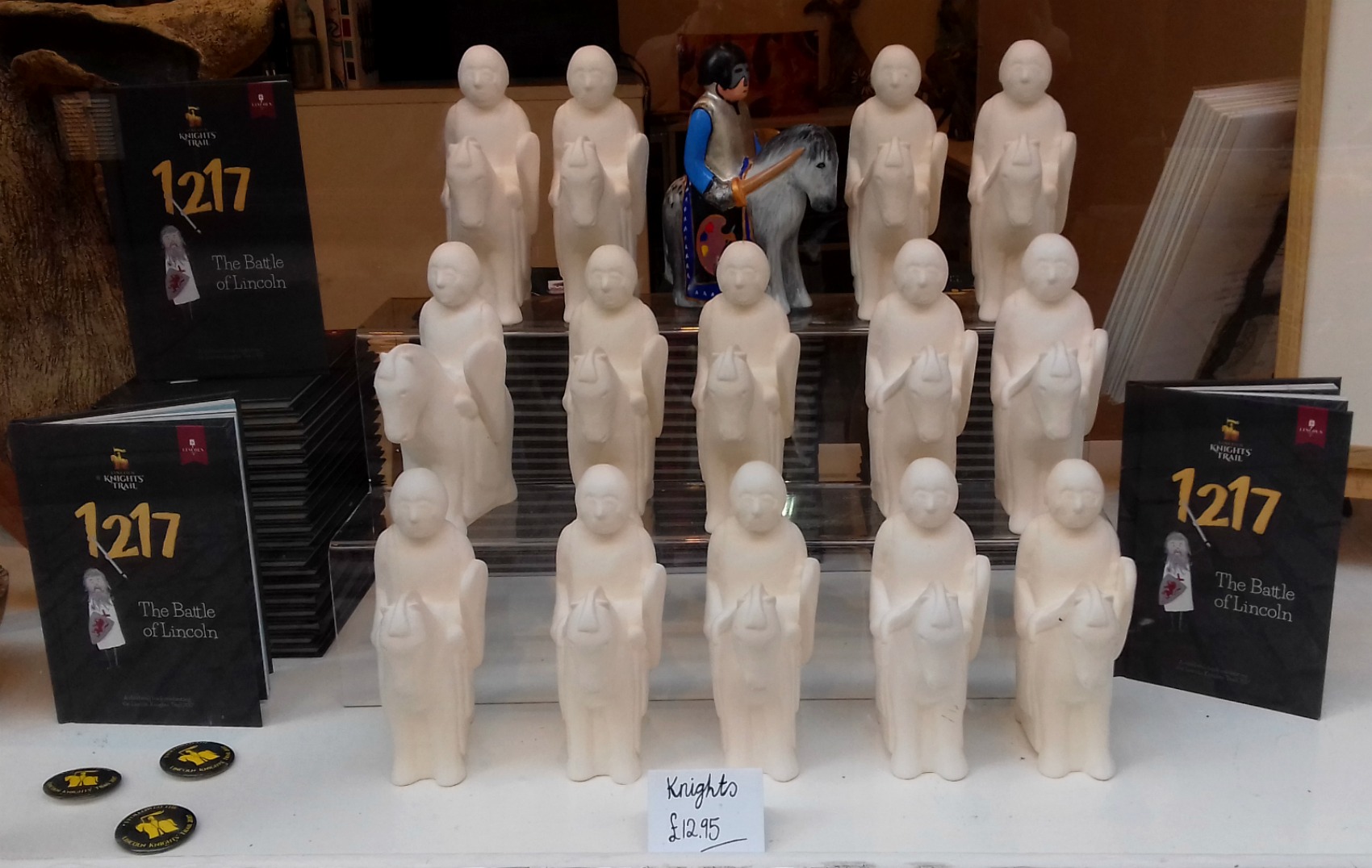
As with the Barons’ Trail, miniature knights can be purchased for people to decorate themselves. We noticed a few already painted and displayed in shop windows.
It should be an interesting and busy summer around Lincoln. There are likely to be a lot more visitors than usual, especially during the time that the Charter of the Forest is displayed at the castle. I don’t think local businesses will complain a great deal…
To our eldest daughter, June is the loveliest month of the year. I’m inclined to agree with her – even though I don’t have a birthday this month as she does. But, to be fair, she made that comment taking lots of things into consideration. June is a very lovely month, so I decided to write a post about it. To start with here’s a sweet little poem, written by Nathaniel Parker Wills:
It is the month of June The month of leaves and roses When pleasant sights salute the eyes And pleasant scents the noses.
Well that sums up a lot about this month, but I’d like to share a few facts about June that I found of interest. (There are dozens more, of course!)
June marks the beginning of summer in the Northern Hemisphere. In the Southern Hemisphere it is the equivalent of the north’s December.
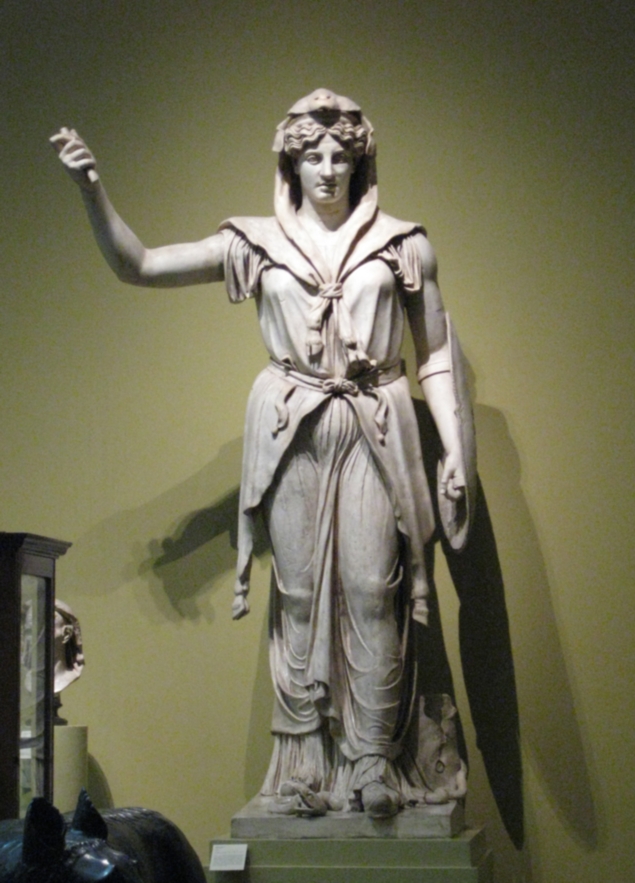
The month is named after the Roman goddess, Juno, wife of Jupiter and goddess of marriage. Hence, June was seen as the perfect month to get married:
Roman statue Juno Sospita, Author: Shakko, Creative Commons.
June is one of the four months with a length of 30 days. The other three are September, April and November.
June is the month with the longest daylight hours of the year.
June’s birthstones are Alexandrite, the Moonstone and Pearl:
Alexandrite Step Cushion 26.75 cts Author: User: at en Wikipedia. Creative Commons
The summer solstice and longest day is June 21st in the Northern Hemisphere (December 21st in the Southern Hemisphere). Many festivals and celebrations are associated with this date worldwide. In the UK, Stonehenge plays a big part in the Midsummer celebrations.
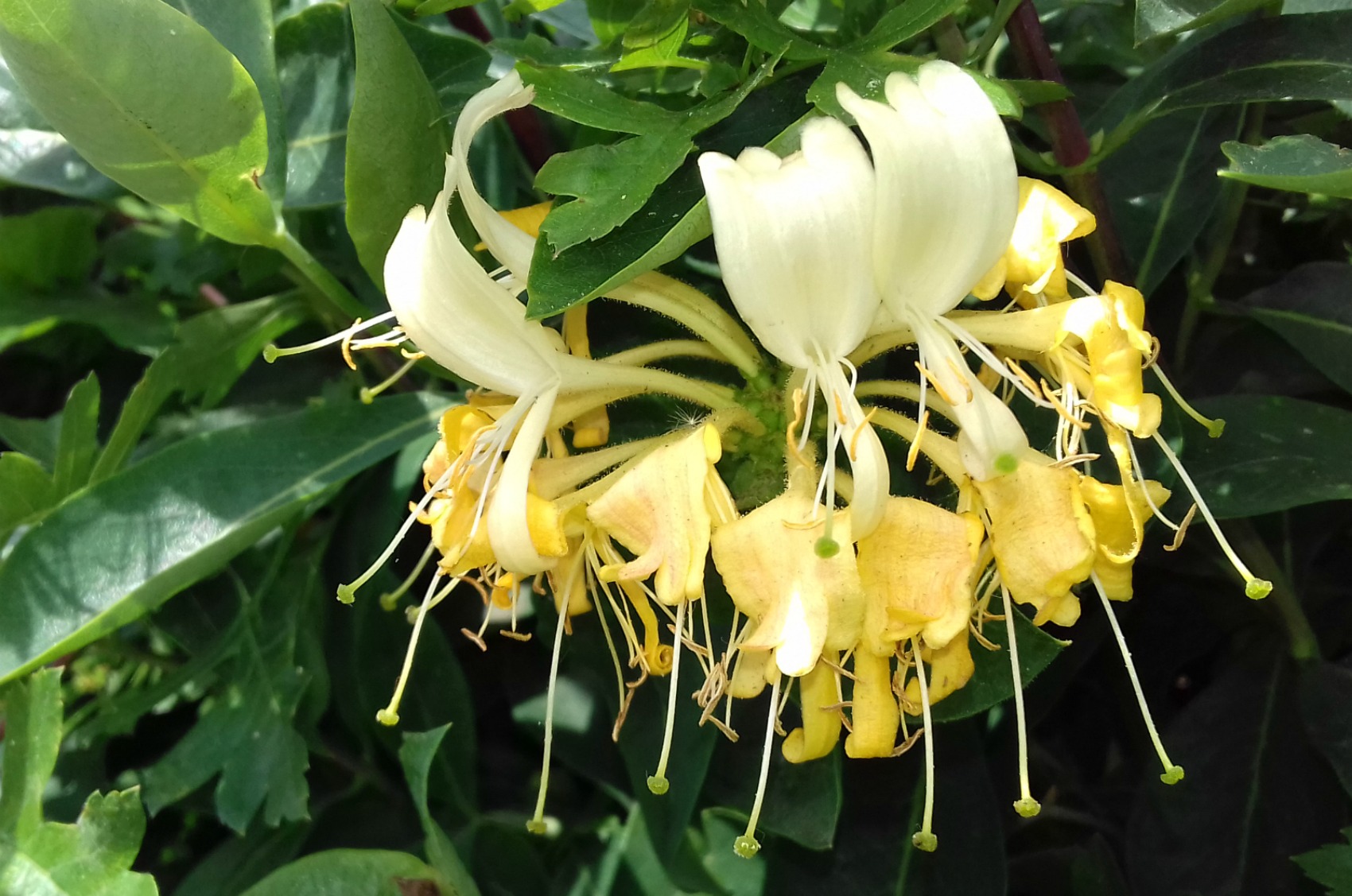
June’s birth flowers are the honeysuckle and the rose – both of which I’ve shown above – but here’s a nice quote from Robert Burns: Oh my luve’s like a red, red rose, That’s newly sprung in June...
June is Gay and Lesbian Pride Month.
Gemini and Cancer are the astrological signs for June. Birthdays from June 1-2o are under the sign of Gemini while June 21-30 birthdays fall under the sign of Cancer:
Image is a reproduction from a medieval book of astrology. Public Domain
Cancer by Osman. Public Domain
Children’s Day in Britain is June 15th.
Fathers’ Day is in June. This year (2017) it falls on Sunday, June 18 in the UK.
Antony and Cleopatra and Henry IV Part 1 are the only Shakespeare plays that mention June
June was the 39th most popular name for a baby girl in 1925 in English-speaking countries but it dropped out of the top thousand in 1986. In the US, June was the most popular name for girls in 2009.
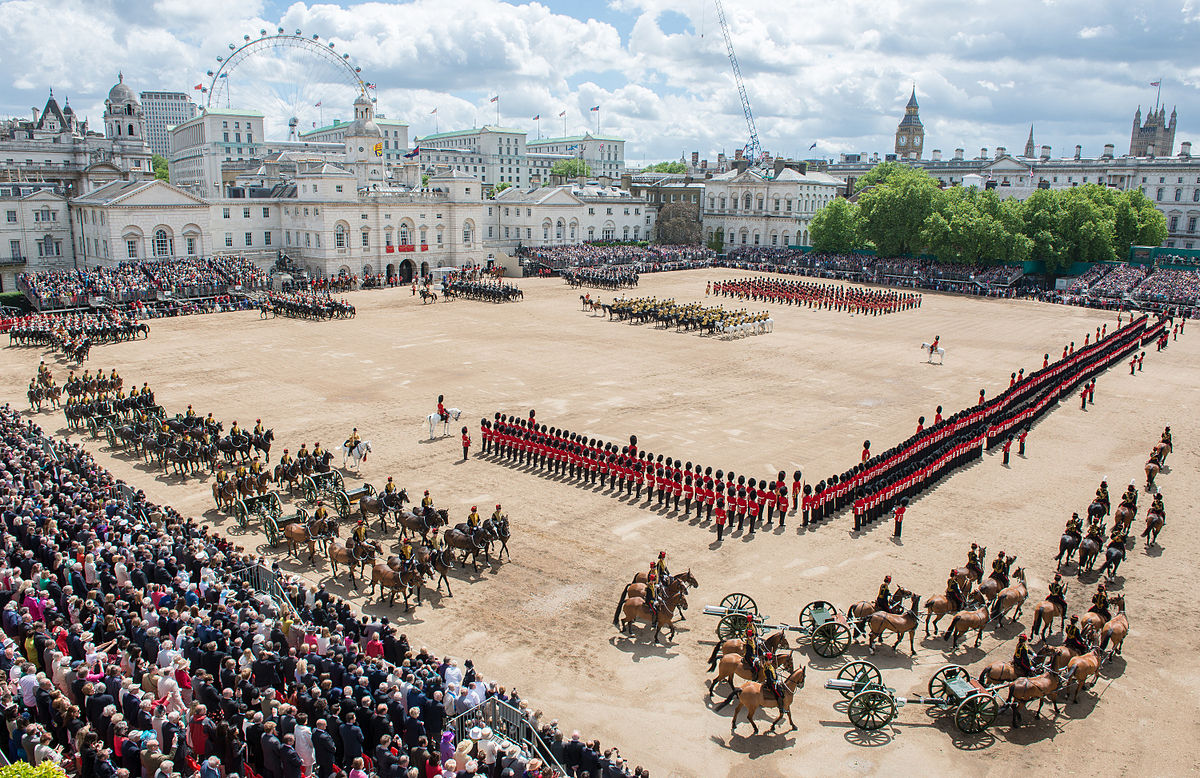
In the UK, the Queen’s birthday is June 13th, which is marked by the Trooping the Colours. This ceremony has marked the sovereign’s birthday since 1748.
The Queen’s Birthday Parade, also known as Trooping the Colours. Horse guard’s Parade. London 2013. Author: Corporal Paul Shaw/MOD. Open Government Licence v 1.0
June is National Smiles Month in the UK:
June is a month when well dressing is prominent in towns and villages in Derbyshire and Staffordshire in the UK. This age-old custom draws many visitors, as the wells and springs look very beautiful decorated with flowers and plants – each with its own theme(s).
Well Dressing at Tissington. Author: User: Whaley Tim Creative Commons
Well, I think that’s enough facts…
Our garden is gradually losing the look of spring. The lilacs have died off and daffodils and other spring bulbs have long since disappeared. Instead, we have roses! June is definitely the month of roses here, although it’s a little too early for our Royal William and other standards. The climbers and ramblers are doing well, though. In fact, some have been flowering since mid-May and are looking rather worse for wear now:
The meadows and lanes around us are also taking on a different look, Dandelions have almost all gone and other species have taken their place:
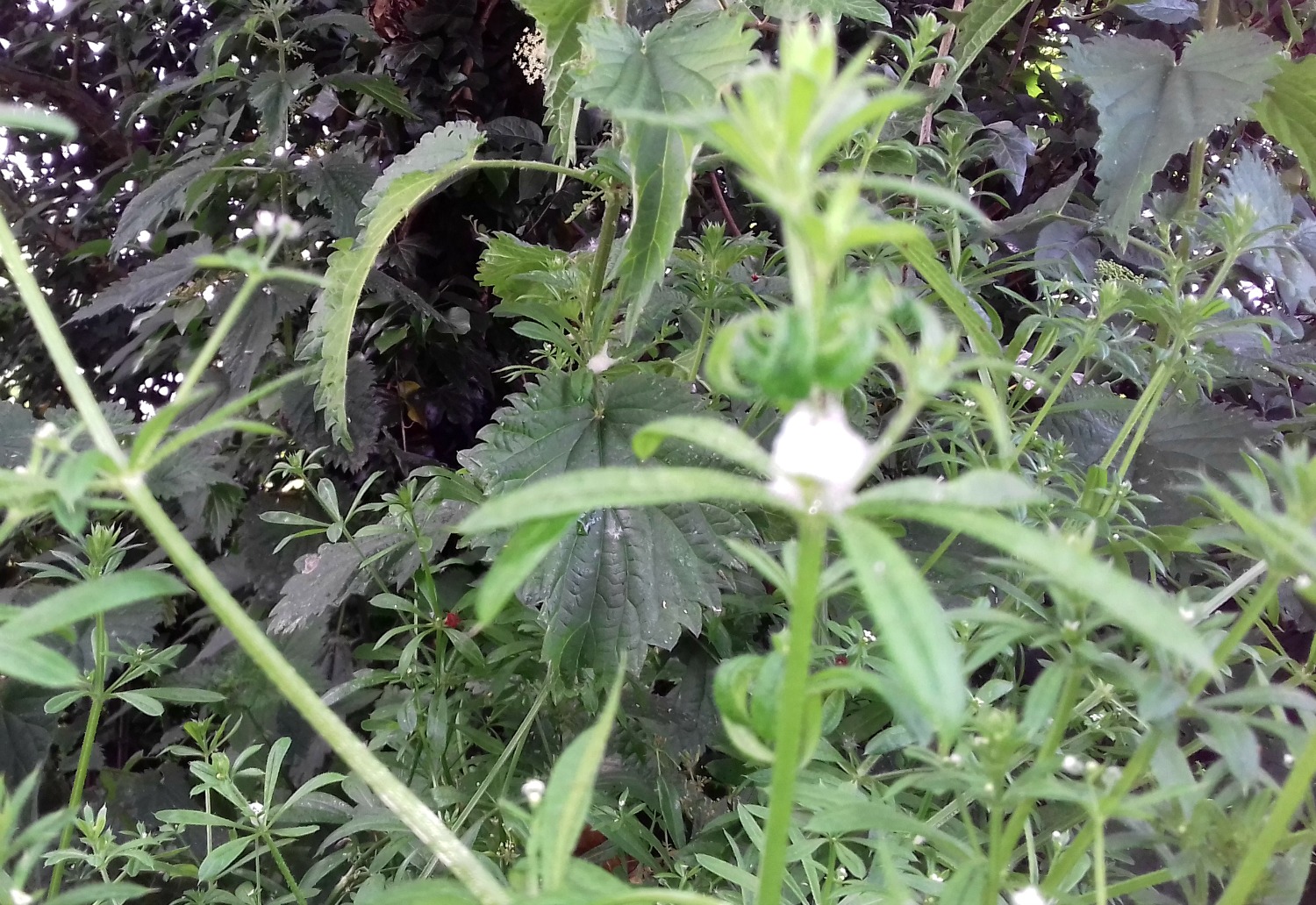
Around the lanes today I also came across a little creature who thought he was safely hidden in his strange little nest. He probably is hidden from any predators, but I knew exactly what I was looking for – and I meant him no harm. This little nymph can be found in a frothy substance we call cuckoo spit:
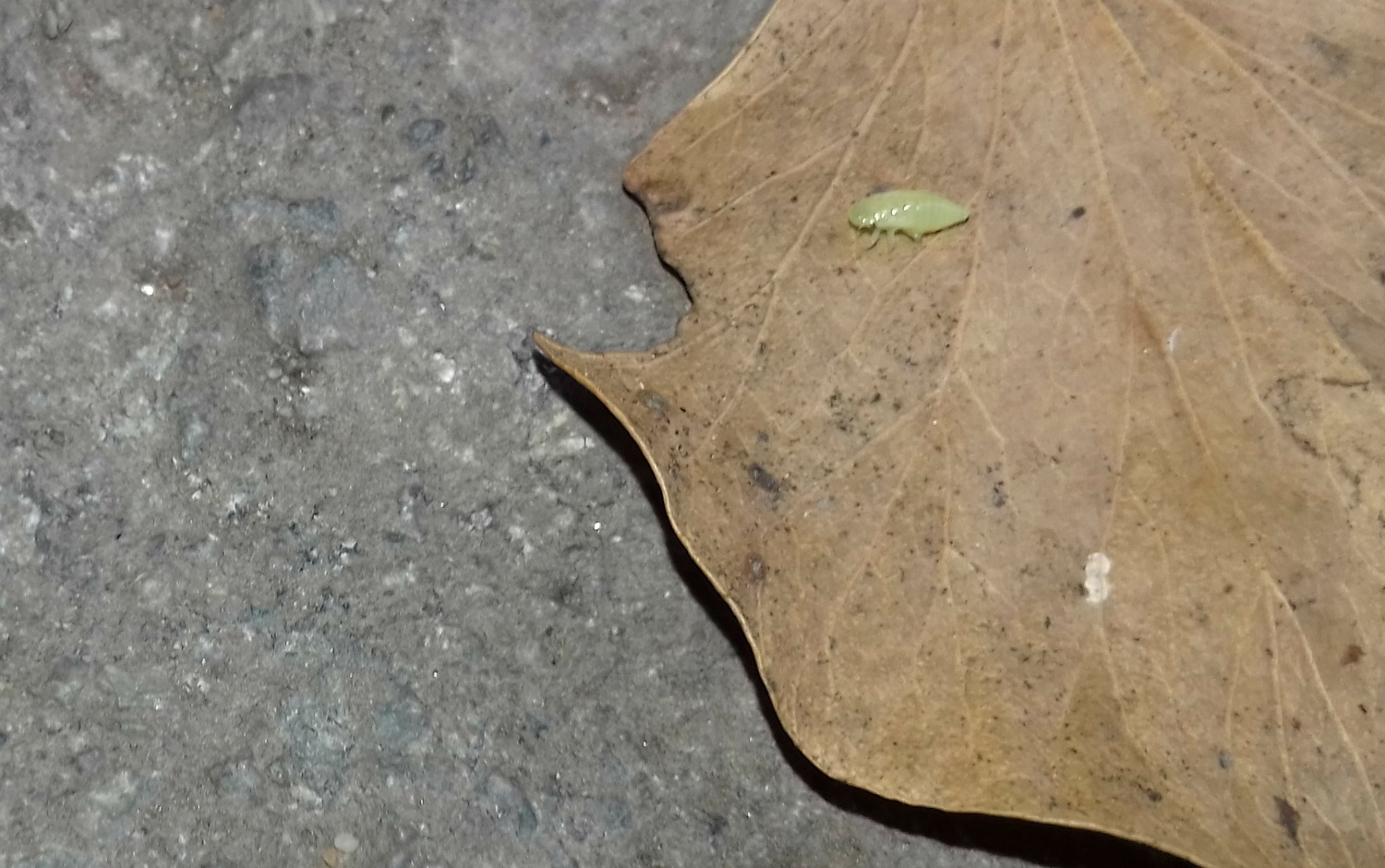
The name, cuckoo spit, has nothing to do with the cuckoo bird, other than the fact that cuckoos are usually around at this time. The little creature that nestles inside this foam-like substance is a froghopper – the nymphal stage of the spittlebug. They’re so named because, although tiny, they are rather ‘frog-like’. I retrieved one from its spittle and attempted to photograph it on an old leaf:
The photo is quite useless in showing the shape of this little thing. so here’s one from good old Wiki. Definitely ‘frog-like’…
A spittlebug nymph on a blade of grass on the banks of the East Lyn River in Exmoor National Park, Devon, England. Author: Diliff. Creative Commons
And here are a few more quotes about June:
There are two seasons in Scotland: June and winter. – Billy Connolly.
If a June night could talk it would probably boast it invented romance. – Bernard Williams.
It is better to be a young June bug than an old bird of paradise – Mark Twain (I couldn’t agree more. Mr Twain!)
To finish, here’s a video from YouTube, uploaded by cendrillon325 – which, hopefully, makes sense of my post’s title. It’s a song from the Rodger’s and Hammerstein 1956 film Carousel – aptly titled, June is Bustin’ Out all Over:
The Second Battle of Lincoln – or the Battle of Lincoln Fair– took place during the First Barons’ War on the 20th May 1217 at Lincoln Castle in Lincolnshire, England. As 2017 marks the battle’s 800th anniversary, it is being commemorated by reenactments of the battle itself together with accompanying activities for locals and visitors to enjoy. One of these extra attractions is the Knights’ Trail, which involves people finding 37 very colourfully painted models of mounted knights, all placed at prominent spots around central areas of the city.
Last Sunday (21st May) we went along to have a look at preparations for the battle and a general potter about at the castle. This Sunday (28th May) we headed off to watch the re-enactments of the different engagements involved. Needless to say the castle and surrounding areas were packed, particularly in the afternoon.
This was understandable for several reasons. Firstly, it was Bank Holiday weekend and the start of the half-term break for schools. Consequently, many families were out and about keeping children entertained as they usually are at such times. Secondly, people came to Lincoln over this particular weekend because the Domesday Book (compiled 1085-86) and Charter of the Forest (1217) were both on display along with the Magna Carta – which is resident there anyway, on loan from Lincoln Cathedral – inside the Old Prison which is in the castle bailey:
Both are incredibly important and precious documents, and although no photography was allowed, it was still wonderful to see them. The two documents will be in Lincoln throughout the summer.
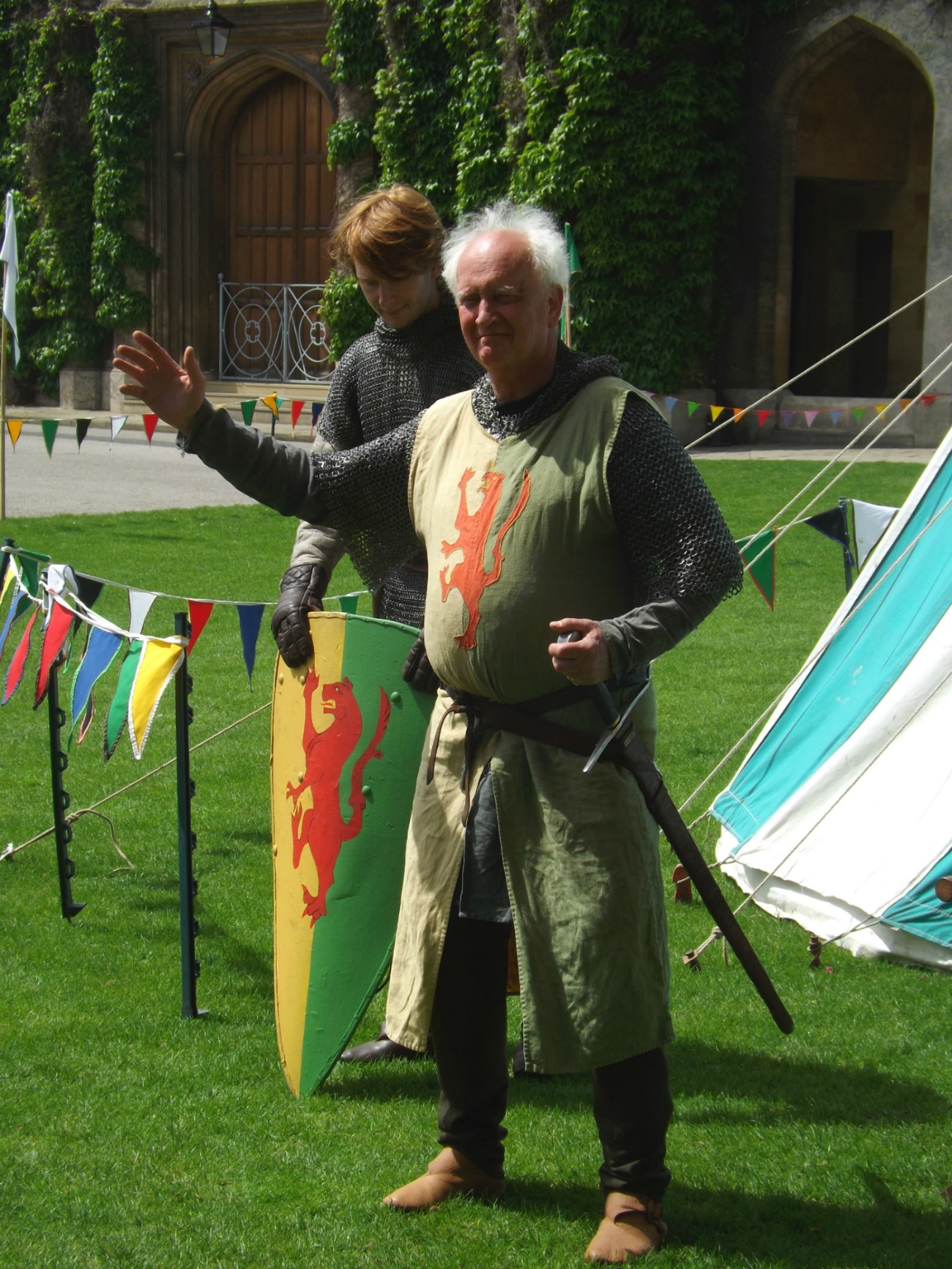
The weather was pleasant with bursts of sunshine, and everyone seemed to be having a great time. We got there around 10.30 am and had a walk round the bailey, generally ‘having a look’ at the encampment of the reenactors and various items and activities going on before the first part of the battle began. These are a few photos from around the camp. Lots of knights were about at this point, too:
The events leading up to this battle are very much linked to King John, who had died the previous year (October 1216). John had been a very unpopular king for many reasons, most of which were based on his inability to rule wisely, as well as his questionable personality traits. When he died he left his son as king – the nine-year-old Henry – with the formidable William Marshal, the earl of Pembroke, as his regent.
Some of the barons who had rebelled against John during his reign and forced him to sign/seal the Magna Carta, had already taken steps to put the French Prince Louis (the future Louis VIII) on the English throne. On John’s death, a few of the barons returned to the loyalist side whilst others pushed on with their intentions of crowning Louis in order to stop John’s son from ruling. The kingdom was deeply divided over this.
Twenty-year-old Louis and his French armies had been in England since May 1216 and by May 1217, aided by the rebel barons, controlled half the country: only Lincoln and Dover castles had not surrendered. At the time of the battle at Lincoln Castle, the city itself was occupied by forces fighting for Louis, led by Thomas, the Comte du Perche. But the castle was steadfast. Lady Nicola de la Haye, the castellian, remained true to the royalist cause and was determined to keep this castle, with its strategic position, out of rebel hands.
Constable of Lincoln Castle, Lady Nicola de la Haye.
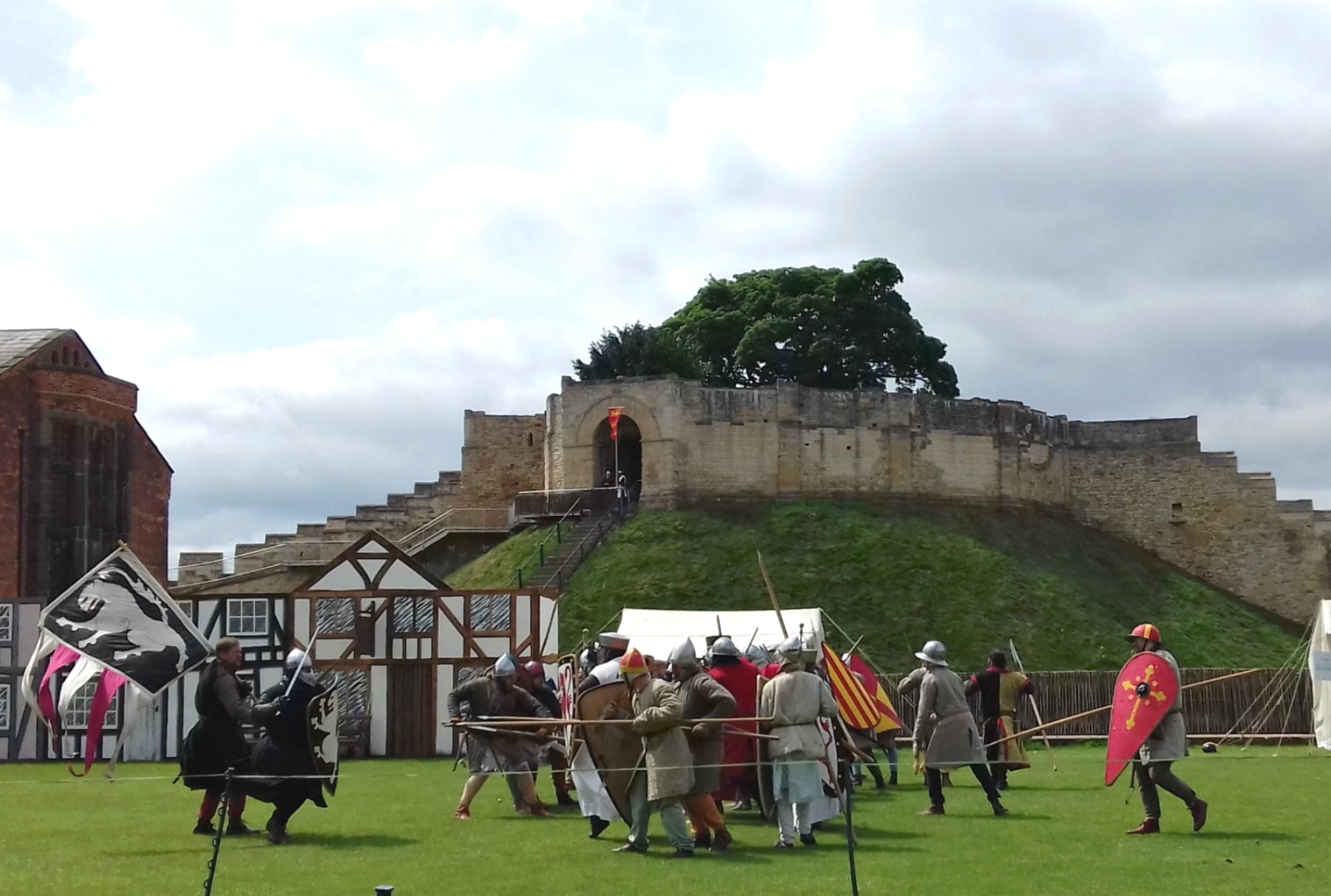
During the day, we watched three different events that took place at Lincoln. The first showed the arrival of the French at Lincoln and their attack on English defenders beneath the castle walls. The English are pushed back and those still alive flee up to the safety of the castle. The Comte du Perche, conspicuous with his shield displaying three chevrons, warns his men to be nice to the citizens of the city and pay for all their food and drink. It’s important to keep the people ‘on their side’!
The second reenactment showed the attack on the Lucy Tower/Lincoln Castle using two different siege engines. One of these was the perrier – one of the least complicated of medieval siege engines It consisted of a simple frame with a huge 17 foot throwing arm with a sling. Some perriers are recorded as needing as many as 16 men to pull the ropes. It was the forerunner of the trebuchet, which has a large swinging arm to hurl missiles at the enemy and a counterweight to swing the arm. This very short clip shows the two siege engines being used on the day. The first we see is the trebuchet:
The Comte du Perche sees the bombardment as a great success, as parts of the castle walls begin to crumble.
The third engagement – the actual Battle of Lincoln Fair – followed the arrival of reinforcements for the English, led by the formidable, 70-year-old William Marshal, the earl of Pembroke and regent to the young King Henry III. This was him as he delivered his his speech about his life and duties to the Crown to the crowds earlier in the day:
Marshal had roused his loyal barons from across the country and ridden to Lincoln. The arrival of his army, together with the steadfast hold on Lincoln Castle by Lady Nicola, proved to be decisive factors in the defeat of the rebels – and the end of their attempt to put a French prince on the English throne.
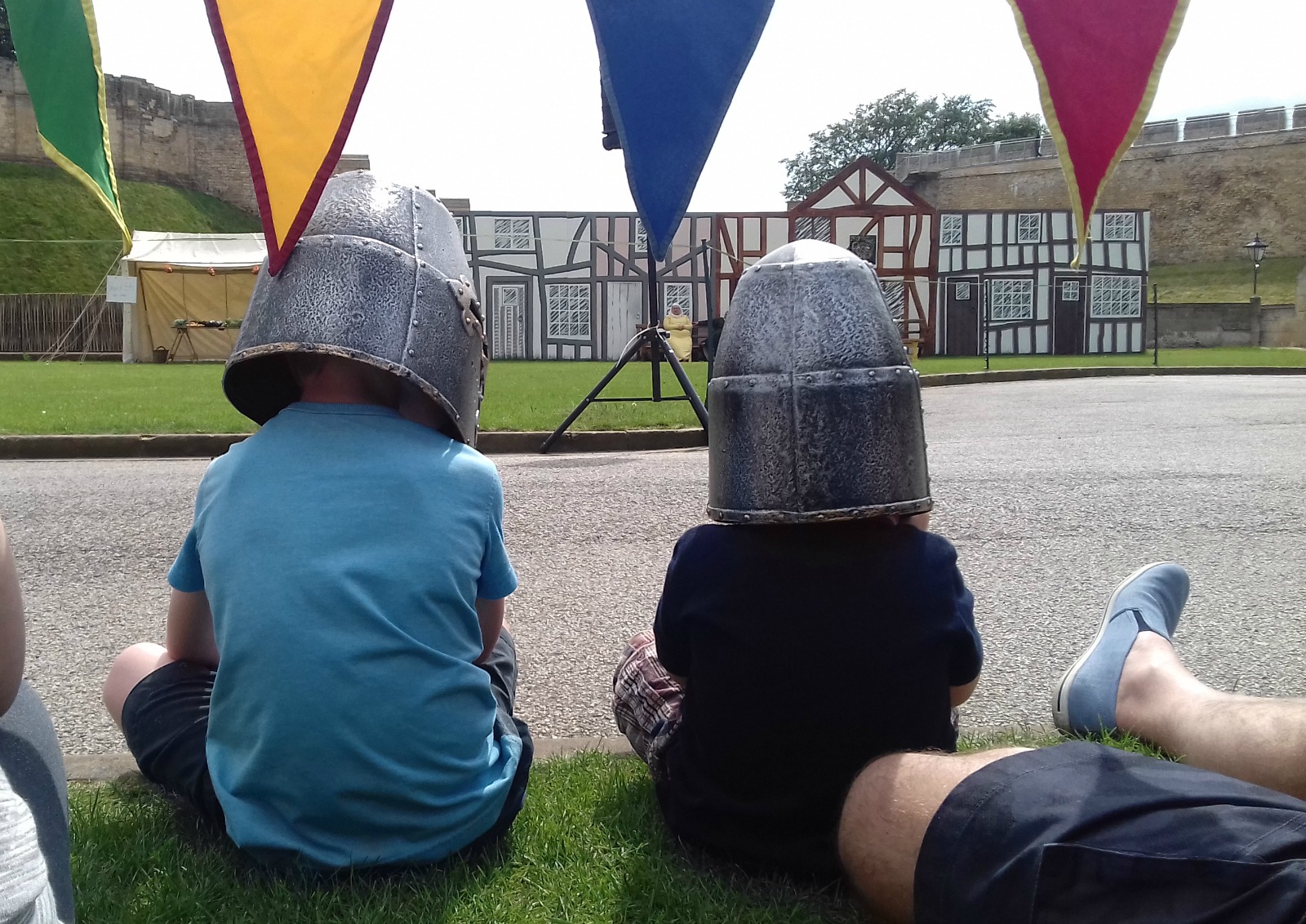
We attempted several videos of this battle but, unfortunately, there were so many spectators (and we got there too late after lunch!) to grab a good spot for photography. I managed to squat on the grass near the front – until these to two delightful little boys with buckets on their heads – in reality, replica battle helms – decided to take the space in front of me:
I eventually managed a few photos during this battle, some of which show Lady Nicola taking stock of events from the gateway of the Lucy Tower:
Nick managed to film part of the battle, before people walked in front of him. It’s not too wonderful ‘ He missed Marshals’ rallying speech to his army, and the film had to be cut before the end, but it gives a general idea of events. The English come in from the left on this one, and William Marshal is on horseback.
Following this short clip, English soldiers come up behind the French. Caught between two attacking armies, the rebels are soon overwhelmed. Thomas, Comte du Perche, is shown being cut down in the arena – contrary to the 13th century drawing by Matthew Paris which shows him being shot down by a crossbowman as he fled from the castle. But, whatever happened, the comte obviously died that day.
Following the battle, Marshal’s soldiers ransacked the city that had welcomed and supported the French. Most Lincoln people had hated King John and welcomed the possibility of a new king from France. Marshal’s army used that as an excuse to pillage at will as they celebrated their triumph over the combined armies of the French and rebel English barons.
And thus we have the name of The Battle of Lincoln Fair: a celebratory post-battle ‘free for all’ for William Marshal’s victorious army.
I’ve written a few posts about visits and events connected to Lincoln Castle over the past couple of years, including the wonderful, German-style Christmas Market held annually in the castle grounds. But perhaps the most important events of recent years were in 2015, which focused on the 800 year anniversary of the signing of the Magna Carta by King John at Runneymede in 1215.
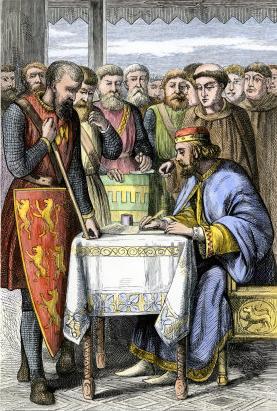
19th century coloured wood engraving of king John signing the Magna Carta. Public Domain
That Lincoln should become so involved with the Magna Carta anniversary is understandable, since one of only four of the remaining original documents from Runneymede is held at Lincoln Castle – on loan from Lincoln Cathedral. Two are held at the British Library and one at Salisbury Cathedral.
The Magna Carta anniversary involved lots of events throughout the summer in Lincoln, including the Barons’ Trail and the amazing sand sculptures displayed in the castle bailey. They all did wonders for tourism in the city and gave everything a very holiday feel.
This year, Lincoln is celebrating another anniversary, that of the Battle of Lincoln Fair (also known as the Second Battle of Lincoln) which took place in and around Lincoln Castle in 1217. This event is also linked to the infamous King John, even though he’d died the previous year.
This event is being held over two separate weekends and we went along to the first part yesterday, Sunday May 21. This one was held in the castle bailey and presented the preparations for battle. The second part, the actual reenactment of the battle itself, will be next weekend from Saturday to Monday, May 27-29 (Bank Holiday weekend here in the UK).
As with the Barons’ Trail of 2015, this anniversary is made fun for the city and its many visitors by having a Knights’ Trail throughout the central areas of the city. It’s a great activity for kiddies (and adults!) to hunt all 37 of the knights out. The knights are already in place, and we started photographing them yesterday. I hope to do a post about them all soon. The photo of Nicola de la Haye (or Nicholaa de la Haye, according to some sources) at the top of this post is one of them.
I don’t intend to do a full post about Lincoln Castle itself here: that’s set for a future date. But I’ll just say a little about it before I show photos of the event.
Lincoln Castle was built in 1068 on the orders of William the Conquerer. It stand on the site of the Roman fortress and settlement of Lindum Colonia (which dates from around AD60) in ‘uphill Lincoln’. This elevated position ensures the castle has commanding views of the surrounding countryside and can also be seen for miles – as can the nearby Cathedral. It is probable that, prior to the Roman fort, a Celtic settlement once occupied the site, which I’ll discuss another time.
The castle at Lincoln was one of the finest Norman castles in the country. It consists of an outer curtain wall (with an excellent Wall Walk along the top) along which are two gates – the East and West Gates, the former having a barbican, or fortified entrance. Three towers stand along the walls, two of them built on top of mottes (mounds or small hills, often man-made for the purpose). The two towers sitting on mottes are the Lucy Tower and the Observatory Tower, the one without a motte is Cobb Hall, at the north-east corner of the wall.
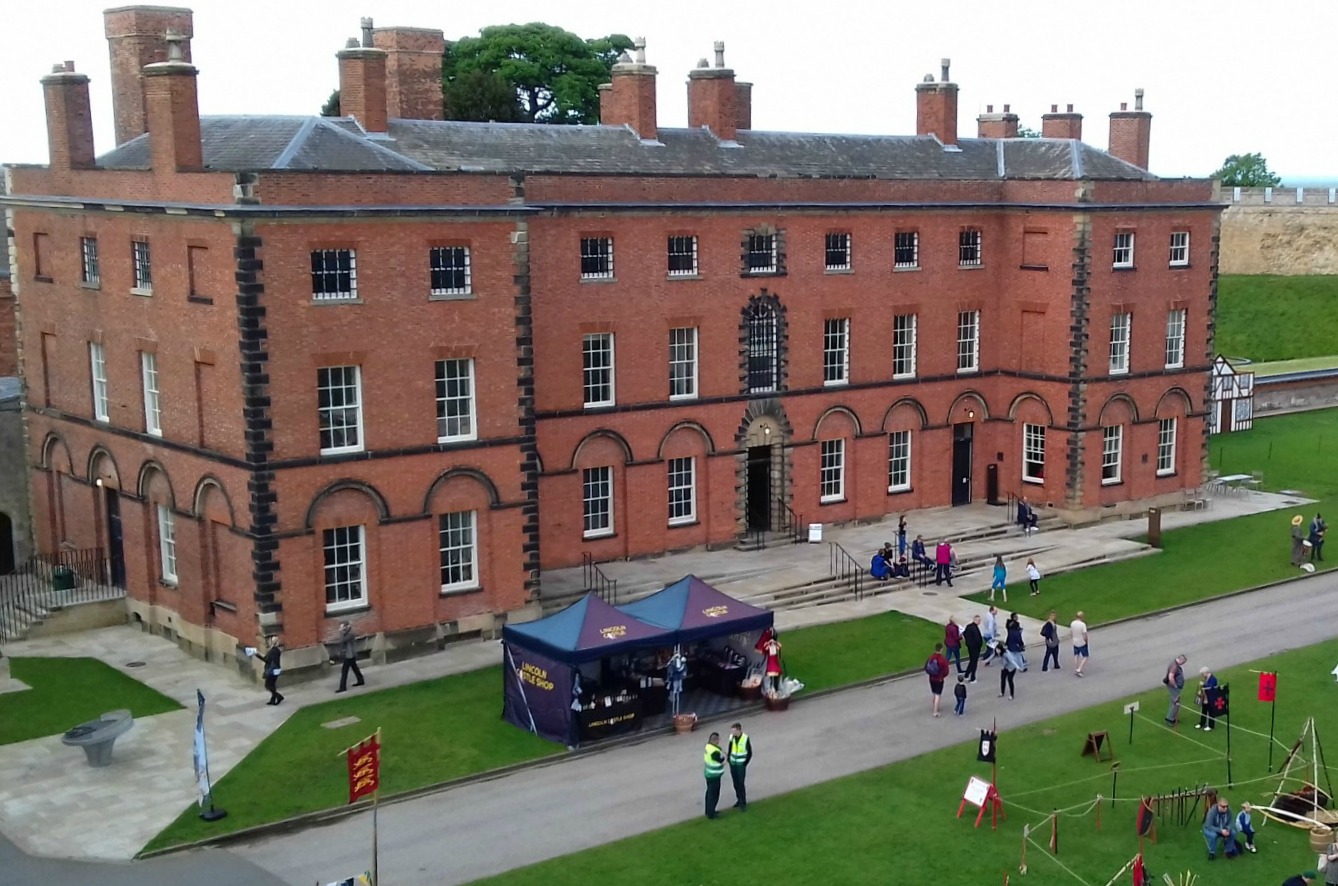
Inside the curtain wall is a large bailey (courtyard) in which there are three buildings of more recent origins. The first part of the Old Prison dates from 1788 and was completed in 1848. The Court House, which is still used today, dates from 1826, and the Heritage Skills Centre is a real baby, having only been officially opened in 2013. It’s the only new building within the castle walls for 150 years. It lies immediately behind the Law Courts:
Here are a few more photos of the castle, most taken from the Wall Walk. Some look down at the bailey, one or two at places beyond the castle, others along the wall itself:
Lincoln Cathedral from the Wall Walk
Bailey with Law Courts in the background
Looking down on the East Gate
Bailey and Prison
Bailey with Old Prison and Observatory Tower in the background
Law Courts through the trees
The Back of the Old Prison with Observarory Tower and Cathedral in the background
Looking back at Lucy Tower
Knights’ horses waiting to take part in the demonstations
The motte beneath the Observatory Tower
Law Courts
I’ll save the detail and views inside the different towers for another time.
Tents and stalls were set up in the bailey for this event. Some of the attractions included ‘having a go’ at archery and instruction on the use and importance of the crossbow. A number of stalls showed foods and weapons of the time and there were birds of prey trained for hunting on display. We missed the actual presentation of the different birds of prey as we were up on top of the wall at the time. Still, we heard the falconer announce that he couldn’t allow the birds to fly at present because of the peregrines nesting on the cathedral – who would see his birds as competition and we could end up witnessing an airborne battle!
Here are a few photos of attractions and displays from around the Bailey, from ground level:
And here are a few of two of the demonstrations we watched. The fist was of knights (comically) preparing for battle.
Garbing a knight in his gambeson – a padded, defensive jacket, often made of canvas stuffed with wool
Garbing the knight in his chain mail armour.
Practising fighting techniques
How to form a shield wall.
Attack and defence in a shield wall
The second was of three mounted knights displaying their skills in attacking their opponents – one of the ‘opponents’ being a cabbage, which represented the head of a Norman knight. 😀 The smaller of the three horses was included to demonstrate the type of horse/pony used prior to Norman times. It’s the type that was used by the Vikings and is the only breed to be found in Iceland today.
Finally, here are a few photos of Nicola de la Haye (the constable of the castle) and an episode with a French envoy who had come to persuade her to surrender the castle to the French invaders who intended to put their own Prince Louis on the English throne. In doing that, they would simply depose the son of King John – the nine-year-old Henry III. The French were supported in this by the barons who had rebelled against King John. Nicola adamantly refuses and, as the French have already landed in England, she prepares the castle garrison for forthcoming battle:
And absolutely lastly, the Battle of Lincoln Fair was named from the festivities that followed in Lincoln after the French were defeated in the battle. This drawing, by Matthew Paris in the 13th century, shows the death of the French commander as the French flee from the castle. It also shows the importance of the crossbow.
Amber sensed his presence before she opened the door. The air had that familiar chill and she sighed, knowing it was time to leave. The old man had come to replace her and change people’s lives for a while. They’d basked in her warmth and colour for long enough.
He entered the hut with an icy blast and she donned her russet cloak. ‘I am ready to go, Old Man,’ she said, tossing her auburn curls. ‘I’ll return when folks weary of the next summer’s heat and long for mellowing days.’
The old man smiled, tiny cracks patterning his glacial face, and swept through the room, turning all to white with his icy breath. Amber smiled in return, knowing he would delight folks with his tricks. Who else but he could order the snowflakes to fall, creating a paradise of white? Who else could style playgrounds of ice over lakes and ponds?
Old Man Winter raised icicle fingers and bowed his silvery head. ‘Your task was done well, kind Autumnus. Rest now, until next year.’
Word Count: 175
*
This is my story for Flash Fiction for Aspiring Writers, a writing challenge hosted by Priceless Joy. It asks us to write a story from a given photo prompt in 100-150 words, give or take 25. If you’d like to join in, follow the above link to see what to do. The challenge runs from Tuesday – Tuesday every week.
This week’s prompt was kindly provided by Ioniangraphics.
***
To read other stories or add a story yourself, click on the little blue frog:
We visited the Lost Gardens of Heligan in the afternoon of the second day of our holiday in Cornwall in June 2016. After spending a full Monday morning and early afternoon at Tintagel (the subject of A Look at Cornwall (4)) we decided to stop off on our way back to Newlyn for a quick look round this fabulous site. It was a gloriously sunny afternoon and we could have done with many more hours there.
This map shows where Heligan is located in Cornwall. (X marks the spot). The site is a mile and a half from Mevagissey and six miles from St. Austell. It’s also only ten miles from another famous Cornish attraction, The Eden Project – which we haven’t visited since 2003.
X marks the approximate location of the Lost Gardens of Heligan, near Mevagissey, Cornwall UK
There are many wonderful gardens in Cornwall, all of them well worth a visit, but as the name suggests, the Lost Gardens of Heligan are particularly special. Not only are they amongst Cornwall’s finest gardens but – as you might guess – the word ‘Lost’ is the reason why they’re special. The story of how they were ‘found’ again – in other words, restored – is interesting as well as being an incredible feat.
At Heligan today there are over 200 acres of Victorian walled gardens, working buildings including bothies, a potting shed and a tool shed. There are exotic glasshouses, pleasure gardens, lawns, lakes and ponds and many acres of orchard as well as a farm (Home Farm, where lovely old breeds of cattle, sheep and pigs are reared) 22 acres of subtropical jungle and a 30 acre ‘Lost Valley’. But for many years following WWI, the beautiful gardens lay neglected and overgrown, the glasshouses broken and useless. So what is the story behind all this?
Heligan House was built by William Tremayne in 1603. It was the home of the Tremayne family who controlled over 1000 acres in the area. It is still privately owned and not open to the public.
Heligan House. The house is in private occupation and not open to the public. Source: geograph.org.uk Author: Neil Clifton. Creative Commons
Before WWI, the estate was completely self-sufficient, having its own quarries, woods, farms, a brickworks – the earliest in Cornwall – a flour mill, sawmill, brewery and productive orchards and gardens. Apart from luxury goods, the only imports were lime for fertilisers and coal for heating.
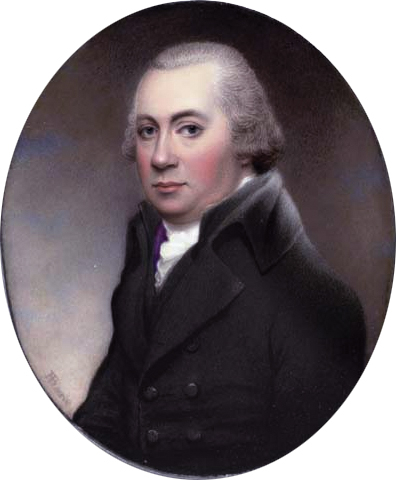
Most of the gardens and ornamental woodlands were created during the 19th century by the successive efforts of Henry Hawkins Tremayne, John Tremayne and John Claude Tremayne, all noted botanists and horticulturalists.
Henry Hawkins Tremayne (1766-1829) in black coat and waistcoat with aubergine lining, white coat, powdered hair. Source: Christies. Author: Henry Bone (1755-1834) Public Domain
By 1900 they had amassed a wonderful collection of trees and shrubs from all over the world. Follies and temples were scattered throughout and walks and rides were created. The local community depended on the estate for income: it was the centre of the community, with 20 house staff and 22 garden staff.
But the First World War changed all this, just as it did with most stately homes at that time (as shown in the fictional Downton Abbey).
In 1914, the male staff at Heligan ‘signed up’ for active service, most being sent out to the trenches on the Western Front. Heligan House was taken over by the War Office and became a convalescent home for officers. The house was returned to the family in 1919, but after the war, only 6 of the 22 garden staff returned, the rest having not survived the battles in Flanders.
The following picture is from an information board at Heligan…
…accompanied by these notes:
We know the names of 13 outdoor staff who served in World War One and have sown a field of Flanders Poppies in thankful memory of all of them, including 4 who served and returned. (Individualphotos were given by relatives of those brave Heligan men.)
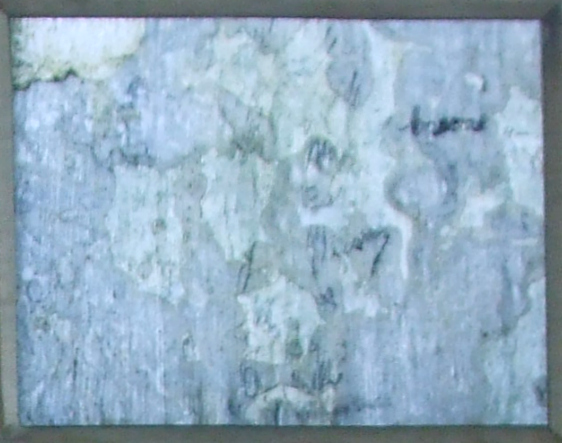
During the Second World War, the house was allocated to the US army (practice landings for D-Day took place a mile away at Pentewan Beach). The gardens remained with the Tremaynes, but for many years after the war the gardens were simply neglected, remaining in a time capsule – efectively, ‘lost’. But, in 1990, a chance meeting between John Willis, a Tremayne family member, Tim Smit (an archaeologist) and John Nelson saw the start of an amazing journey of restoration. When Smit and Nelson discovered a tiny cubicle at the bottom of a small, walled garden (since known as the Thunderbox Room – yes, the toilet) and saw the pencil signatures written on the flaking plaster walls, evoking past lives, they knew that the restoration project must be undertaken in the names of those former Heligan workers.
The Thunderbox room at Heligan (far doorway, through which the child has just emerged).Fading, pe-WWI pencil signatures on the flaking lime walls of the ‘Thunderbox’ at Heligan. Photo from the same information board as the one of the servicemen above.
Before I share some photos of the parts of Heligan we managed to see in the short time we had, here are a few images (from information boards again) of what the site looked like in 1990, i.e. before restoration started:
The bee skeps (hives) before restoration
Overgrown and neglected gardens before restoration started.
Head gardener’s office, derelict in 1991
Restoration begins! 1991
A brick wall appeared following the removal of a huge, fallen-down tree. The doorway was too enticing for Smit and Willis to ignore.
Quote from beneath the hidden door photo.
“Close in front of us we could see the finial of a glasshouse gable-end at a crazy angle, like a sinking ship”. How Smit described the above discovery in his book.
And this photo shows what the head gardener’s hut looks like now, after careful restoration:
And these are the bee skeps now, on Bee Bole Lawn, which we passed on our walkabout:
In the following photos, I have tried to show things we saw along the way as we walked round. We had no particular, pre-arranged route, and just went where the fancy took us.
This is the Entrance:
From the ticket office, we set off along the paths towards Flora’s Garden:
The Witch’s Broom. Notes from a nearby board: “The green ‘necklace’ around this Douglas Fir is called a ‘Witch’s Broom’ – a phenomenon that can occur on any evergreen or woody plant. Highly prized by Bonsai enthusiasts, they can be collected, rooted and grown as Bonsai specimens.”
Next we spent some time investigating the different walled gardens and outhouses:
The aptly named ‘Sundial Garden’.
From the walled gardens we headed along the Woodland Walk, where we found some great woodland sculptures, all created by local artists.
The Giant’s Head
The Grey Lady
The Mud Maid
This is my final set of photos before this post becomes ridiculously long. They are of an area of Heligan known as the Jungle. It covers an area of eight acres with what is described as ‘a watercourse’ running along the floor of the valley that links four ponds. The ‘big house’ looks down the valley, which winds its way to Mevagissey. It houses a collection of sub tropical plants and was created a hundred and fifty years ago when a craze for collecting exotic plants swept the country. Cornwall’s mild climate is ideal for such species. Visitors follow boardwalks along the valley.
Eventually we headed back to the entrance, with Louise being disappointed at not having found the one place at Heligan we all remembered from 2003. It was simply some stone steps that Louise had taken a photo of. Some years later, she created a very lovely painting (acrylic on canvas) of the image – a huge one that stands on an easel. As we got closer to the cafe and shop we saw an interesting-looking opening between some rocks and decided to investigate. And there we found the steps – which we all duly photographed again.
Although we managed to see a lot of the gardens, there were areas of the site we didn’t have time to get to – including the Lost Valley and Home Farm – so they’re now at the top of the list for our next trip down to Cornwall. And next time, we’ll get there in plenty of time to enjoy a Cornish cream tea in the cafe. On this occasion, it had already closed. 😦
When we first moved to the village in which we’ve lived for the past ten years, people who didn’t know me called me ‘the lady who walks’. Well, I don’t mind being labelled as such because, quite honestly, it suits me. I do walk a lot, simply because I can’t bear being cooped up indoors. There’s so much to see out there, and every day is different; every month even more so. Besides, it keeps me fit and, hopefully, young. (Fat chance of that considering that I had my 70th birthday last month. Notice I didn’tsay celebrated my birthday! How is getting old something to celebrate? 😦 On the other hand, I got some seriously nice prezzies).
And now it’s May, and the rest of spring has still to unfold before the summer ahead. So what does the onset of May bring to mind for you? This will obviously depend on which part of the world you live in and which season you’re about to embark upon. Here in the UK, it’s SPRING! Glorious Spring… the month of promise.
These are some of the photos I’ve taken over the first few days of May. They are of our garden and from around and about the village:
The photos of the sparrowhawk were taken two days ago through the glass of our conservatory, so apologies for the fuzzy look. He was gorging himself on a blackbird when we spotted him, and if we’d opened a door or window he would have rapidly skidaddled.
As for returning migratory birds, our house martins returned to their usual nesting place beneath our eaves a few weeks ago…
… and there are plenty of swallows about. But I haven’t yet heard a cuckoo, and often they arrive before the end of April. (In May and June they sing their tune.) I expect to hear the familiar call any day now. I wrote about the egg-laying habits of the cuckoo last year, here.
What else does May bring to mind?
For me, May will always make me think of Robin of Sherwood, the TV series filmed in the ’80s. To me and our two daughters, it was the best Robin Hood production ever. Michael Praed and Judi Trott were wonderful as Robin and Marion and the rest of the cast were also superb. The series was made even more poignant by the awesome music of Clannad.
Here’s a short YouTube clip of the first time Robin set eyes on Marion:
Did you spot the line… You’re like a May morning? Marion’s youthfulness fits perfectly with the idea of freshness and beginnings. This is the rest of the little bit of dialogue, which seems to have been cut from that video version:
Robin: You’re like a May morning. Stay here in Sherwood and be my May Queen. Marion: In Sherwood? And be your May queen? But what will I be when winter comes? Robin: I’d build a fire at the cave’s mouth, wrap you in sheepskin, and hold you close.
More snippets about May…
May was named after the Greek goddess Maia. It was a time of great celebration in the northern hemisphere; the time when flowers and crops emerged. Before 1430, May was called Maius. Meyes or Mai.
The Anglo-Saxon name for May was Tri-Milchi, which referred to the new lush grasses that allowed milking of cows to be three times a day.
On the 1st of May in days long past, young girls would rush out and wash their faces in dew. It was thought that May dew had magical properties: anyone who washed their face in it would have a beautiful complexion all year round. It also removed freckles, spots and pimples. (Sounds like good stuff!)
People born in May are said to be loving and practical
The zodiac signs for May are Taurus until May 20 and Gemini from May 21 onwards.
May’s birthstone is the emerald (emblematic of love and success) and also chrysophase in the UK.
In the U.S. and in many countries around the world, Mother’s Day in is May (May 14 this year, I believe). In the U.K. we celebrate that day in March.
May 1st is May Day in many countries and celebrated in a variety of ways, which I wrote about here. The day is also International Workers Day worldwide.
And here are some well known quotes about May:
Among the changing months, May stands confest The sweetest, and in fairest colors dressed. – James Thomso
Rough winds do shake the darling buds of May – William Shakespeare
Sweet April showers do spring May flowers – Thomas Tusser
To finish with, here’s a video of an old song, Now is the Month of Maying, written by Thomas Morely in 1595. It has been recorded by a number of choirs and singing groups and this one was uploaded to YouTube by Ana Pachero. It features The Kings Singers.
And now, after three posts about it, I’ll leave May alone and have a think about my next post about Cornwall.
The Collingham May Fair has been going for years – long before we moved to this area 20 years ago. For many years it was held in the area of the village green, and since the green itself is so small, this involved the road being closed to traffic for the day. The ‘green’ is just beyond the houses to the right of the road in the second picture below:
For the past few years the Fair has been on Collingham Cricket Ground – a nice large area for all the stalls and activities. Yesterday, May Ist, Nick and I went along to share in the fun. On Sunday I wrote a general post about May Day celebrations in the UK, so now I want to share a few photos from a typical village May Fair.
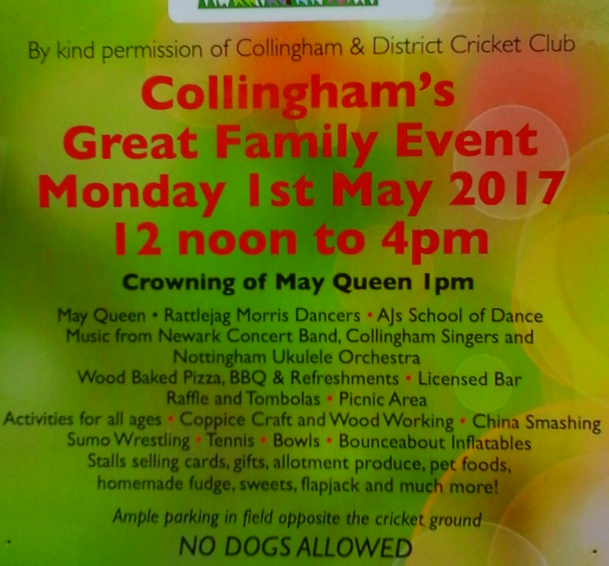
I used this poster advertising the list of events for this year’s show on my last post, but here it is again:
We arrived at the cricket ground at 12.15 pm, so not too many people were there. We walked around, looking at and photographing the various stalls while more people filed in. As you can see from these distant shots, the stalls were around the edge of the ground:
These are close-up versions of various stalls and activities on offer:
At one o’ clock we had the crowning of the May Queen. Traditionally the young woman chosen would have been one eligible for marriage, which in the past would have been a girl of perhaps fourteen upwards. Today’s May Queen was a cute little girl of eight. I suppose it makes sense, considering that it’s the primary schools who usually organise both the maypole dancing and crowning of the May Queen nowadays. Anyway, here is a photo of the ‘Queen’ and her little attendants as they watched the Morris dancers:
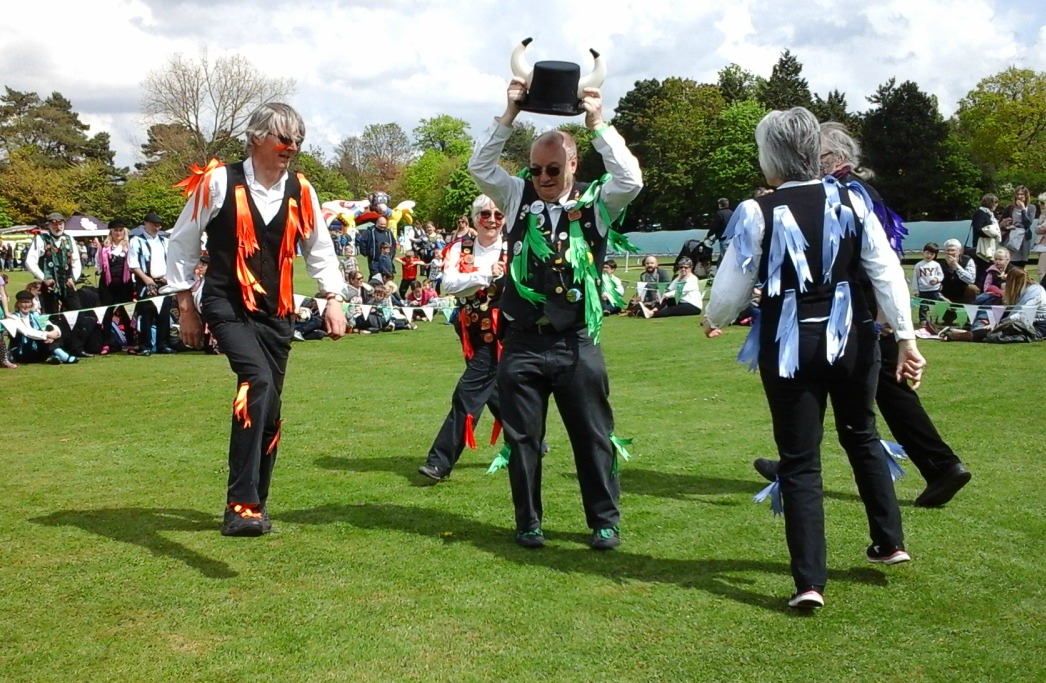
Straight after the crowning of the May Queen came the Morris dancing, performed by the same troop who were here last year – Rattlejag Morris. As it says on their website, they are a mixed troop, formed in 2002, who use recently collected material from East Yorkshire as well as their own material from local research into dancing in Nottinghamshire and Lincolnshire.Their aim is to revive and develop their own locally based dance tradition. The troop performs broom dances, bacca pipe dances and sword dances, as well as many others unique to their group, and are continually developing new dances. On this occasion we didn’t video anything, but here are a few photos…
… and this is one of Rattlejag’s several videos from other events, this one uploaded in 2014. It shows one of the dances the troop performed yesterday in Collingham. It’s called The Rufford Poachers and is based on real events. As it says on the YouTube site, it is a dance “to record the events in Rufford Park in 1851,when the Rufford Park gamekeepers had a battle with the local poachers, resulting in the death on a gamekeeper.”
In the video, the four dancers in the middle represent the gamekeepers and the four outer ones are the attacking poachers.
Rattlejag Morris performed several dances, including one with swords, and their routine was thoroughly entertaining.
Unfortunately, we were unable to stay more than a couple of hours as we were needed elsewhere, so we didn’t get to see the Nottingham Ukulele Orchestra or the Collingham Singers. We’ve seen the Singers on several occasions so we weren’t too bothered about that. All in all it was a pleasant visit and the weather wasn’t too bad at all. Although it was a bit too windy for my liking, at least it didn’t rain. There were some interesting exhibits and demonstrations – the wattle and daub fence making and the pizza making particularly so. The van with the pizza oven inside was something different and I’ve never seen so many items of crockery smashed to bits as on the plate smashing stall! In my experience, it’s usually coconuts we aim for. 🙂
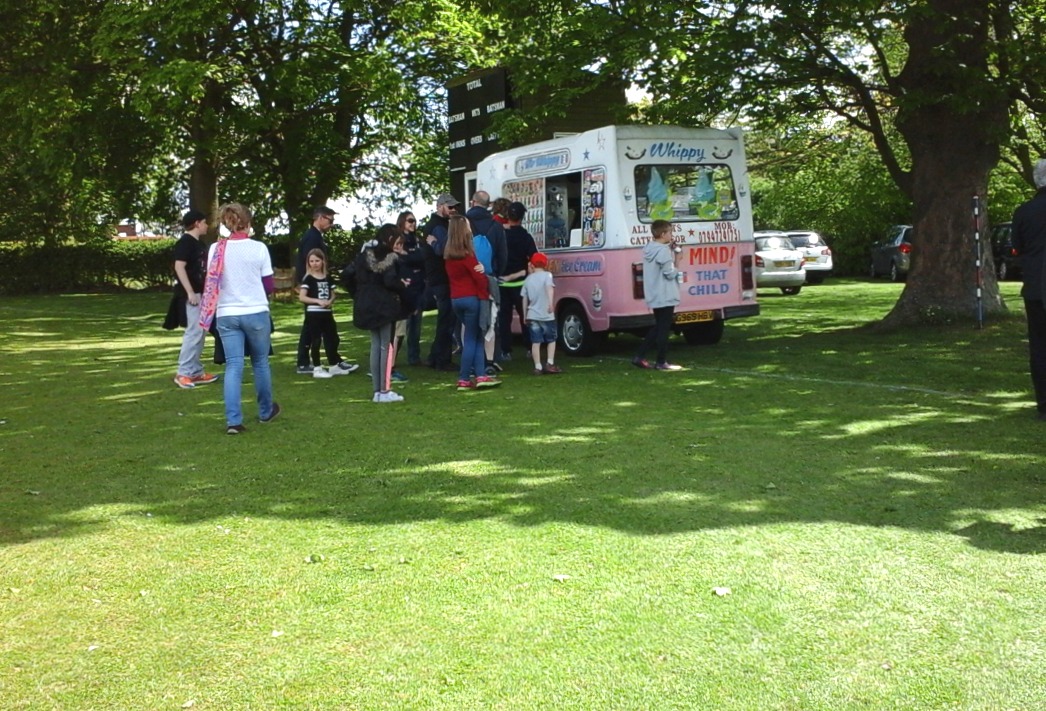
Before we left we headed over to the most important place on the site…the ice cream van. How could we leave without having a Mr Whippy?





































 Millie Thom


,_by_Henry_Bone.jpg)