This is the second post I wrote last year that I’ve decided to reblog recently. After all, information about St. Valentine hasn’t changed since then. Perhaps next year, I’ll find a different angle to talk about. 🙂
Happy Valentine’s Day! ❤
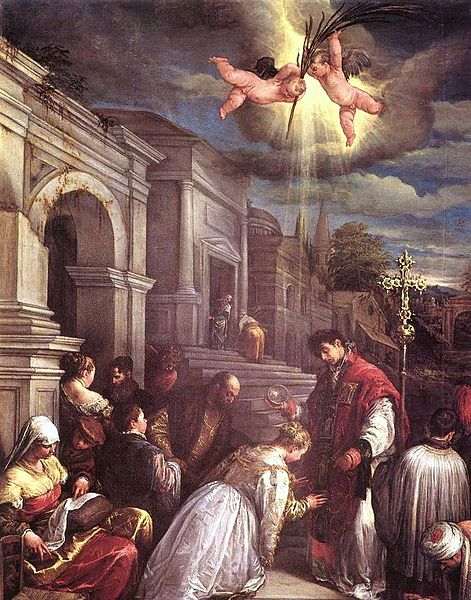
Valentine was a Roman priest during the reign of Emperor Claudius the Second in the third century AD. He is sometimes known as Claudius the Cruel – and is not the Emperor Claudius who was responsible for ordering the building of Hadrian’s Wall across the North of England in AD 122-130.
The story tells us that Claudius believed that married men did not make good soldiers. They worried too much about leaving wives and families behind if they were killed to be truly effective in battle. So Claudius issued an edict, prohibiting the marriage, or engagement, of young people.
Now, Roman society at this time was very permissive, and polygamy was popular. Yet some of the people were still attracted to the Christian faith. Unfortunately for them, since the Christian Church taught that marriage was sacred between one man and one woman, this posed a problem. It was obvious…
I wrote this post exactly one year ago – and yes, you’ve guessed it, it’s Pancake Day again here in the U.K. So I decided to reblog this post and put the third quote of the challenge I’m doing on hold for a day.
This evening I cooked enough pancakes to sink a battleship. Everyone in our family loves the things, and we had several of our offspring round to join us (and save themselves the hassle of making and cooking them!) Naturally, being just ‘Mum’, I’ve got hours of spare time to cater for everyone! I wish!
Well, now I’ve just decided to write about where and when this tradition of stuffing ourselves stupid with pancakes started. So here’s the gist of it:
Shrove Tuesday – or Pancake Day – is exactly 47 days before Easter Sunday. It is called a moveable feast because it’s determined by the cycles of the moon. The date can be anywhere between February 3rd and March 9th and falls immediately before Ash Wednesday, the first day of Lent.
The word ‘shrove’ is derived from the English word, shrive – which means gaining absolution (forgiveness) for…
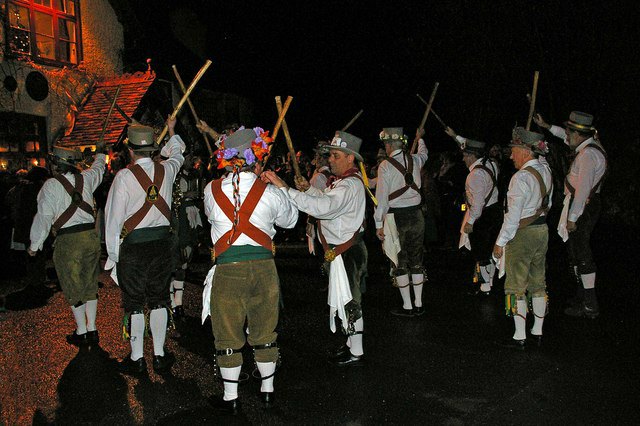
Prelude to a Wassail. Broadmarsh Morris Men perform outside the White Horse before heading for the orchard. Author: Glyn Baker. geog.org.uk. Creative Commons
Tomorrow is Twelfth Night, January 6th, the date traditionally accepted as the end of the Christmas period. It’s the day our Christmas trees and other decorations come down, to be stored away for another year. Nowadays, with many people returning to work straight after New Year’s Day – if not before – many households pack away all traces of Christmas festivities much earler.
In England, January 6th is also often remembered as the day for ‘wassailing’ – which is what this post is about. I’m posting it the day before so you can all get ready the following items for your own wassailing ritual: a nice big, stout stick; a mug of wassail (generally mulled cider, nowadays); a bucket ot the same wassail, with a good stack of toast. Oh . . . and a handy Green Man, if you can find one lurking about anywhere.
More about that to follow. . .
The custom of wassailing in England has its origins in pagan times, although it has seen some renewal in popularity in recent years due to the return to favour of cider amongst drinkers. Wassailing has been associated with the Christmas season since the 1400s, as a way of passing on best wishes to family and friends.
Sharing a Wassail bowl on Twelfth Night. Author Tracey P. Creative Commons
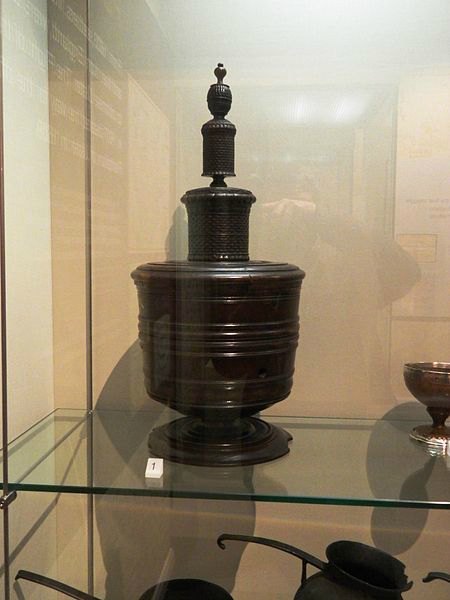
The word ‘wassail’ comes from the Anglo Saxon phrase ‘waes hael’ – which means ‘good health’ or ‘be well’. The wassail itself was originally a drink made from mulled ale, curdled cream, roasted apples, eggs, cloves, ginger, nutmeg and sugar. The Wassail drink mixture was sometimes called ‘Lamb’s Wool’, because the pulp of the roasted apples looked all frothy, rather like a lamb’s wool. It was served from huge bowls, often made from silver or pewter. One wassail bowl, housed at Jesus College at Oxford University, holds up to 10 gallons of drink. The one in the image below is not quite as big and is held in Ulster Museum:
Wassail bowl in Ulster Museum. Made of turned lignum vitae, originally belonging to the Chichester family, Earls of Donegal. Author: Bazonka. Creative Commons
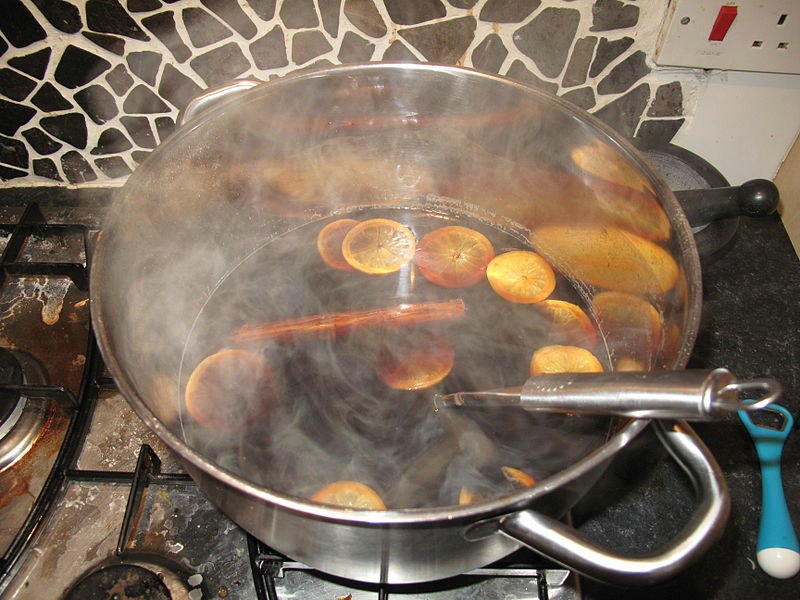
The ingredients in the drink varied between different areas of the country, some using cider instead of ale. This image shows another recipe for the brew being prepared:
There were three ways in which wassailing was celebrated:
The first waywas the passing around a room of a common bowl, often called a ‘loving cup’, to be shared. It would be accompanied by the greeting, ‘Wassail!’ This seems to be the only use, as far as I can see, of a bowl as huge as the one in Oxford. I can’t imagine a great 10 gallon vessel being hauled around the houses, or out to the orchards – although, I suppose, a horse and cart could have been used. According to one legend, wassailing was created when a beautiful Saxon maiden, called Rowena, presented Prince Vortigen with a bowl of wine while toasting him with the words ‘waes hael’.
Rowena offering the Wassail Cup to Vortigen. Artist: Joanna Mary Bryce 1831-1861. Wikimedia Commons. Public Domain
Over the centuries this simple act developed into an elaborate ceremony, with the bowl being carried into the room with great fanfare. A carol about the drink would be sung before the hot beverage was drunk.
The second way of wassailing was what is generally known as carolling today. People would go from door to door with a bowl of wassail, bringing good wishes to those inside. In return, the wassailers would be given drink, money, or some kind of Christmas treat, like a mince pie. The householders believed that this would bring them luck in the coming year.
This is the first verse of the most well known wassailing song/carol, which was popular throughout England by the middle of the 19th century. It’s simply called The Wassail Song:
Here we come a wassailing Among the leaves so green, Here we come a wandering So fair to be seen.
This video shows a really good, modern version of this song, albeit faster and more lively than the way it would have originally been sung. I love the Irish fiddle! You need only watch for a moment or two if time is scarce, just to get the idea of the tune.
The third wayinvolved drinking to the health of the apple trees in the orchards to ensure a good crop in the coming year. This ancient rite was well known in the counties of Devon, Herefordshire, Gloucestershire, Somerset, and other parts of the West Country where apple growing for cider production was common. It generally took place on Twelfth Night –which is generally thought of as being January 6th but, more correctly, it was the evening of January 5th. Sometimes, it was as late as January 17th, which was known as Old Twelfth Night (or Old Twelvey Night).
There are many customs associated with this event, from many different areas, just as there are different recipes for the brew. In one tradition, families and friends would eat hot cakes and drink cider before going into the orchard with more supplies. A cake soaked in cider would be laid at the point where the tree forked and more cider splashed onto it. The men fired guns into the tree and banged on pots and pans while the rest of the group sang the Wassail Song. This rite was intended to ward off evil spirits and encourage good spirits to ensure a good harvest the following year.
Another custom involved carrying the wassail bowl into the orchard, where the apple trees would be alternately serenaded and threatened. Singing, dancing and drinking (the latter for people and trees) continued until, finally, the trees were threatened with an axe if they did not produce an excellent crop in the coming year. There are several songs related to this type of ceremony, so here’s the opening verse from two of them:
‘Health to thee, good apple-tree, Well to bear, pocket-fulls, hat-fulls, Peck-fulls, bushel-bag-fulls.’
And this one:
‘Here’s to thee, old apple-tree, Whence thou may’st bud, and whence thou may’st blow, And whence thou may’st bear apples enow Hats full! caps full! Bushel-bushel-sacks full, And my pockets full, too, huzza!’
I get the impression that the people really, really wanted a good harvest the following year.
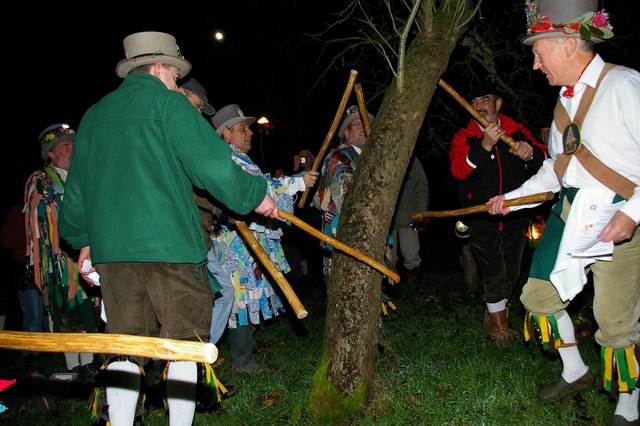
The photo below is a modern re-enactment of a similar ritual:
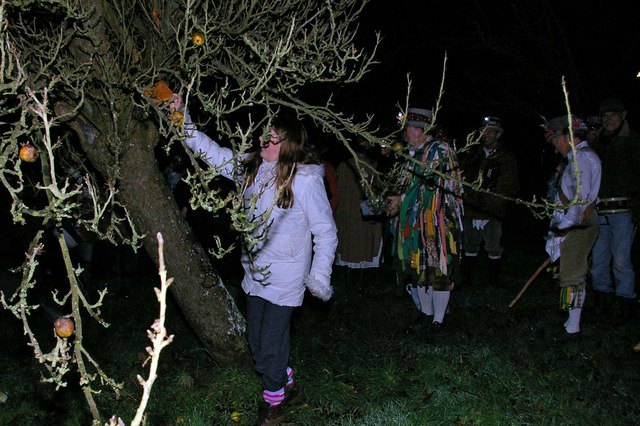
Broadmarsh Morris men beating the apple trees with sticks to drive out evil spirits that may spoil the crop. Author: Glyn Baker. geog.org.uk. Creative Commons
Most Wassail ceremonies today, as in past times, vary from area to area, but there seems to be a roughly similar order for the service. Generally, a wassail queen (and/or) king leads the procession and singing on the way from one orchard to another. The queen is lifted up in order to place pieces of toast soaked in wassail from a clay cup in the boughs of the tree. This is intended as a gift to the tree, but also to represent the apples formed there the previous year:
A “virgin” hangs cider soaked toast in the branches of the tree. The robins will eat the toast and carry away any evil soaked up by the toast. Author: Glyn Baker. geog.org.uk. Creative Commons
Then a song is sung or incantation recited – like those above – and this one:
‘Old apple tree we wassail thee And hoping thou will bear For the Lord doth know where we shall be ‘Til apples come another year.’
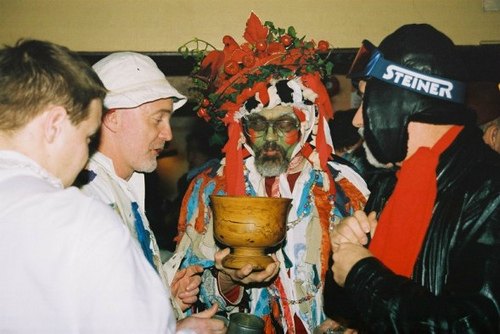
Here are another couple of YouTube videos to show how wassailing is celebrated in some areas. The Green Man, in the last video, is a traditional figure from pagan folklore. Many churches built in the Middle Ages have a little carving of him, generally in a non-too-obvious place. I mentioned him in my post about Fountains Abbey back in October, as there’s a little sculpture of him there, above a high, outside window. Even as late as the 11th and 12th centuries in Christian England, long-held pagan beliefs still lingered. Long associated with the forests, it stands to reason that many wassail ceremonies included the Green Man. I intend to write a post about him sometime soon – if my daughter, Louise, doesn’t get there first. She has her own photo of him at Fountains Abbey on the post I’ve linked to here.
As with the Wassail Song above, the second video below needs only a quick look to see what the Green Man looks like, dressed in his finery. The first video shows one version of the wassail ceremony in an apple orchard. There are several other YouTube videos online – all from different areas.
Wassailing seems to be particularly English, but I came across one ceremony elsewhere that seemed very similar . . .
In Romania, the housewife would knead her special holiday dough in the kitchen. On his way to the orchard, her husband would pass through the house in a terrible temper. She followed him as he passed among the trees, threatening each barren one with being cut down. The wife would ask him to spare this one or that, by saying: ‘Oh no, I’m sure this tree will be as heavy with fruit next year as my hands are with dough this day.’
I’m sure I’d find several others, if I looked hard enough.
The word solstice comes from the Latin word, solstitium, which means ‘Sun standing still’. The December solstice is the day on which the Sun is at its most southerly point, directly overhead at the Tropic of Capricorn, before it reverses its direction and gradually starts to move north again. The image above shows the winter solstice in the Northen Hemisphere over Asia. (Author: Jecowa at English Wikipedia. Creative Commons).
To people in the Northern Hemisphere the winter solstice means the longest night, with the latest dawn and shortest day of the year, with the sun at its lowest point in the sky. The day after the winter solstice marks the beginning of lengthening days, as we head towards the summer solstice on June 21st 2016.
For those in the Southern Hemisphere the opposite is true: people will experience the shortest night and the earliest dawn, with the longest day and the sun at its highest point in the sky.
The December solstice happens at the same time everywhere on Earth. This year it is on Tuesday, December 22nd (today!) at 04:49 GMT/Universal time. At Stonehenge, in Wiltshire, UK, the sun rose this morning at 08:04. The time is different every year, and can be between December 20th and 23rd, although it’s rarely on the two extremes. The last time it was on December 23rd was in 1903, which will not happen again until 2303.
Interpretations of the winter solstice have varied worldwide and across cultures, but many have involved the recognition of the rebirth of sunlight after the darkest time of year. As such, it has been celebrated with holidays, gatherings, festivals and rituals around that time. Many of these celebrations have been observed since the earliest times.
The prehistoric monument of Stonehenge in Wiltshire, UK (constructed from 3000-2000 BC) is aligned on a sight-line that points to the winter solstice sunset . . .
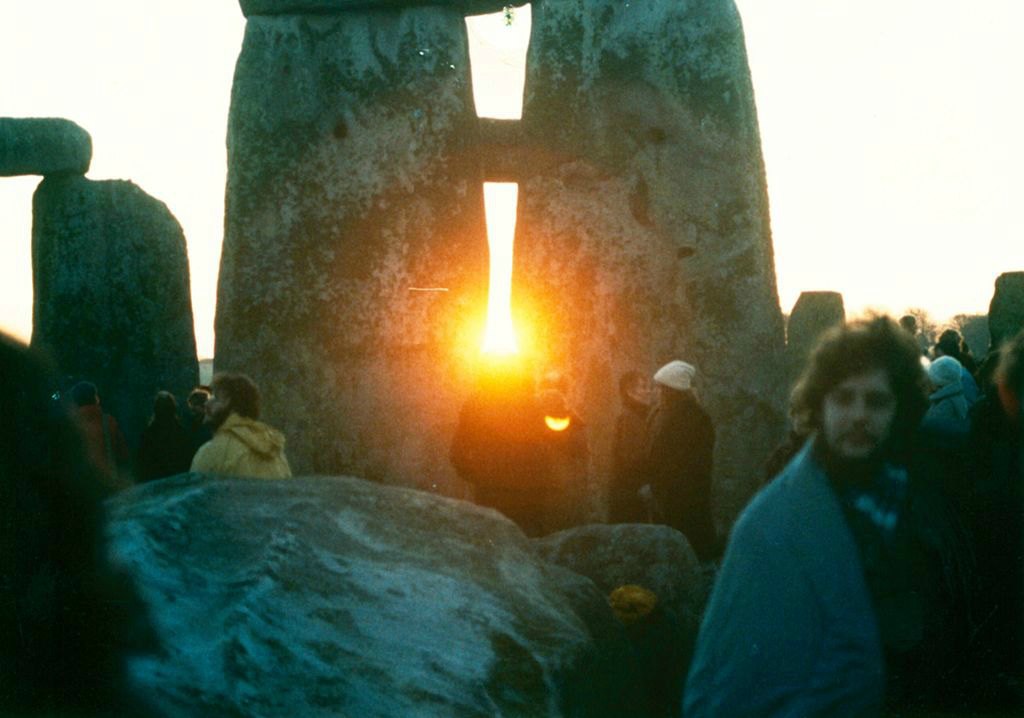
Sunrise between the stones at Stonehenge on the winter solstice. Author: Mark Grant. Creative Commons.
. . . in comparison to the Newgrange prehistoric monument in County Meath, Ireland, which points to the winter solstice sunrise:
Newgrange prehistoric monument, County Meath, Ireland. Author: Shira. Creative Commons
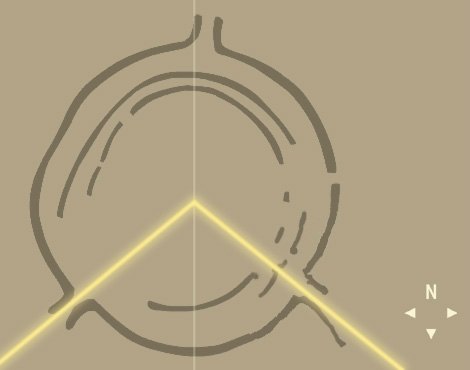
Then there is the Goseck circle in Germany, which is aligned to both sunset and sunrise:
Neolithic site of the Goseck circle. The yellow lines are the direction the Sun rises and sets at winter solstice. Author: de:Benutzer:Rainer Zenz, Public Domain
It is believed that the winter solstice was more important to the people who constructed Stonehenge than the summer solstice. The winter solstice was a time when cattle were slaughtered, so they would not have to be fed throughout the winter, and most of the wine and beer was finally fermented by then, and could be enjoyed.
In ancient Rome, the winter solstice was celebrated with a festival called Saturnalia. This began on December 17th and lasted for seven days. Saturnalian banquets were held as far back as 217 BCE to honour Saturn, the father of the gods. It began with a sacrifice at the Temple of Saturn in the Roman forum, followed by a public banquet, a private gift giving and continuous partying!
The carnival overturned Roman social norms, being more like a free-for-all, when all discipline and orderly behaviour was ignored; colourful clothes replaced the formal togas. Wars were interrupted or postponed, gambling was permitted and slaves were served by their masters. All grudges and quarrels were forgotten (but were they suddenly remembered again afterwards, I ask?).
Dice players on a wall in Pompeii. Author: WolfgangRieger. Public Domain
At the gift giving (December 19th) it was traditional to offer gifts of imitation fruit – a symbol of fertility. Dolls were given, which were symbolic of human sacrifice, and so were candles – a reminder of the bonfires associated with pagan solstice celebrations. The whole festival would become a week-long orgy of debauchery and crime:
Saturnalia sculpture by Ernesto Biondi: a bronze copy n the Botanical Gardens in Buenos Aires. (Original in the National Gallery of Modern art in Rome). Uploaded by Roberto Fiadone. Creative Commons
In the Norse lands of pre-Christian Scandinavia, the winter solstice was celebrated with the feast of Jul (or jól), from which we get the terms Yule and Yuletide. Yule is what later evolved into today’s Christmas, though the Danes still call it Jul. The Danish Vikings sacrificed and offered up goods and animals to the gods in order to conquer the darkness of winter. Then they drank a toast for the year and for peace. The toast was very important and a beaker of beer was offered to the gods. Then the people would toast and drink and thank each other and the gods for the past year and welcome in the new.
People would light fires to symbolise the heat and light of the returning sun and a Jul /Yule log was brought in and dropped in the hearth as a tribute the god Thor. The Yule log was often an entire tree, carefully chosen and brought into the house with great ceremony and sometimes, the largest end of the log would be placed into the fire hearth, while the rest of the tree stuck out into the room.
Image from Shutterstock
I wrote a short post about the Yule log last December, with a brief paragraph from Shadow of the Raven describing the Yule celebrations. It can be found here.
The log would be lit from the remains of the previous year’s log which had been stored away and, later on, in Christian times, was often fed into the fire through the Twelve Days of Christmas. The log was burned until nothing but ash remained, then the ashes were collected and either strewn on the fields as fertiliser every night until Twelfth Night or kept as a charm and or as medicine. A piece of the log was kept as both a token of good luck and as kindling for the following year’s log.
These are just three of the ways in which peoples of the past celebrated the winter solstice. There are many others from different times and cultures, but I can’t do them all. There’s only a couple of hours left of December 22nd, 2015, here in the UK, so the shortest day has almost been and gone . . .
On Saturday I went into Nottingham with my elder daughter, Nicola, and grandson Kieran, to do some Christmas shopping. We went on the train – just to keep my train-mad grandson happy – and were out all day, not getting home until the evening. As you can see from the photo above, it poured down for most of the day, so we did spend more time than we’d have liked mooching around inside the shops.
Nottingham is a big city with a history that goes back hundreds of years. It is known worldwide mostly for its connections with the Robin Hood stories, but there’s a lot more to Nottingham than that, and I’ll probably do a post about it sometime next year.
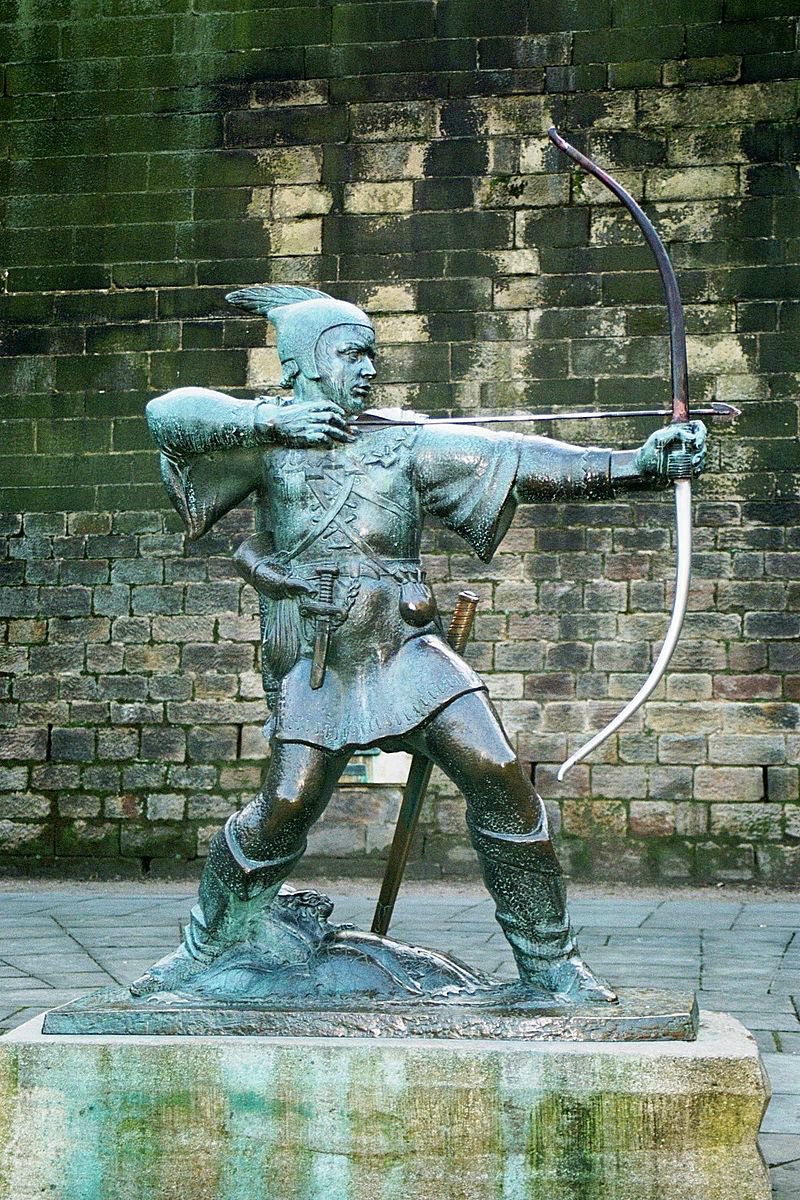
Robin Hood Memorial in Nottingham, near to the castle. Uploaded by Soerfm under GNU Free Documentation License. Wikimedia Commons.
For now I’ll just share some of the photos I took of the Old Market Square, and give you a little bit of information about it:
In the days before the City of Nottingham existed as such, the area which is now the Market Square was the centre-point between two Anglo Saxon towns in the old kingdom of Mercia. One of these towns was Snotengaham (also called Snothryngham, Snottingaham and – the usual name around here – just Snottingham). Whichever name is used, it simply means ‘the settlement of Snot’s people’ – to most people’s amusement. So the central area between these two settlements has been the centre of the city’s growth for hundreds of years.
The Old Market Square, as it is known, is an open, pedestrianised area, from which shopping streets spread out in all directions. It’s a place where friends can meet and do some shopping, or visit one of the many cafes, restaurants and pubs. It is the largest public space in the U.K. after Trafalgar Square in London and is a centre for Nottingham’s transport links. Trams run around the outer edge of the square, as can be see from the overhead lines in a photo of the Council House lower down the page. Unfortunately the only photo I took of a tram is not a good one, particularly as people stepped in front of me as I snapped it. Here it is anyway:
In summer for several years now, a large area of the square has been converted into an artificial, sandy beach for parents to take their children to play on, with a huge paddling pool in the middle – an excellent idea for a ‘Midlands’ city, a long way from the coast. The square was also the original site for Nottingham’s famous Goose Fair, which originated over 700 years ago and is held every October. In 1928, the fair was moved for redevelopment of the square and is now held on the Forest Recreation Ground, an open space about a mile north of the city centre.
The Bell Inn, thought to be one of the UK’s oldest pubs and dating back to around 1276, can also be seen at the back of the square. I forgot to take a photo of it as we dodged the rain, so here’s a (summertime) photo from Wikipedia:
Updated photo of the Bell Inn in Nottingham Market Square. Author: Lee J. Haywood. Creative Commons,
But the building that dominates the square, although undoubtedly impressive, is nowhere near as old as the Bell Inn. This is the Nottingham Council House building as seen on my ‘header’ image and this one below. It was built to replace two much older buildings that had been used for this purpose over the years – the old Norman ‘Moot Hall’ and the English Guildhall, last used in 1877.
This new Council House was designed by Nottinghamshire architect T. Cecil Howitt and a building called ‘The Exchange’ was demolished in 1926 to accommodate it. In 1929, thousands of people gathered to watch its official opening in by the Prince of Wales, who later became King Edward VIII, open the great doors with a golden key, which is still displayed on a wall plaque, just inside the building to the left of the grand staircase.
Unlike the Lincoln Christmas Market, held only over a long weekend, Nottingham’s is held throughout December. Like several others in the U.K. nowadays, it is also fashioned after the German markets, although Lincoln was the first in the country to do so. Still, it all looked very pretty, with a little fun fair and lit-up stalls – despite the rain.
The ‘Helter Skelter’ pub.
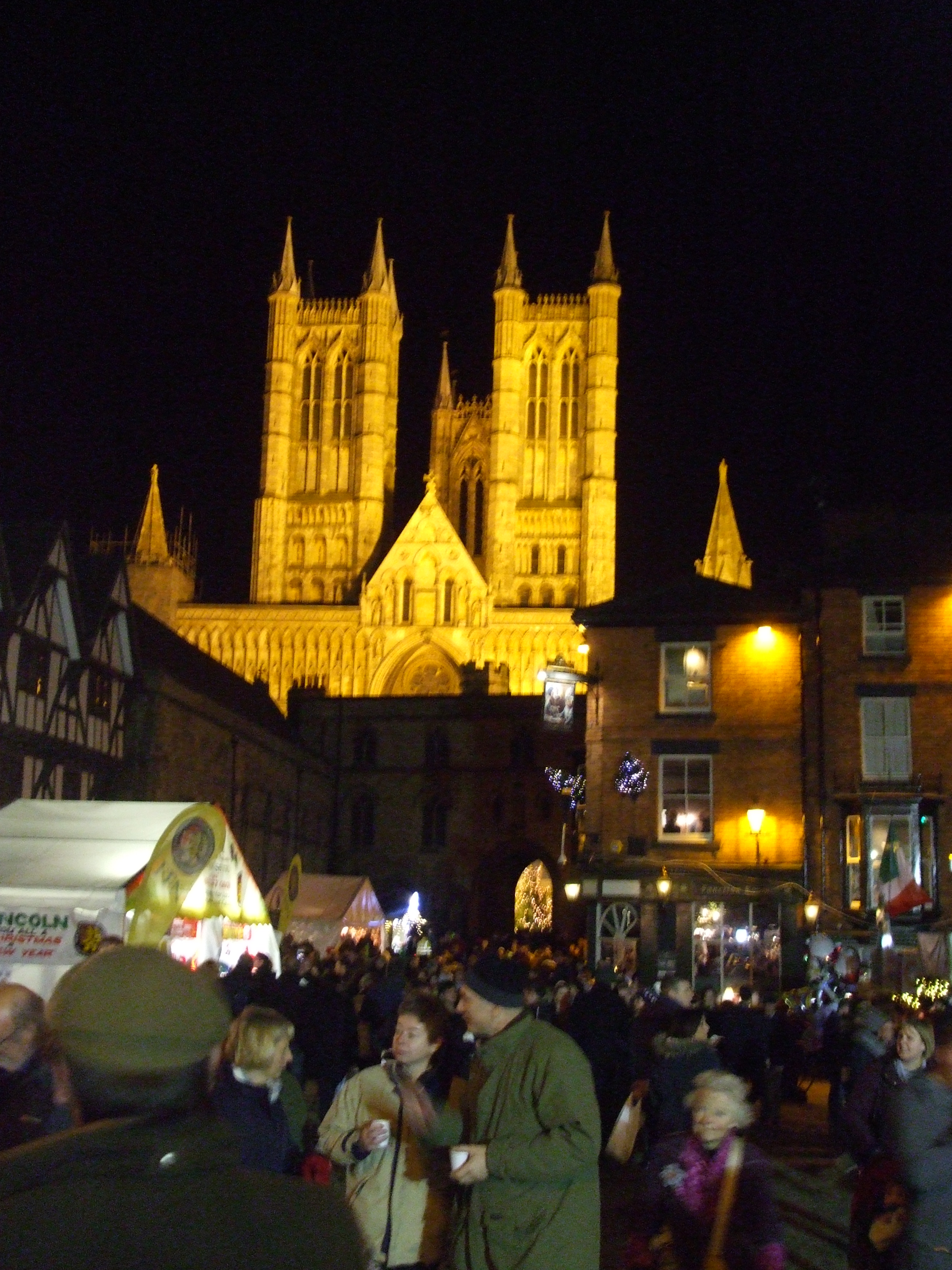
Lincoln Christmas Market, however, has the great advantage of its wonderful setting in the castle bailey and being overlooked by the beautiful, towering medieval cathedral. It draws people back, year after year.
Over the last weekend, the annual Christmas Market was held in Lincoln. As always, stalls stretched across a section of ‘uphill’ part of the city known as the cultural area – i.e. where the castle and cathedral are. This area is, literally, ‘uphill’. Lincoln is a strangely shaped city: parts of it are at the top of the hill and some stretches out at the bottom. The slope in between the two is quite steep, though it is built on, of course, and the main, narrow road leading from the main shopping area of lower Lincoln to the top of the hill is aptly called, Steep Hill.
Top of Steep Hill before it dips down towards the lower part of the city
This year, we decided to visit the market in the evening, when it feels the most atmospheric. Last year we had a daytime visit, simply so we could take photos. I’m glad we did, because this year, our photos haven’t turned out well at all. I’ll share a few on this post, but a better view of the stalls and goods on offer can be seen on my last year’s post here. (Oddly enough, I posted that one on December 7th last year.)
As I said last year, the Lincoln Christmas Market is one of the oldest in England and the first one to be ‘German-styled’. It started in 1982 following the ‘twinning of the city with Neustadt in Germany, with an initial eleven stalls standing between the cathedral and castle. These two pictures are the same German stall with the name Neustadt on it. The one on the left was taken this year, at night, and the other during the daytime last year:
Now stalls spread through the castle grounds and along some of the streets –
The Lincoln Visitor Centre, seen from Steep Hill
Bar along Westgate on the way to the market
Approaching the market
and the fun fair, along with more stalls, takes over nearby carparks:
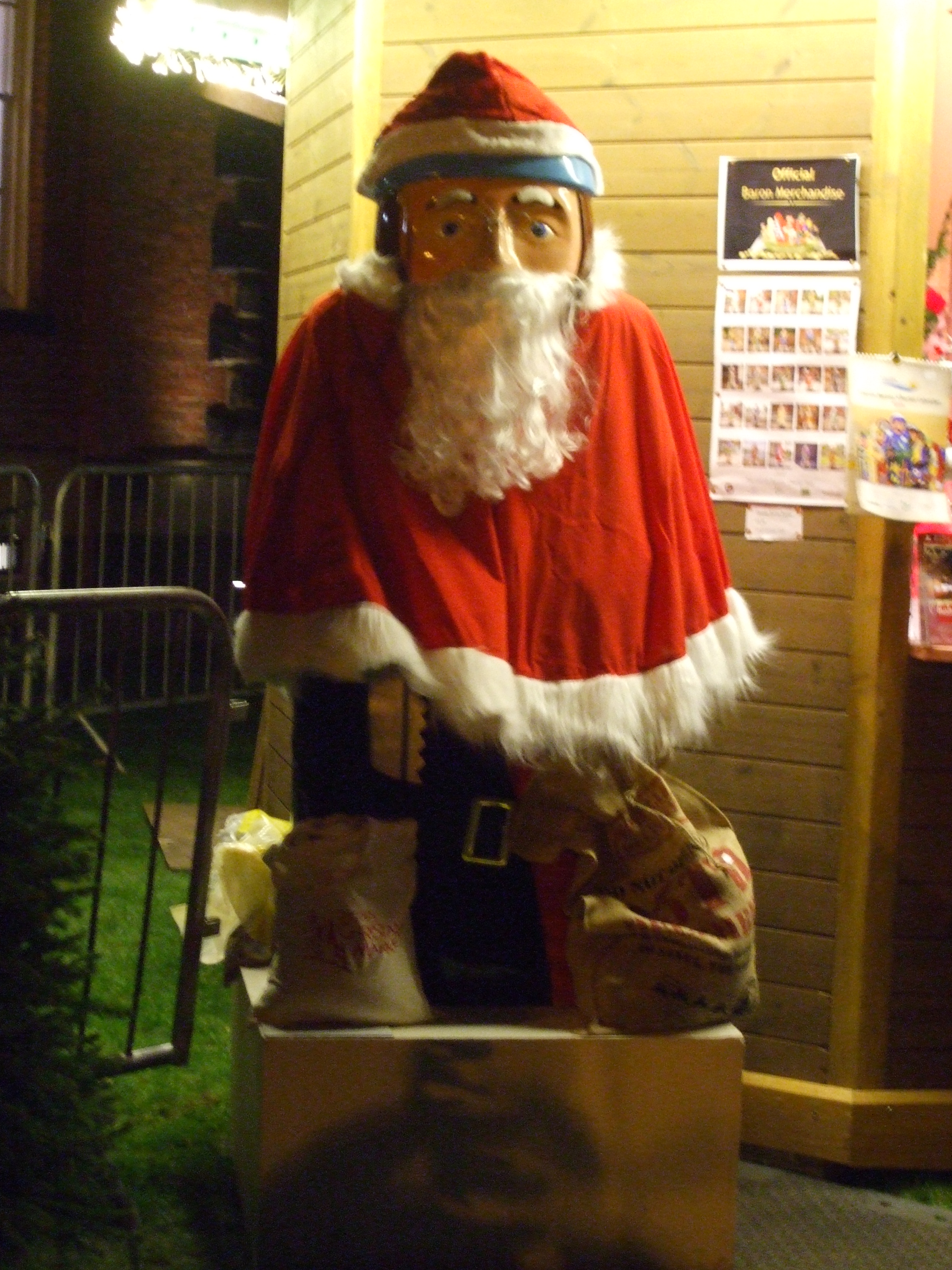
At the main gateway into the castle grounds was this welcoming figure. One of the ‘Barons’ of Magna Carta fame from throughout the summer had taken on his new role:
The majority of stalls were inside the castle grounds, many the traditional chalet style, others beneath a number of marquees. There were many goods on offer, on stalls from several European countries as well as different areas of Britain. German stalls were prevalent, as to be expected due to the ‘twinning’. Many of them sold food and drinks of one type or another, both hot and cold.
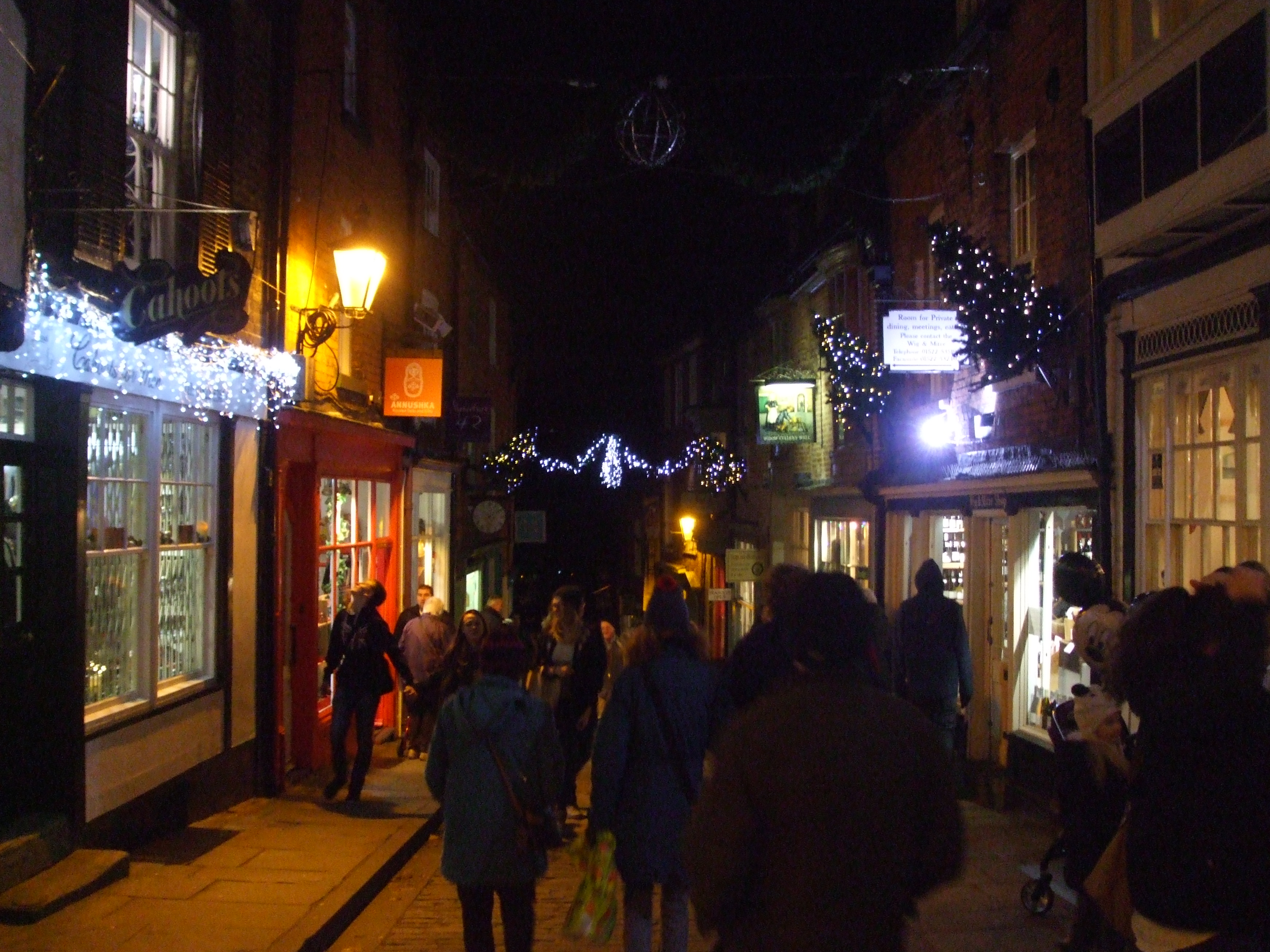
Here are a few of the dozens of photos we took around the market and castle grounds. Many were just too ‘glary’ due to the bright lights.
Well, that’s it for this year about the Lincoln Christmas Market. Now I need to think of a post about all the ‘mini barons’ that are hidden around the city. We’ve managed to find quite a few.
In December of last year, I did several posts about different Christmas traditions in the U.K., plus one about the Lincoln Christmas market, which will be here again from next Thursday, December 3rd until the Sunday. So I decided to have a look at a couple of traditions I didn’t write about last year. And considering that Advent starts today, Sunday, I’ve put together some information about what Advent means and some of the traditions associated with it.
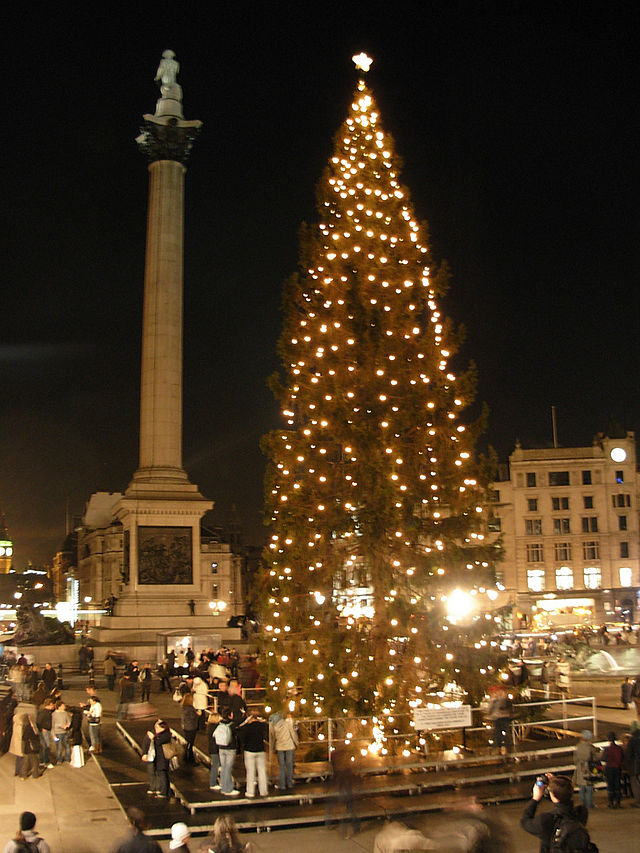
Advent starts four weeks before Christmas, beginning on November 30th (St. Andrew’s Day) or the Sunday closest to it. This year it begins on November 29th. The day marks the start of the Christian year and the beginning of the Christmas season for many people in the U.K. Some people even decorate their homes this early, although most leave the household decorating until a week or two before Christmas Eve. In towns and cities, however, Christmas lights and a large Christmas tree in a central place, like a market square, generally appear during the first week of Advent. The huge tree in Trafalgar Square in London is a yearly gift from Norway, in thanks for Britain’s support during the Second World War.
The word Advent comes from the Latin word ‘adventus’, which means ‘arrival’ or ‘coming’ – referring to the birth of Jesus Christ as well as the time that he will come again. The origin of Advent preparations for Christmas is unknown, although it certainly existed by the year 480. It was also introduced by the Council of Tours (in France) in 567 as an order to make the monks fast throughout December until Christmas. Some people believe that Advent goes back as far as the time of the Twelve Apostles; others say it was founded by St. Peter. All in all, it is impossible to say exactly when it began.
Several traditions are followed during Advent – other than decorating homes and towns and sending Christmas cards and so on. I think everyone is familiar with Advent calendars, as the one in my first picture above. What child doesn’t like to open one of the little doors each day from December 1-24, to see what’s behind? Some calendars have little Christmassy pictures behind the doors – some showing the Nativity, or having a poem or part of a story relating to it. Others have pictures of teddy bears, Christmas trees, bells, candles, robins, snowmen etc. – anything connected to the season and Christmas celebrations. Nowadays, many Advent calendars simply contain small chocolates.
Styles vary from pieces of card to wooden structures and models that can be used each year. Advent calendars were first used by German Lutherians in the 19th and 20th centuries, but have since been used by many Christian denominations. Here are some pictures showing different styles:
German Advent calendar (1903) from Im Lande des Christkinds. Windows contain Christmas poems. Images from a cut-out sheet were pasted over them. Authot Richard Ernst Kepler, 1851-1927. Public Domain.
Homemade Advent calendar made from wood in the shape of a Christnmas tree. Author: Tin ‘Avatar’ Bartel (made for his girlfriend). Creative Commons,
Homemade Advent calendar featuring presents. Author: Andrea Shaufler. Creative Commons
Christian churches take on a different look during Advent. Instead of the usual flowers that decorate many churches throughout the year, an Advent Wreath (sometimes called an Advent Crown) will be placed inside the church:
Lutherian Advent wreath with one red and three blue candles, around a decorated white candle, all lit. Author: Kittelandan. Creative Commons.
These wreaths are made of evergreens, like holly and ivy or some kind of conifer, formed into a circle – which represents God, i.e. no beginning and no end. The ‘evergreen’ itself is a reminder that God does not change, holly also being a reminder of the crown of thorns placed on Christ’s head at his crucifixion. Four candles are set around the circle, plus one in the centre. The candles can be of any colour, the central one generally a different colour to the others. Sometimes, four red and one white candle are used, red being the Christmas colour.
Unlit candles represent darkness. One of the outer candles is lit on the first Sunday of Advent, that one plus another on the second Sunday and so on until all four are lit on the fourth Sunday. On that day, the central candle is also lit, representing Christ as the light of the world. The other four candles also have meanings and prayers on each of the four Sundays focus on those themes. They are Peace, Hope, Love and Joy.
Also, in Western Christianity during Advent, the usual liturgical colour is either violet / purple or blue. This colour is often used for hangings around the church, the clerical garments and, in some Christian denominations, often the tabernacle.
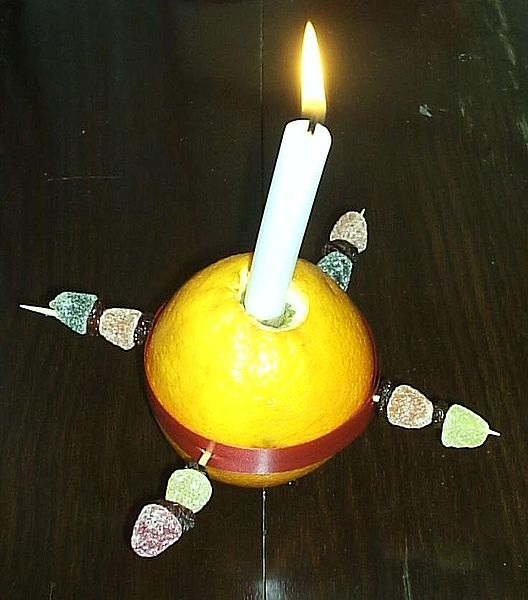
A Christingle is used in many Christian churches in the U.K. during Advent. It is a symbolic object, its name meaning ‘Christ Light’, and is used to celebrate Jesus Christ as the ‘Light of the World’. The tradition was unknown in England before 1968 – so they weren’t a feature of my childhood Christmases.
The various parts of a Christingle represent different things. The round orange itself represents the world and the candle represents Jesus as the light of the world. The red ribbon (Christian faith) goes all the way round the world, its colour being a reminder that Christ died. The four cocktail sticks have two meanings: the four corners of the world or the four seasons. And lastly, the sweets (or dried fruits are sometimes used) are a reminder of God’s gifts to the world, including love and kindness. (The small circle of aluminium foil at the base of the candle is purely for collecting drops of hot wax.)
Christingles have now been part of Advent celebrations in the U.K. for 47 years. It was John Pensom of The Children’s Society who introduced it to the Church of England in 1968. He adapted the form we see today from the original idea used by Bishop Johannes de Watteville in Marienborn, Germany in 1747. The bishop wanted to find a way to explain to children the happiness that comes through believing in Jesus. In his children’s service, he gave each child a lighted candle wrapped in a red ribbon whilst he said the prayer, ‘Lord Jesus, kindle a flame in these children’s hearts that theirs like thine become’.
There are other traditions associated with Advent, including the singing of Christmas carols such as O Come O Come Emmanuel and Lo, he comes with clouds descending, at church services. There are also some old ‘folk traditions’, both in the U.K. and other European countries that I could talk about, but I’ll not go into all of those here. I’ll just mention the most familiar one in Britain, which dates back to the Middle Ages. The custom was for poor women to carry around the Advent images: two dolls dressed as the Virgin Mary and Jesus. Anyone to whom these dolls were shown was expected to give a halfpenny (ha’penny). It was believed that bad luck would strike any household not visited by these ‘doll bearers’ before Christmas Eve. Not a pleasant thought to carry with you into the New year . . .
Spectators gather around a bonfire at Himley Hall near Dudley, on 6 November 2010. Author: SJNikon – Sam Roberts. Wikimedia Commons
On November 5th last year I wrote this post about how the celebrations for Bonfire Night – or Guy Fawkes Night – in the U.K. have changed since my childhood in the 1950s. Yesterday, I posted about the history behind the celebrations and thought it might be an idea to re-post this to complement it. I’ve made a few minor changes to the original and added a couple of pictures (I had no idea I could use Wikipedia or Wikimedia images when I first started my blog!). So here it is...
Spectators around a bonfire at Himley Park near Dudley Nov. 6. 2010. Author: S.J. Nikon -Sam Roberts. Commons
Remember, remember, the fifth of November,
Gunpowder, treason and plot.
I see no reason why gunpowder treason
Should ever be forgot.
This well known rhyme has been sung in Britain by generations of children as November 5th approached. It is still sung in primary schools as children are taught the historical significance of Guy Fawkes Night / Bonfire Night and why it is celebrated with bonfires and fireworks. Literacy, drama and art work of all types also stem from this colourful spectacle.
There’s more than enough online about Guido Fawkes and his co-conspirators, and why they wanted to blow up King James I and the Houses of Parliament, so I won’t elaborate on that. Guido suffered one of the most horrible deaths imaginable for his part in the plot – and being…
Last November I wrote a post about how Bonfire Night, or Guy Fawkes Night, is celebrated in the U.K. today – and how different it is now to when I was growing up in the 1950s and 60s. In that post, I didn’t focus on why Bonfire Night is celebrated in the first place: in other words, I wrote little about the history behind the event. But in this post, that’s what I do intend to do…
In earlier centuries, the Gunpowder Plot of 1605 was often called the Gunpowder Treason or the Jesuit Treason (treason being a crime involving disloyalty to the Crown in any way, including plotting against the sovereign’s life). It was a failed plot by thirteen Catholics to assassinate James I by blowing up the Houses of Parliament.
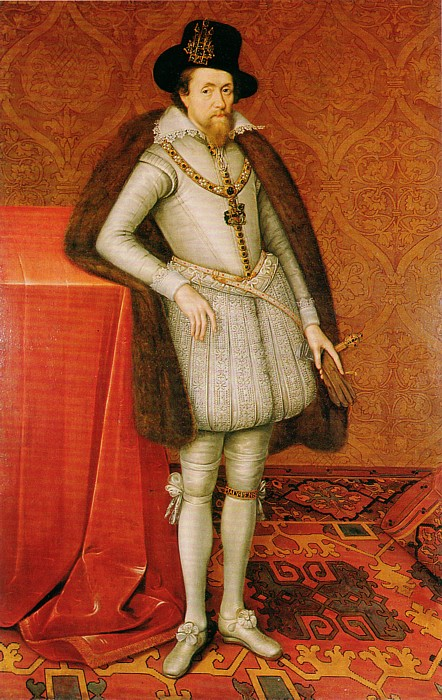
Portrait of James VI and 1, c. 1606, by John de Critz. Now located in the Dulwich Picture Gallery. Public Domain
So what was the reason for the plot?
When Queen Elizabeth I died in 1603, English Catholics who had been persecuted under her rule had hoped that their future would be greatly improved, and her successor, James I, would be more tolerant of their religion. James had had a Catholic mother (Mary Queen of Scots) and had a Catholic wife. At first, the signs were promising and reforms were made. But by 1605, under pressure from his spymaster, Sir Robert Cecil, and in an effort to appease the more extreme Protestants such as the Puritans, James once again incresed the penalties on anyone practising the Catholic faith. He ordered all Catholic priests to leave England.
Robert Cecil, 1st Earl of Salisbury by John de Critz the Elder. National Portrait Gallery. Wikimedia Commons. Public Domain
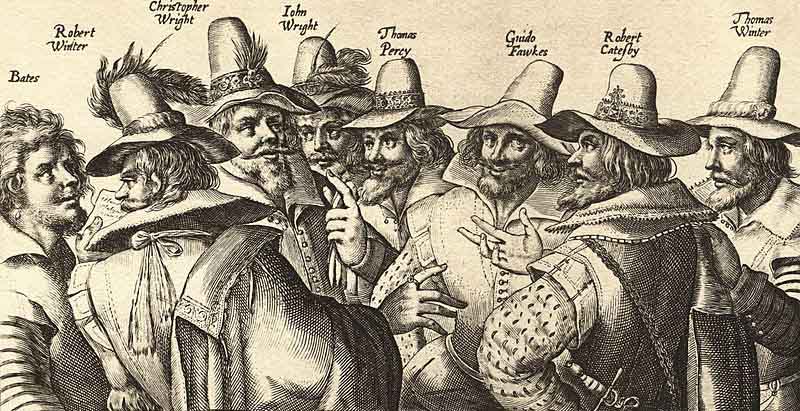
This so angered some Catholics that they were willing to take extreme measures, supported by the Catholic monarchies of Europe. Two plots against James had already failed when a third group of plotters began to take shape, under the leadership of Robert Catesby, a well-to-do gentleman of Warwickshire. The thirteen young men hatched a plan to strike at the opening of Parliament on November 5th, 1605. Eight of them are shown on this picture:
Detail from a contemporary engraving of the Gunpowder Plotters. The Dutch artist probably never actually saw or met any of the conspirators, Source: National Portrait Gallery. Wikimedia Commons
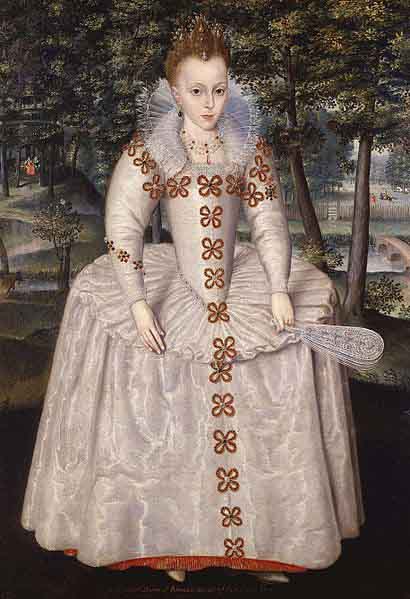
Once James was dead, they intended to put his daughter, Elizabeth, on the throne, thus returning England to the Catholic faith.
Princess Elizabeth of Bohemia, daughter of James 1. Artist: Robert Peake the Elder (1551-1619). Photographer: Weiss Gallery. National Portrait Gallery, London. Wikimedia Commons. Public Domain.
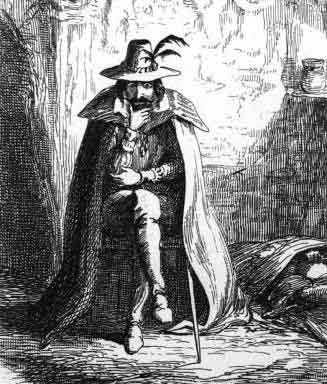
It was Guy Fawkes (who had adopted the name of Guido while fighting for the Spanish) who posed as a servant called John Johnson and began locating sources of gunpowder.
Guy Fawkes in Ordsall Cave by George Cruikshank in 1840. Public Domain. Wikimedia Commons
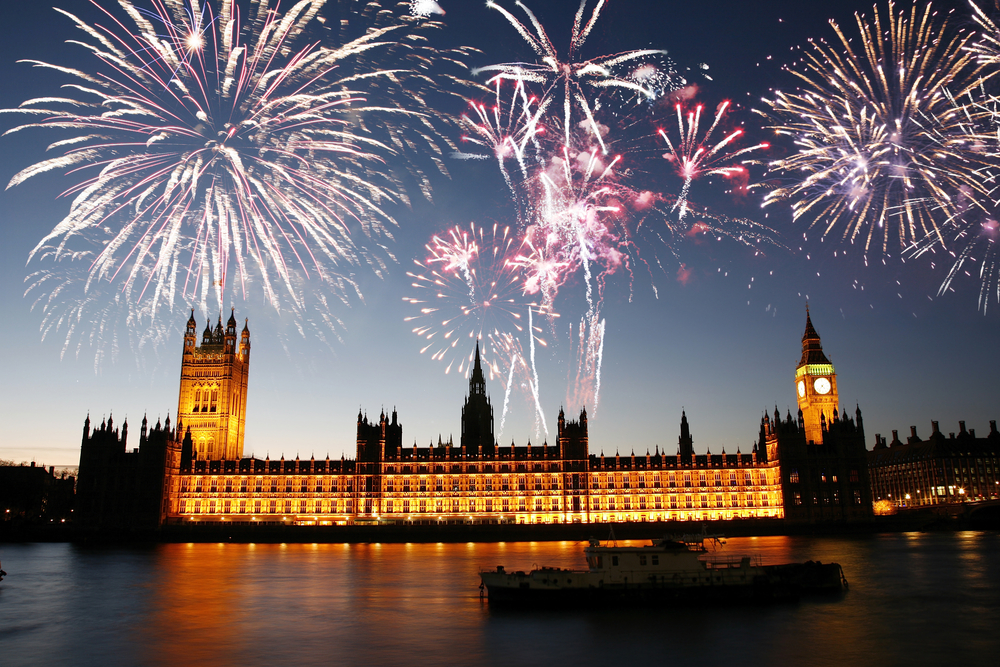
The plotters rented a cellar/undercroft beneath the House of Lords (a chamber inside the Houses of Parlaiment shown on the first image above) and began stocking it with enough explosives to kill the king and the most powerful men in the land when they met on November 5th. Eventually they managed to store 36 barrels of gunpowder, enough to reduce the House of Lords to rubble.
The cellar underneath the House of Lords, as drawn by William Capon, 1799. Public Domain. Wikimedia Commons.
As the day planned for the strike neared, it became clear to some of the plotters that innocent people would be killed in the attack, including people who had fought for the rights of Catholics. Lord Monteagle, the brother of Francis Tresham, one of the plotters, received an annonymous letter (almost certainly from Tresham) warning him to avoid attending the opening of Parliament on November 5th. Monteagle passed the letter to Robert Cecil.
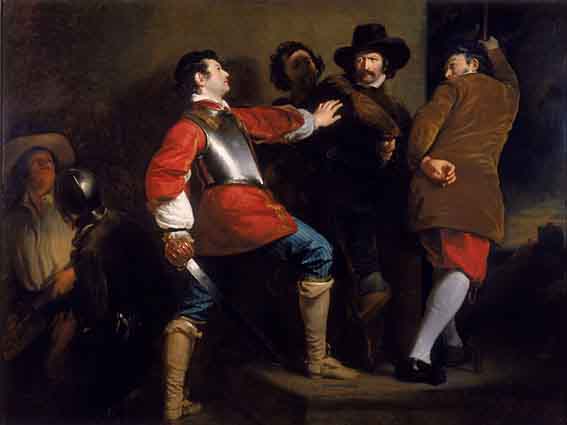
Cecil decided not to act immediately: he wanted to catch the plotters in action. On November 4th he ordered searches of the whole of the Houses of Parliament and Fawkes was arrested. He was dressed ready for a swift get-away, with spurs on his boots.
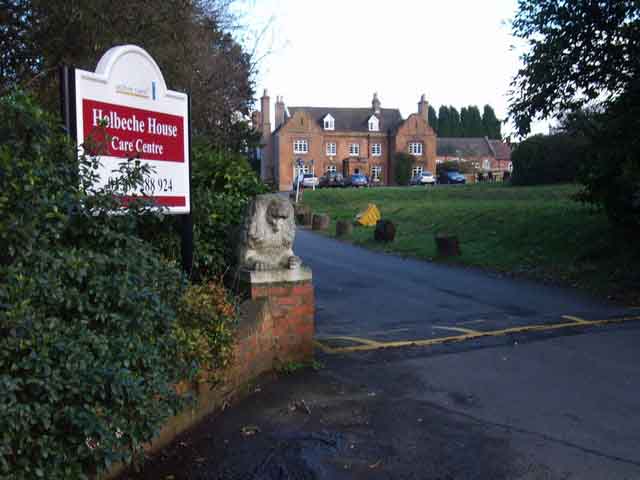
Most of the conspirators fled as they learned of the plot’s discovery. Several made a stand against the pursuing Sheriff of Worcester and his men at Holbeche House, Catesby’s home.
Holbeche House near Dudley was the home of Robert Catesby, leader of the Gunpowder Plot. It is now a nursing home. Author: Gordon Griffiths. geog.org.uk. Creative Commons
Catesby was one of the plotters shot and killed, leaving eight of the survivors, including Guido Fawkes, to stand trial.
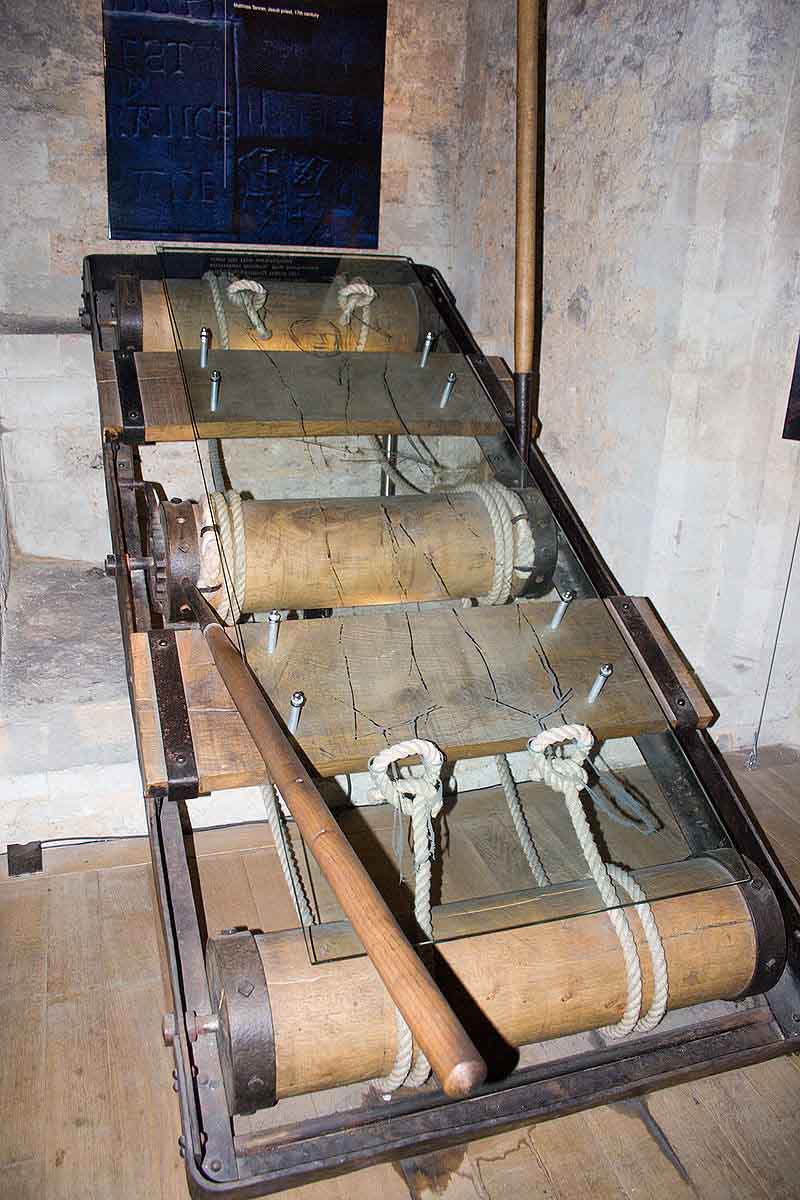
Fawkes suffered two days of severe torture on the rack in the Tower of London before confessing everything.
A torture rack (as the one used on Guido Fawkes) photographed in the Tower of London by David Bjorgen. Creative Commons
His chief interrogator was Edward Coke:
Sir Edward Coke, chirf interrogator of Guido Fawkes. Author: attributed to Thomas Athow, after unknown artist, after Cornelius Johnson. Public Domain. Wikipedia Commons
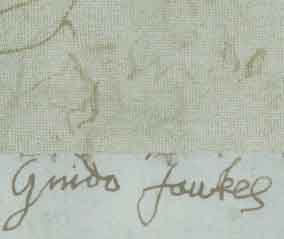
The confession Fawkes signed shows how much his joints, including those in his hands, had been so severely damaged.
Signature of “Guido” on his confession under torture, very faint and shaky. Public Domain
At their trial on January 27th 1606, the eight surviving conspirators, including Fawkes, were convicted of high treason and condemned to be hanged, drawn and quartered.
The execution of Guy Fawkes’ (Guy Fawkes), by Claes (Nicolaes) Jansz Visscher, given to the National Portrait Gallery, London in 1916. Wikimedia Commons
The punishment consisted of the the victim being dragged, usually by a horse, on a wooden frame to the place where he was to be publicly put to death. This involved a gruesome procedure in which the victim was first hanged until almost dead, them emasculated, disembowelled, beheaded and quartered (cut into 4 pieces). The intestines /entrails were thrown onto a fire and the other remains were usually displayed in prominent places, such as London Bridge.
In the months after the plot, new laws were passed removing Catholics’ right to vote and restricing their role in public life. It was 200 years before these restrictions were fully lifted.
*
In Britain we continue to celebrate the failure of the plot against James I and the execution of his would-be assassins on November 5th every year. The burning of a ‘guy’ – an effigy of Guido Fawkes on top of a bonfire – has ensured the plot survives in national memory.
Remember, remember, the fifth of November
Gunpowder, treason and plot.
I see no reason why gunpowder treason
Should ever be forgot.
Here are a few pictures of Bonfire Night in the U.K.
Bonfire Night in Lewes, Sussex. Author: Perter trimming. geograph.org.uk
Bonfire Night in Lewes, Sussex. Author: Perter trimming. geograph.org.uk
Gary Marshman (11) enjoying an English Bonfire Night on November 5. Author: R. Neil Marshman. Commons
Free firework display in Thornes Park, Wakefield, UK. Author: Stephen Bowler. Wikimedia Commons
In the United Kingdom, Father’s Day is celebrated on the third Sunday of June, in keeping with the United States, where the custom originated, and many other parts of the world. This is in contrast to Mothers’ Day, which has a very different history in the U.S. and the U.K. (Happy Mother’s Day). Many countries outside of Britain celebrate Mothers’ Day in May, whereas in Britain the date varies according to the date on which Easter falls that year. Most often it falls in March.
Father’s Day is a day to honour fathers and father figures, including grandfathers and fathers-in-law. Many people make a special effort to visit their fathers or to send them a card or gifts. As for Mothers’ Day in Britain, children spend time making their own cards, and gifts tend to be the same as many dads will get for Christmas – socks, slippers, ties and various items of clothing. Sometimes mugs are bought with slogans like ‘The World’s Best Dad’ or simply ‘Dad’ written on them. Items like T-shirts, mouse mats, bags and T-shirts are sometimes offered to dads with photographs of the children printed on them. As for giving flowers… In the U.S. fathers were traditionally given the gift of white or red roses. The rose is the official flower for Father’s Day. Wearing a red rose signifies a living father, while a white one represents a deceased father. I haven’t heard of roses being given here in the U.K. but that doesn’t mean the custom isn’t observed at all.
For some dads in the U.K. Father’s Day can be a day for being taken out and treated to a pint or two down at the pub. Some families make more of things and the ‘treat’ could be a meal out somewhere special, or one of the popular ‘Father’s Day’ experiences, like driving a rally car, tank, fire engine, or even an aeroplane. Some children pay for Dad to have a golf, football or cricket lesson with a celebrity coach.
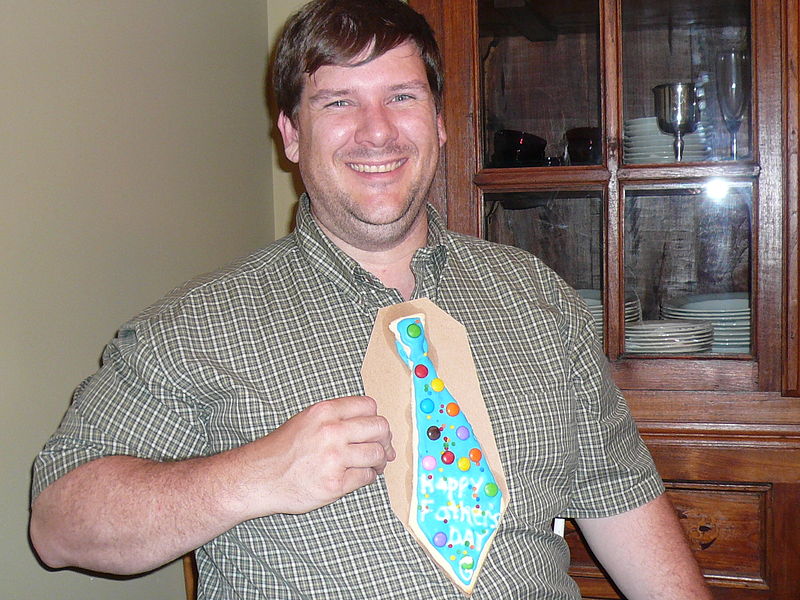
A father holding a necktie cookie on Father’s Day. Author: Dean Michaud, originally posted on Flickr, terms compatible with Commons.
There are two versions regarding the origins of a special day to honour fathers in the United States. Some people maintain that it was first introduced in 1910 by a woman called Sonora Smart Dodd, who was inspired by the work of Anna Jarvis, the woman who had pushed for Mother’s Day celebrations. Sonora’s father raised six children by himself after the death of their mother – which was uncommon at that time, as many widowers placed their children in the care of others or quickly married again – and Sonora felt that her father deserved recognition for what he had done. The first Father’s Day was held in June 1910, and was officially recognized as a holiday in 1972 by President Nixon.
Others in the U.S. say that Grace Golden Clayton from Fairmont, West Virginia, should be credited with the idea of Father’s Day, after she suggested a day to celebrate fatherhood in 1908, following the anguish of the Monongah mine disaster in December 1907. Officially, 362 men died, in that disaster, 250 of them fathers, leaving more than a thousand children without a dad. It was America’s worst mining accident. Most of the men were Italian migrants and the actual death toll is estimated at nearer 500.
Grace Golden Clayton, whose father was killed in the tragedy, suggested a service of commemoration for this lost generation to the pastor of her local Methodist chapel, and the first Father’s Day took place on July 5, 1908. But Grace’s idea did not spread outside this isolated mining settlement. It took off two years later, after Sonora Smart Dodd’s campaign.
Father’s Day again fell into disuse until the 1930s, and then slowly gained official recognition. President Richard Nixon proclaimed it a national holiday in 1972.
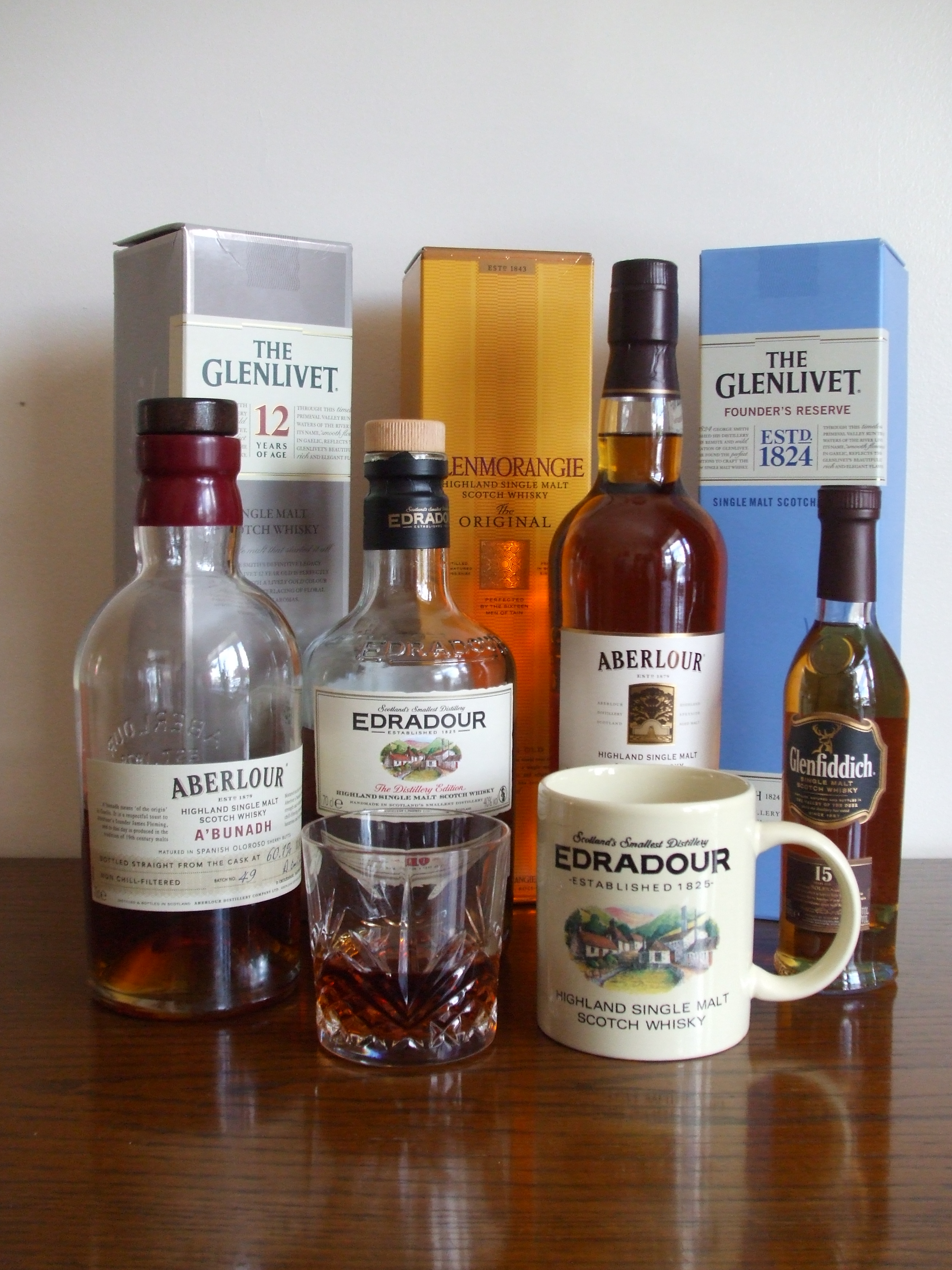
I have to confess that until I looked this up, I didn’t know the origins of Father’s Day in the U.S. I knew the custom started in America but, like many other people, I assumed it was either another money making ploy on behalf of the gift and card industry, or a way of keeping things equal with Mother’s Day – which is partly true. In our house, our children usually come round with presents. This year, they’ll probably start arriving later this afternoon. The usual gift is some type of malt whisky, although sometimes there will also be the odd box of chocolates. Our youngest son, who works in various places abroad, often sends some kind of plant for our garden via Interflora or suchlike. We have lots of plants and flowers that started life in wicker baskets, and they’re doing very nicely.
One last note or two…
In Germany, Father’s Day (Vatertag) or Men’s Day (Männertag) is celebrated differently from other parts of the world. Groups of men go off into the woods with a wagon of beer, wines and meats. Heavy drinking is common on that day and traffic accidents tend to rise, causing police and emergency services to be on high alert. Some right-wing and feminist groups have asked for the banning of the holiday. Father’s day with a kick, I’d say!
A Hiking Tour on Father’s Day. Author: Steffen Gebbhart at Wikimedia. Public Domain
In China, Father’s Day used to be on August 8. This was because the Chinese word for 8 is ‘ba’ and the colloquial word for father is ‘ba-ba’. It has now been moves to the third week in June to keep in line with other countries.


 Valentine was a Roman priest during the reign of Emperor Claudius the Second in the third century AD. He is sometimes known as Claudius the Cruel – and is not the Emperor Claudius who was responsible for ordering the building of Hadrian’s Wall across the North of England in AD 122-130.






















 Millie Thom

