

It’s now Sunday, and I’ve been in Andalucia since late morning on Thursday. The two main observations I’ve made so far are that it’s very beautiful and that it’s flippin’ hot for the first week of May!

This map shows just how many rivers there are in Andalucía. The one that features in Book 3 of my Sons of Kings trilogy is the Guadalquivir – the longest river in Andalucia, with innumerable tributaries. It flows right across northern regions of Andalucía and out through its delta into the Atlantic Ocean. Of course, rivers were very important to my intrepid Vikings, who were heading for Cordoba, on the Guadalquivir.
Since Friday we’ve been in Seville and both today and yesterday it’s been well over 30°C. Now, that may not sound hot for this time of year to all you people who are treated to weather like this every spring. But to someone from the north of England, it’s like walking into an oven every time I step out of the hotel door!
I’ll probably do a post about Seville later on, but today I just want to post a few photos of two smaller towns we passed through after landing at Malaga.
The first was just a visit and overnight stop in the tiny village of Mijas, situated twenty one miles to the south-west of Malaga. It’s a lovely, typical old, white-washed Andalucian village, nestling high on a hillside with wonderful views over the Mediterranean coast.

One of the things that Mijas is known for is its use of donkeys around the town, which has caused many complaints to be made by tourists regarding their misuse. Complaints have included the animals being left standing in the hot sun for hours on end. I won’t go into this issue here as I’m sure there’ll be plenty online about it. Of course, the donkey taxi service is regarded as a big tourist attraction, as seen in the statue we saw:

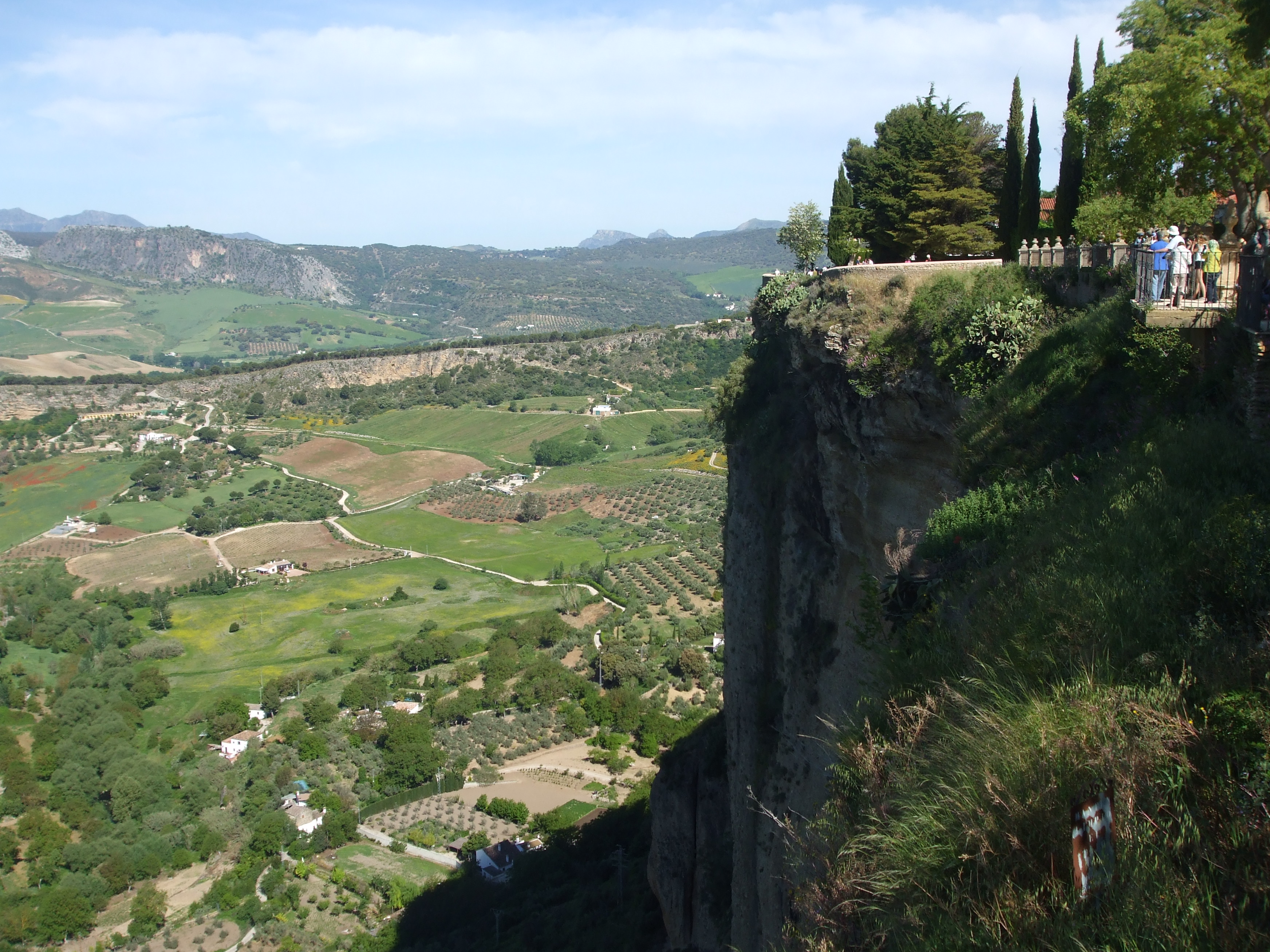
The following day we continued on to Ronda, just thirty one miles from Mijas. Ronda is of the most ancient cities in Spain, and is quite a stunning place, cut into two by the deep gorge of the River Guadalevin. On one side is new Ronda and the other, the ancient city. Both sides are joined by the Puente Nuevo bridge, (New Bridge) built between 1751 and 1793.
Here are a couple of photos of the gorge and bridge that we took.


 Ronda’s main claim to fame is that it has the oldest bullring in Spain, and even the world. The first fight took place in 1785.
On Monday we head for Cordoba for a few hours, before moving on to Granada for our last two days.

Here is a map of Andalucía to show the location of towns. It’s the only one I could find whilst away from home:
 Millie Thom