I am a reader and writer of historical fiction with a keen interest in the Earth's history and all it involves, both physically and socially. I like nothing better than to be outdoors, especially in faraway places, and baking is something I do when my eyes need respite from my computer screen.
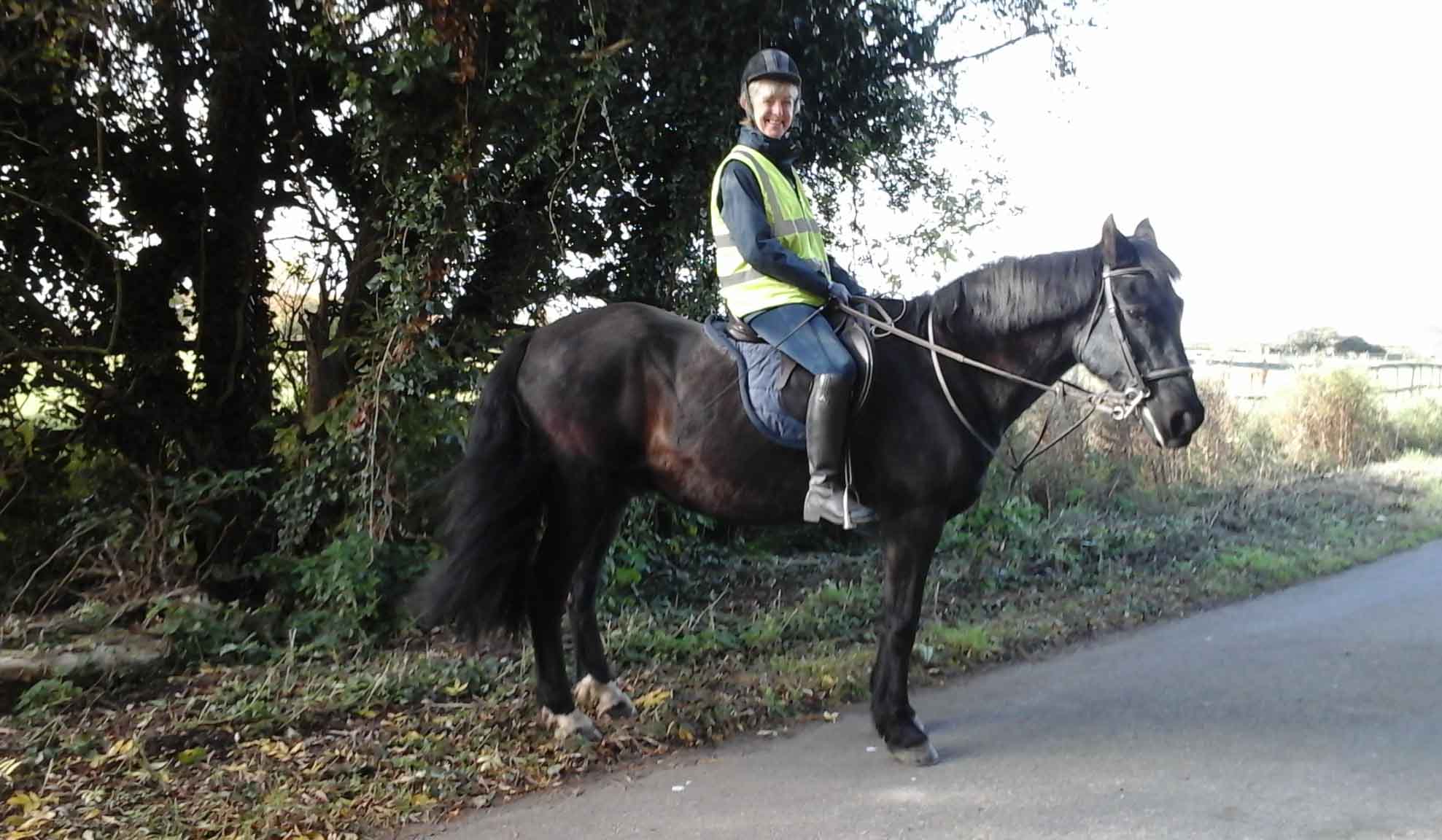
A couple of days ago I was chatting with fellow blogger, Lynn – from Lynz Real Cooking – about the lovely colours of Fall. Lynn suggested I do another post about the village in which I live and show what the autumn lanes looked like. The lady on the horse, above, is a neighbour and retired teacher, like me. There are so many people with horses in this village, and the clatter of hooves is a common sound. (Nothing to do with autumn – just part of village life.)
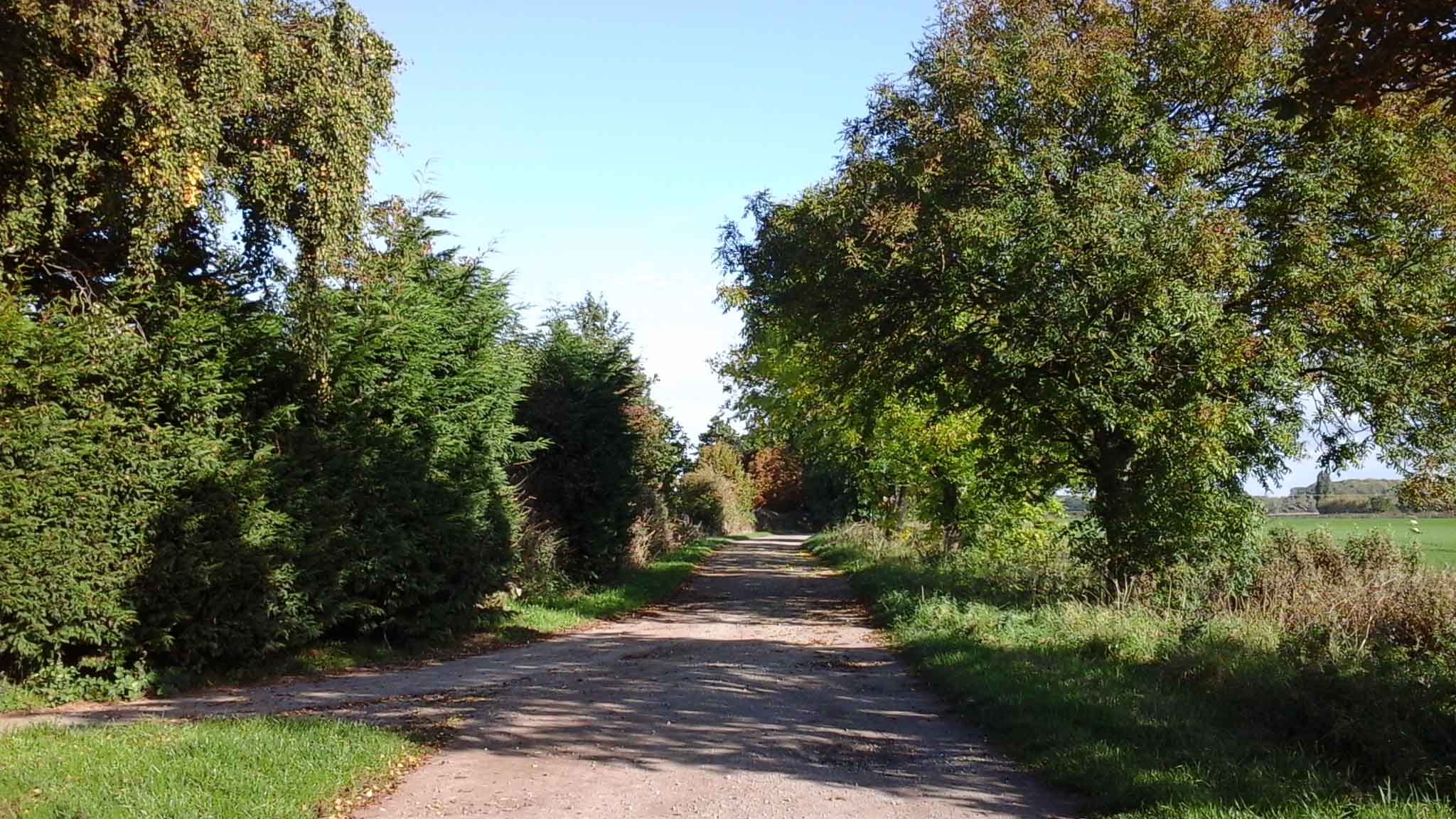
As you can see, much of the landscape around our village is holding on well to its summer green. The trees are turning gold, some species more so than others, as to be expected. But the good old oaks, always the last to give way, are still pretty green, whereas most of the ash trees are bright yellow. Deep amber, horse-chestnut leaves also litter the ground, with shiny conkers amongst them:
Most of the berries that filled the hedgerows a month ago are now becoming wizened; only the hawthorne berries (haws) still bright red. Haws can usually be seen well into winter, as the birds don’t seem to like them much, and only eat them when all the juicier fruits have been devoured.
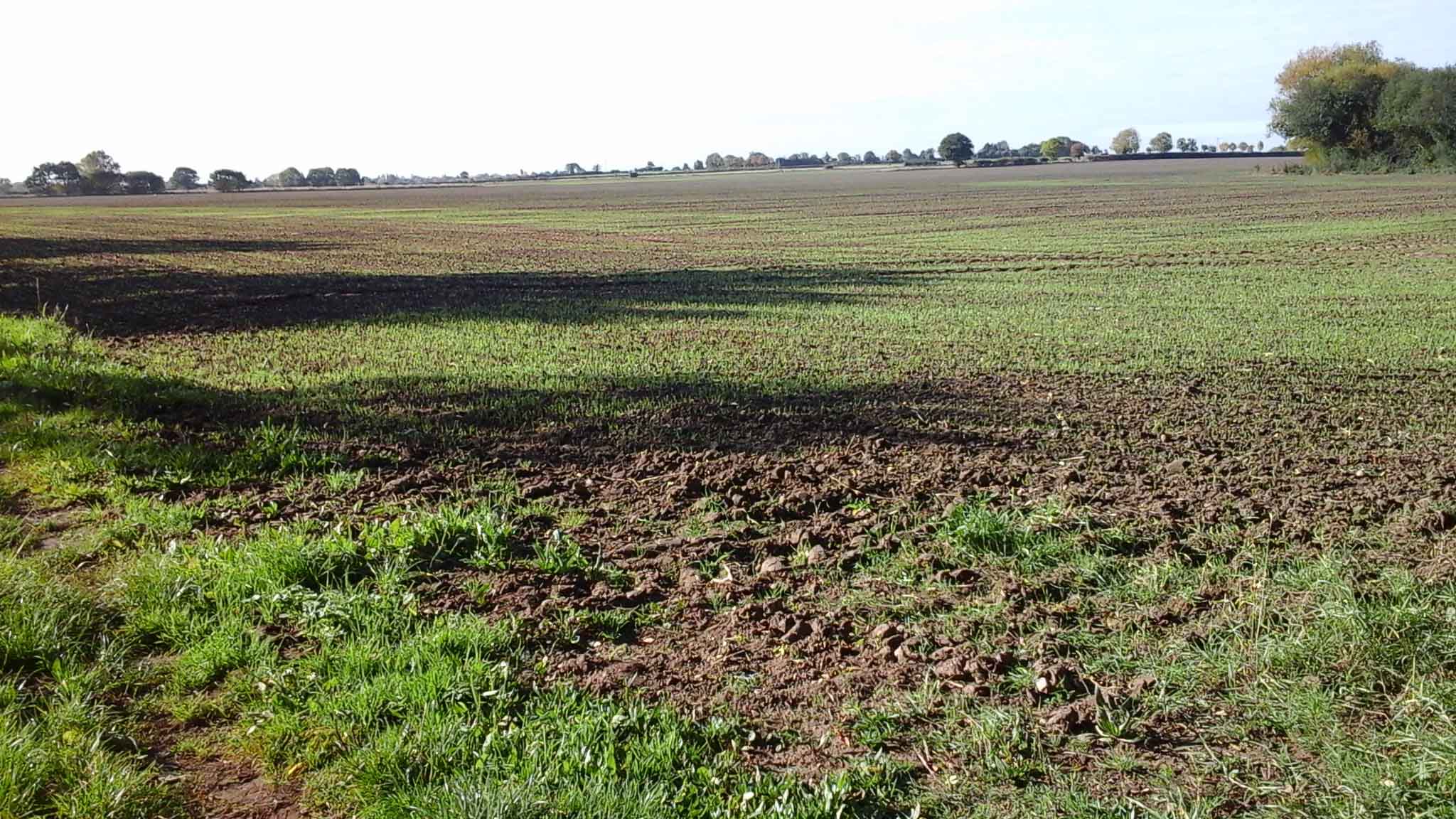
The photos below show a mix of lanes, hedgerows and trees, in varying states of ‘browning’. We have little of the blazing red colours common to parts of North America, so our colours tend to be a mix of golds, ambers and browns, with the deeper red of the odd copper beech here and there. We do have the occasional red maple, and they make a wonderfully bright splash aamongst the rest. Many of the fields are now sprouting spring wheat or barley, ready to grow with all haste once the winter’s done:
Here are a few more photos from my walk down the lanes immediately round our house…
And here’s a selection of views from around the village. We have a mix of houses – old and new – some dating back a few hundred years. The church of Saint Helena dates back to the 11th century and old telephone box is definitely past its sell-by date, but there’s still a useable phone in there. I’ve never seen anyone using it, so whether it actually works is anyone’s guess. The dovecote is a rare old thing, too, built in the 13th century (last picture). The amusing name of Washtub Lane has two possible origins, both related to a farmhouse once located there. The name could refer to the lines of washing hanging at the farm, or to the big tubs standing there, for washing leather and tannery.
Well, that’s it until winter comes along and I can take some frosty pictures, if not snowy ones. Next Saturday the clocks go back in the U.K. and the dark nights will descend earlier and earlier. Now that is a really depressing thought. 😦
All children love this rhyme, and this version of it is from the late nineteenth century. The first version, earlier that century, made no mention of a pig.
And the reason I’m quoting the rhyme at all . . .?
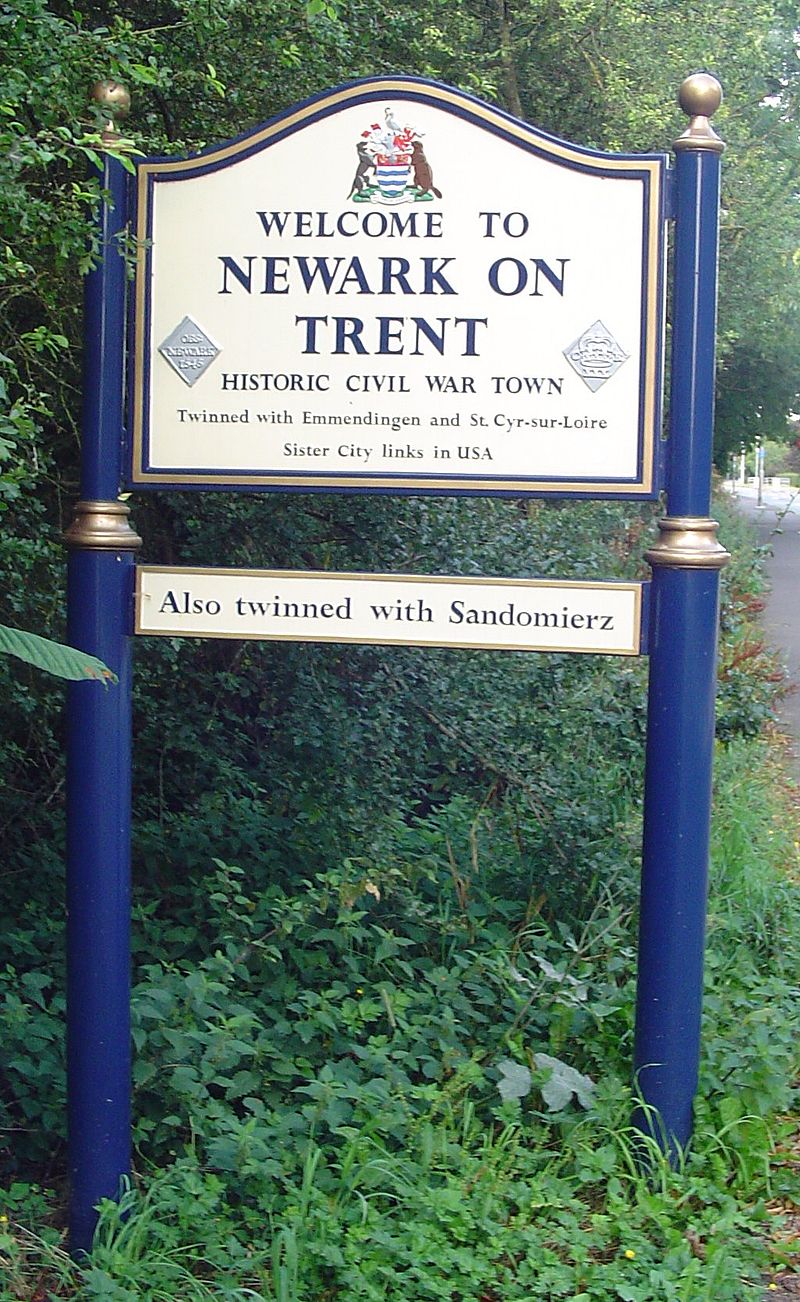
Well, I love old towns, old buildings and anything of historical interest in general. The market town of Newark (full title, Newark-on-Trent) in Nottinghamshire, is simply brimming with history, and I’ll be doing a post about it some time soon. (We lived in Newark for eleven years, before moving out to enjoy village life seven miles away.) Today I just want to share some views of the market and market place in general and a few words about its history. Our eldest son has his butcher’s shop there which, naturally, we visit when we’re in town.
Newark Royal Market is one of the oldest in the UK, dating back to the 12th century when a charter was granted by Henry VI. Originally held on a Sunday, it became the first market in England to operate on a Wednesday. Its Royal Charter was granted in 1549 by Edward VI, and since then it has continued to be a key trading centre for the region. Markets are held five days a week: general markets on Wednesdays, Fridays and Saturdays and ‘collectors’ or antique markets on Mondays and Thursdays (which sound impressive, although few stalls are involved).
The markets are held in the impressive market place, overlooked by the Georgian town hall, with the spire of the church, St. Mary Magdalene, also in the background. Both of these can be seen in the photos below, as well as a few very old, Tudor-style buildings and the old water pump. There are also some stocks – which I forgot to photograph yesterday.
Until relatively recently, Newark was famed for having the oldest cobbled market place in the country, and possibly in Europe. But sometime around 2000, the old cobbles were removed and replaced by new, smoother and flatter ones. I completely understand that this was done for safety reasons – old people, either on foot, in wheelchairs or mobility scooters, and mothers with pushchairs, all found the bumpy cobbles difficult to walk on. For anyone unsteady on their legs, they were obviously dangerous. Yet the destruction of something of such historical value still causes a pang.
And this is my son’s butcher’s shop, also in a really old building, close to the market square:
The cellars beneath Richard’s shop have tunnels running through the shops alongside it, right up to the building facing the market place. They were all once part of that building – an old hotel/inn called The Clinton Arms. The last picture above shows the view from his shop to the market. We’re delighted that it’s such a prime site for him, and his shop is very popular. Not surprisingly, he’s a great butcher, having worked at it since leaving school (and he’s now 41).
So I suppose, if anyone wanted to buy a fat pig (though not a live one) Richard’s would be the place to go . . .
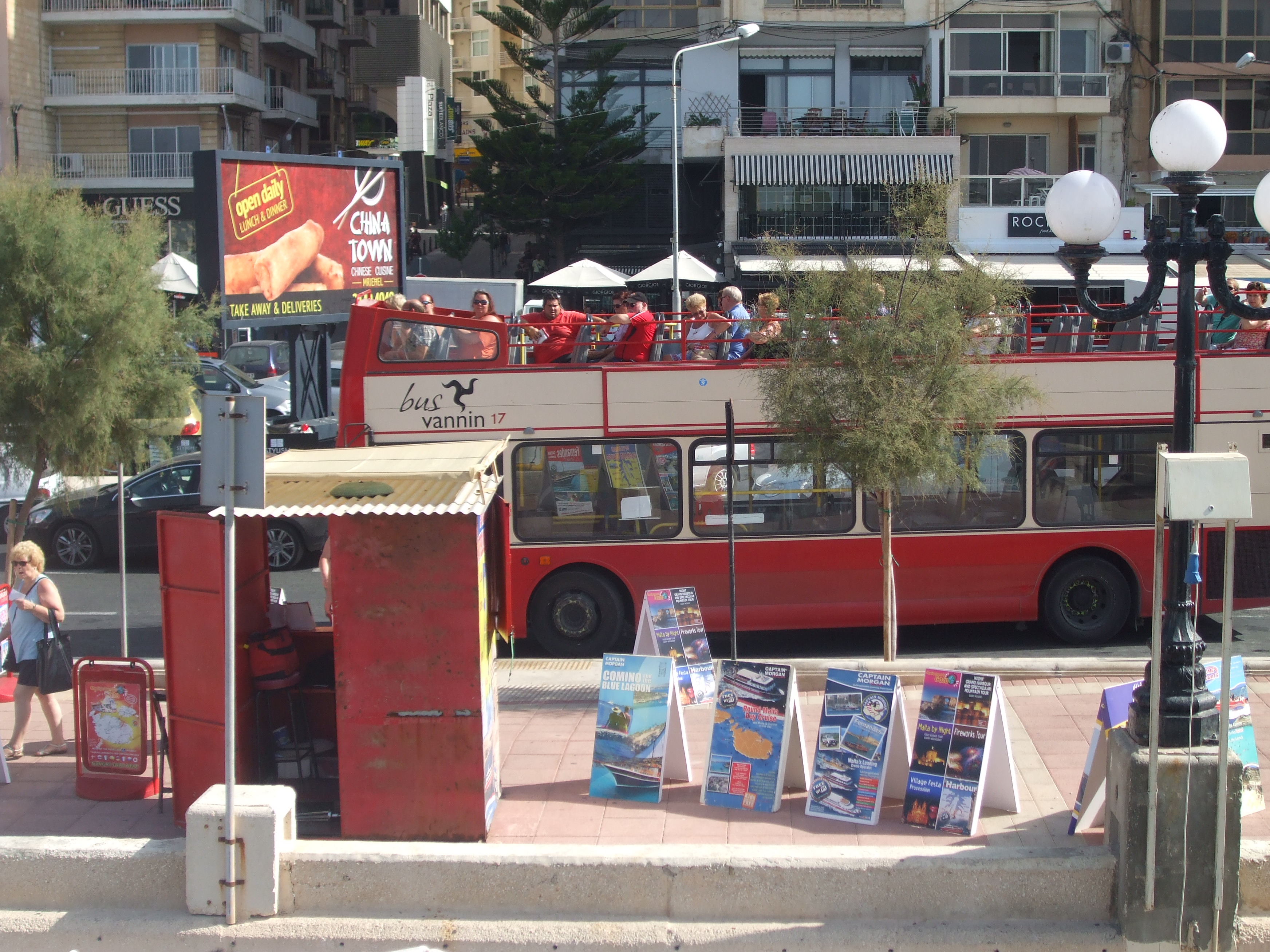
I only have a couple more posts on Malta to do now and this one, along with the one following it, are about two sites we visited on the Thursday of our week’s holiday in September. To travel out to these sites we used the ‘hop on-hop off’ buses that are so well used on both Malta and Gozo:
Ghar Dalam – which means ‘Cave of Darkness’ in Maltese – is a naturally water worn, limestone cave on the outskirts of Birżebbuġa in the south east of Malta. It is one of the island’s most important monuments and the only cave on Malta where the Pleistocene (Ice Age) can be seen in an uninterrupted sequence, dating back 180,000 years. The earliest evidence of human presence on Malta has also been found in the cave, with artefacts dating back 7,400 years to the Neolithic Period.
On leaving the building where the reception and museum are housed we headed down the steps and through a small garden of exotic and indigenous trees. From here there are excellent views across the Dalam Valley, in which the cave is located.
Then it was off to the cave . . .
The scientific importance of Ghar Dalam wasn’t realised until 1865 when a Genoese geologist, Arturu Issel, came to Malta in search of Palaeolithic Man and found the remains of various animals as well as many pottery sherds in the cave. Other scientists soon followed but, unfortunately, so did poachers raiding the bone deposits. These thefts were eventually stopped by the installation of a gate at the cave’s mouth, as can be seen in my first/header photo above.
On entering the cave, it becomes obvious why it was given the name, Cave of Darkness. Without the many lights, it would have been very dark within feet of moving away from the entrance – and it’s 144 metres (472 feet) long, although only the first 50m are open to the public for security reasons. This photo is looking into the cave from just behind the gate:
Like all limestone caves there are stalactites and stalagmites along its length, and there are labels at intervals to explain which types of remains were found at those spots and at what depth. Here are a few photos:
Ghar Dalam’s scientific importance revolves around the effects of the Ice Age on the Maltese Islands. During the time that ice sheets covered most of Central Europe and the northern hemisphere, Malta experienced a Rain, or Pluvial, Age instead. Torrential rains swept animals away and carved out valleys, including the Wied Galam. Falling sea levels created a land bridge, joining Malta to Sicily – across which many animals travelled to Malta, pushed south by the harsh conditions of glaciation to the north. These included elephant, hippopotamus, bear, wolf and fox.
Over the thousands of years these large animals underwent evolutionary change to ensure their survival: a small island could not possibly provide enough food for herds of large animals. The type of adaptation these species underwent on the island is called NANISM -i.e. they became smaller. Sometimes it is referred to as ‘dwarfing’ or ‘dwarfism’.
There are also examples of gigantism – the opposite of dwarfism – on Malta. This generally occurs in species that breed continuously, so only the biggest and strongest will find enough food to survive. The giant dormouse grew to be the size of a modern guinea pig and the giant lizard reached a length of 70cm (27-28 inches). The giant Maltese tortoise grew to the size of today’s Galapagos Island tortoises.
Malta is not the only one of the Mediterranean islands to exhibit nanism and gigantism, as this (not very clear and in-need-of-editing) map shows:
In the Ghar Dalam Cave there are six distinct layers of deposits, each labelled according to the main species or characteristic material found in it. Animal remains have been found in layers 2, 4 and 6 – where 6 is the uppermost layer. Layer 2 is known as the hippopotamus layer, layer 4 is the deer layer. Layer 6 is the cultural/domestic layer, covering the last 7,000 years since humans arrived on Malta – as well as containing animal remains and pottery.
The Victorian-style museum was opened in the 1930s. Showcases contain bones of similar size and origin mounted on boards in rows, and teeth are held in jars or stacked in rows. Everything was designed to impress through sheer quantity – with little attention given to the exhibit’s scientific or educational value. The mounted skeletons all belong to present-day animals and are not from the cave.
Hippopotamus
Elephant
Wolf
Deer
A second room was opened to the public in 2002 covering different aspects of the cave’s formation and animal and human finds, as well as information on the fossil fauna that were present on the Maltese Islands during the Ice Age.
Ghar Dalam Cave has served as shelter for humans and animals since prehistoric times. The remains of Early Man have been found as well as pottery. Middens (ancient rubbish pits) have revealed animal bones and the cave served as a cattle pen until the excavations of the mid-nineteenth century. During the Second World War (August and September of 1940), 200 people lived in the cave, leaving it when the Royal Air Force wanted to use it for the storage of aviation fuel.
All in all, the Ghar Dalam Cave well deserves to be listed as one of Malta’s most important sites.
Word of the Week (WOW) is a weekly challenge created by Heena Rathore P. It’s a fun way to improve vocabulary by learning new words every week. To participate, simply do a post with your word and leave the link as a comment on Heena’s WOW post for this week (above link).
Eating the chocolate ice-cream was an ephemeral pleasure in Ellie’s otherwise hectic day.
2. Having a short lifespan or a short annual period of aboveground growth. Used especially of plants – as in chickweed:
Chickweed is known as an ephemeral weed because it produces several generations in one season.
Stellaria Media Common Chickweed. Author: Lazaregadnizda. Wikimedia Commons
3. Noun: Anything that is short-lived, as certain insects – like mayflies.
Mayflies emerge from the water and live for only 24 hours – in which time they must mate and the female lay the eggs on the surface of the water. If enough of them appear at the same time, as in some species, they create a swarm.
Mayfly swarming on Tisza. Author: Kovacs,sziland. Commons
Word Origin:
1570-80; from theGreekephḗmer(os) meaning short-lived,lastingbutaday
The blaze of colour along the valley seemed all the more wonderful to the hikers because it was so ephemeral:
2. Lucy gazed at the old photo of two models wearing 1930’s style swimsuits, considering how fashions were so ephemeral: new ones come in and old ones disappear, perhaps to be reintroduced at a later date:
Fashion Photo: Bathing Suit, Modell Schenk. Circa 1930. Author: Yva (1900-1942). Public Domain: Wikimedia Commons
3. For my third example ‘sentence’ I have concocted this little tale, in which I have attempted to use the various forms of this week’s WOW:
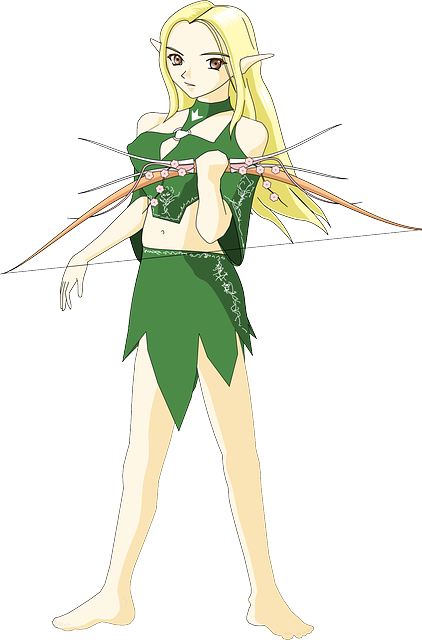
King Eldrin of Elf Land glared at his daughter, Elinora, her pretty face marred by yet another ephemeral scowl. Desperately wanting the wilful young princess out of his hair, he hoped one of today’s contenders would suit her style.
But Elinora had rejected several suitors already, her affections as ephemeral as the beautiful daylilies adorning Eldrin’s palace grounds.
Red and yellow daylily, called a Red Magic Lily. Author: Victorrocha. Commons.
The ephemerality of Elinora’s affections worried King Eldrin, as his daughter was rapidly leaving her youth behind. His worried subjects would soon be assigning her spinster status. He understood too well the ephemeralness of beauty. One only had to look at his wife, Queen Ermintrude, whose rare beauty had rapidly deteriorated post wedlock. Before long she had begun to resemble the cow* after whom she was named.
Today, a handsome young prince named Elandorr would attempt to engage Elinora in ephemerally interesting conversation. As long as it held the girl’s attention for an hour, Eldrin would declare him the victor in this marriage game, as previously arranged. With a bit of luck, Elinora and her ephemeral nature would henceforth be Elandorr’s problem.
* Ermintrude was the name of the cow in the 1960’s cartoon series called The Magic Roundabout – since made into a film. Ermintrude was really quite sweet, so I mean no offence to her! All the pictures I could find of her were copyright, hence I’ve none to show here. 😦
If you’d like to view more interesting words, visit Heena’s Page
Flash Fiction for for Aspiring Writers is a writing challenge hosted by Priceless Joy. It asks us to write a piece of fiction from the photo prompt provided in around 100-150 words – give or take 25 words. It encourages us to comment, constructively, on other entries, so supporting each other’s writing. If you’d like to join in with this challenge, follow the above link to see what to do. The challenge runs from Tuesday to Tuesday every week.
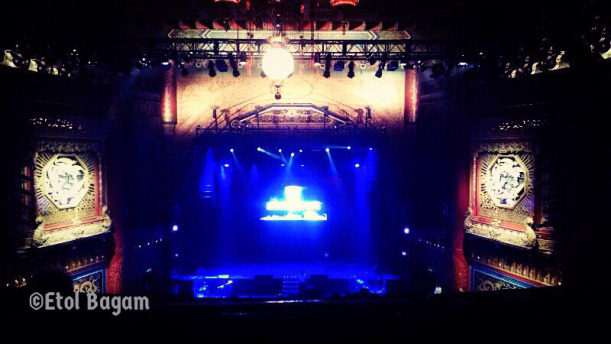
Here is this week’s prompt, kindly provided by Etol Bagam:
And this is my story:
No White Feather
Reg swigged back his ale and grinned at his wife, chuckling at the stand-up’s jokes. The music hall was packed, every table full. Ale was flowing and the noise from the audience was rising rapidly.
‘I knew you’d enjoy it,’ he said, taking her hand. Some good turns on – though I didn’t know Vesta Tilley’d be singing tonight.’
Agnes nodded. ‘I’ve heard of her. She dresses like a man to make people laugh – and to persuade men to recruit into Lord Kitchener’s Army. Not married ones, I hope . . .’
Cheers erupted as Vesta Tilley appeared on stage, dressed in a soldier’s uniform. Her first few songs had everyone singing along. Then all fell silent as she stepped down from the stage, wandering amongst the tables singing, ‘Oh, we don’t want to lose you but we think you ought to go,’ touching men’s shoulders as she passed.
As most of the men, Reg rose and followed Vesta back to the stage. He’d fight the Hun for king and country. No white feather for him.
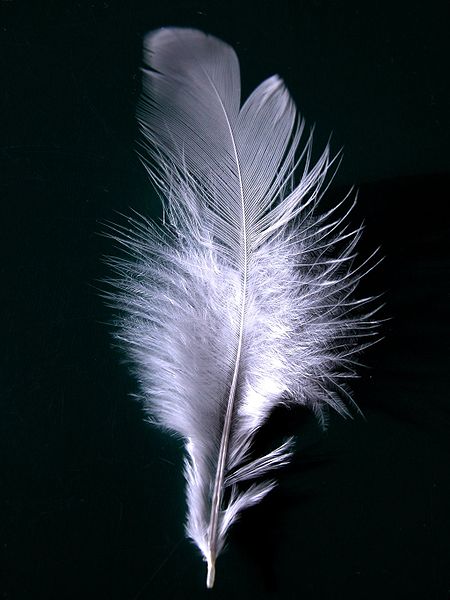
A single white feather close up. Author: Joao Andrade de Frietas. Uploaded by Rex Public Domain.
’Word Count: 175
If you’d like to view other entries, click the little blue frog below:
For anyone interested, here is a some information about music halls and a few things mentioned in my story that might be unfamiliar to people:
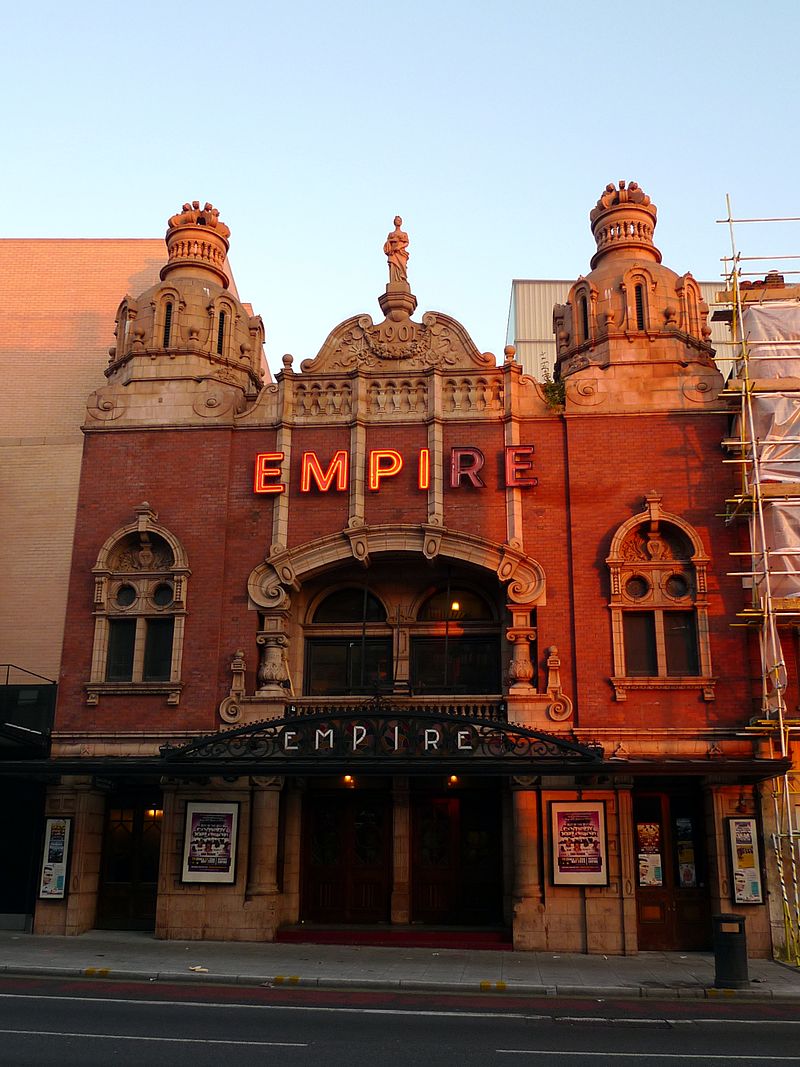
British Music Halls were originally tavern rooms which provided entertainment in the form of music and speciality acts such as short plays, comedy sketches, acrobats, minstrels, dancers, magicians, jugglers and even trick dogs. By the middle years of the nineteenth century the first purpose-built music halls were being constructed in London. Soon there were many around the country:
The Hackney Empire, a typical Music Hall. Author: Ewan Munro from London, UK. Commons
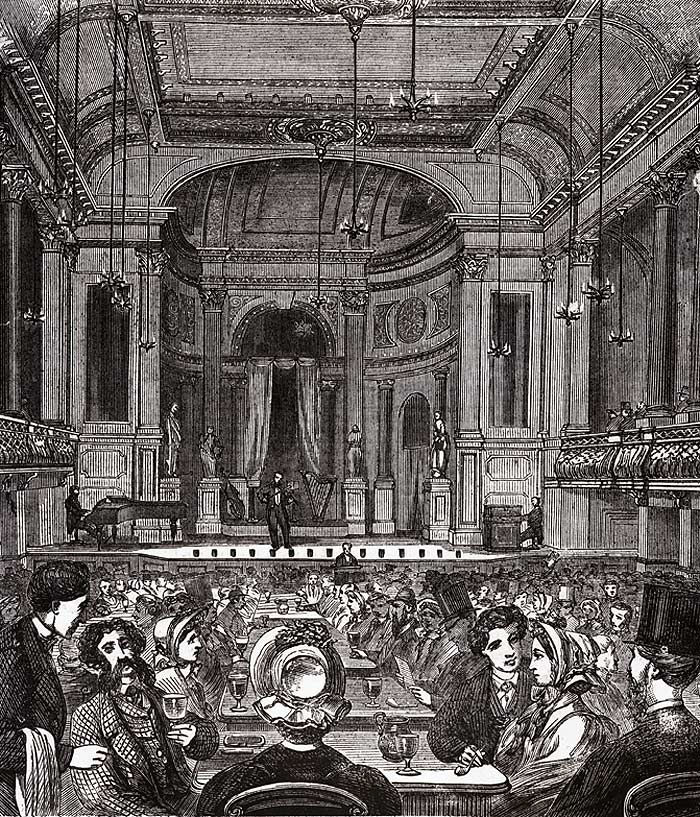
In effect, they were half pub, half theatre. The large halls had a stage but in the seating areas, tables were provided so that patrons could continue their drinking and socialising (generally noisily) while the ‘acts’ were on:
The Oxford Music Hall 1875. Public Domain. Uploaded by File Upload Bot (Magnus Manske) Wikimedia Commons
The halls created a demand for new and catchy popular songs, many composed by professional song writers with their working class audiences in mind. Songs like ‘My Old man Said Follow theVan’ and ‘Waiting at the Church’ described situations which the urban poor would be familiar with.
‘Well oiled’ on cheap beer, the audience chorused songs they loved and abused acts they loathed. In some places audiences would throw things at dud acts, and the bottles carried by the waiters were chained to the trays to prevent them being used as missiles.
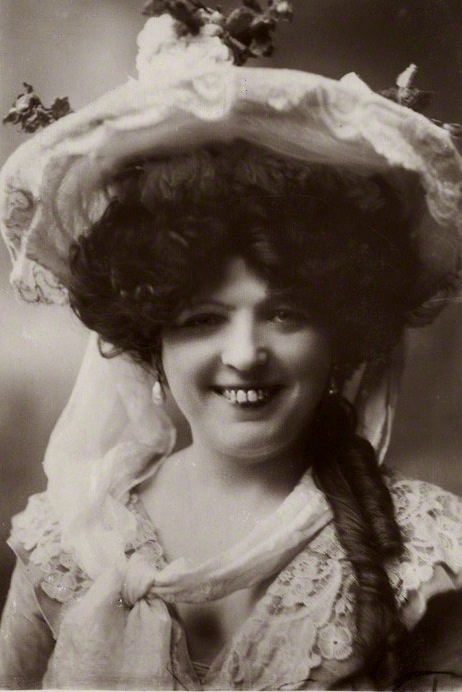
Music Hall’s support for the war effort is well documented – although no one can deny that owners, landlords and song writers made a lot of money out of it. By the end of 1914, 30 or more specially composed songs promoting recruitment had been written. Many music hall performers threw themselves into the effort, including, the most popular of all the singers, Marie Lloyd . . .
Postcard print of Marie Lloyd. Author Louis Saul Langfier (1859-1916). Public Domain
. . . and the singer most famous for her army recruitment success, Vesta Tilley:
Vesta Tilley had sung in music halls since she was 5 and generally dressed in men’s clothes (although during the day she took care to dress in her usual women’s wear to emphasise her femininity). One of her most popular songs was about a young swell, ‘Burlington Bertie‘. During the early years of WW1, along with many other music hall performers, she helped in the recruitment of thousands of men.. She dressed as a soldier and sang patriotic songs, including Jolly Good Luck to the Girl Who Loves a Soldier and The Army of Today’s All Right. She was given the nickname of ‘Britain’s best recruiting sergeant’.
Vesta Tilley in her role as Burlington Bertie. Public Domain
In 1914 Lord Kitchener introduced voluntary enlistment to increase British forces. It helped to create Britain’s first mass citizen army. Kitchener was one of the few British leaders to believe that this war would be long and difficult, and not ‘over by Christmas’. Within a year it became obvious that it was not possible to continue fighting by relying on voluntary recruits. Conscription was introduced in March 1916.
Kitchener’s First World War Recruitment Poster. Public Domain. Author Alfred Leete, 1882-1993 Wikimedia Commons
The name ‘Hun’ was a derogatory term for German soldiers. It resulted from a remark made by Kaiser Wilhelm of Germany in 1900, when he sent his armies to deal with the Boxer Rebellion in China. He told his troops to show no mercy – just as the Huns, 1000 years earlier, had exhibited wanton destruction as they swept through Europe.
The White Feather has been a traditional symbol of cowardice, used within the British Army and countries associated with the British Empire since the 18th century. It aimed to humiliate men who were not soldiers.
The White Feather Movement was a propaganda campaign in England during WWI to encourage men to enlist in the army. White feathers were distributed by women of the Order of the White Feather to any man they deemed capable of joining the army who was out of uniform. They aimed to make men realise that women viewed them as cowards. Other men would therefore be so afraid of receiving a feather they would join the army. Conscientious objectors were seen as cowards and received white feathers if their stance became known.
This poster was not one printed for this movement, but a part of the Parliamentary campaign:
May 1915 poster by E.V. Kealey from Parliamentary Recruiting Committee. Public Domain. Wikipedia Commons
This is a continuation of my post about the Maltese island of Gozo, which we visited on the Wednesday of our week in Malta in early September. It was a great day out, and we saw a lot of the island, the main site being the Ggantija temples (pronounced like something like J-gan-tia) which my last post on Gozo was about. This time I’m adding a little about some of the other places we visited. So here we go.
After leaving the Ggantijan temples at Xaghra, we headed out to the east coast to the town of Marsalform to take a ride on a little trackless train:
Marsalform itself is the most popular seaside resort on Gozo and is always crowded . . .
. . . but we headed on along the coast to have a look at the 300-year-old, rock-cut Qbajjar Salt Pans, the biggest salt works on Gozo and stretching over 3km. Several tons of sea salt are produced each year, continuing the centuries old Gozitan tradition:
We were all handed a nice little bag of sea salt from an old Gozitan stationed along the roadside. The ‘train’ pulled out so quickly that none of us had chance to even offer the old man a tip! I can only hope the tour company pay him for providing this little ‘extra’ service and keeping the customers/tourists happy.
Heading off across country to the west coast, we stopped en route at a Craft Centre to have a quick look round. There were a variety of goods on display, one of the main things being traditional Maltese lace:
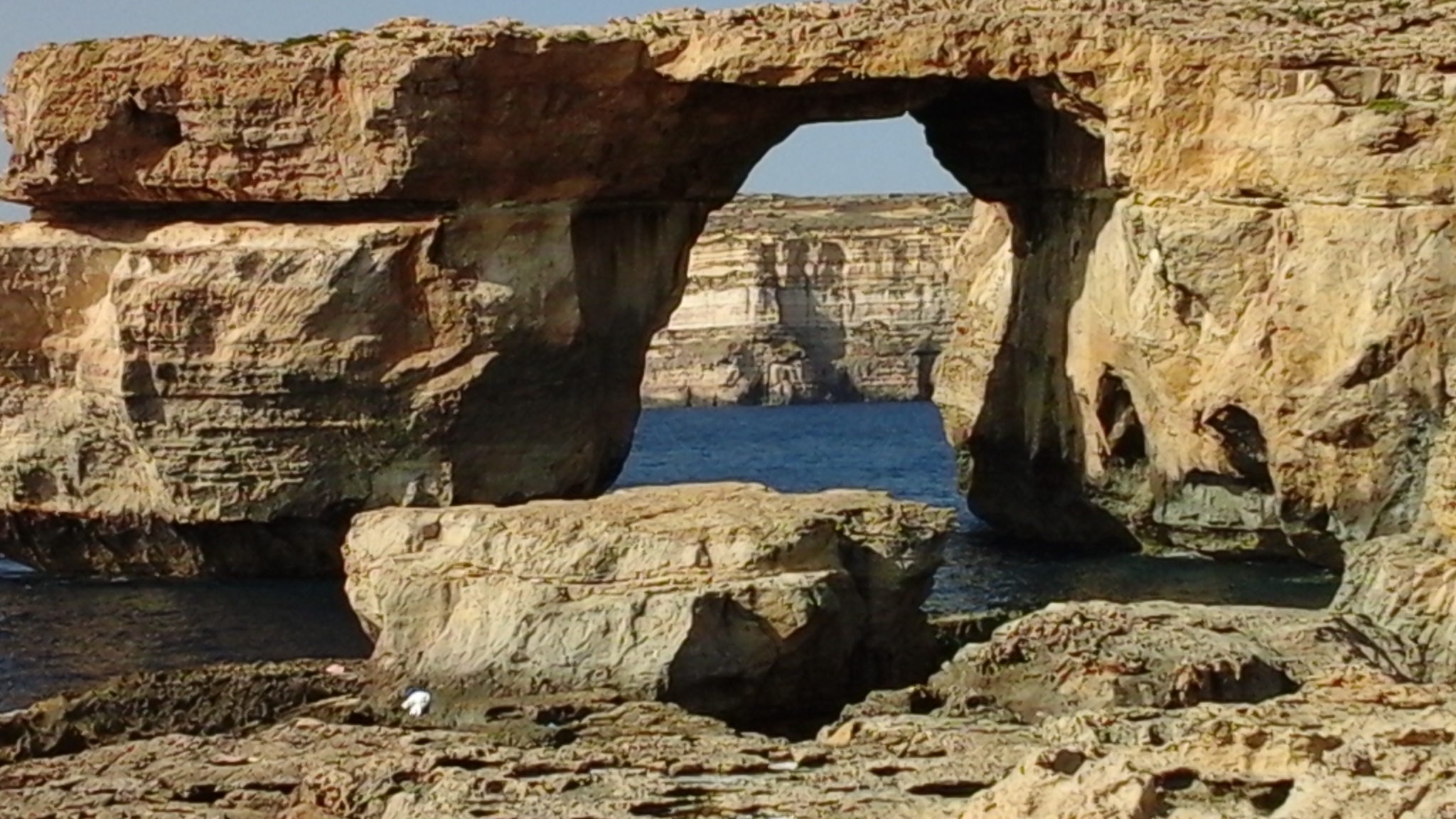
On to the west coast … and the beautiful Azure Window (my f1rst image on this post). All three of the main Maltese Islands have a ‘blue water attraction’ for tourists to admire. On the south coast of Malta is the Blue Grotto and on the little island of Comino, the Blue Lagoon. On Gozo, near to Dwejra Bay on the Inland Sea, it’s the Azure Window – a favourite place for scuba divers from all over the world. There is an underground cave close by and the sea is warm for snorkellers and sea bathing. Here’s another picture of it, although it’s little different to the one above:
The Azure Window itself was created by the collapse of two limestone sea caves, and is very lovely to see. It has been featured in many films, including: Clash of the Titans (1981) the Count of Monte Cristo (2002) The Odessey (1997) – and last but not least, even Game of Thrones!
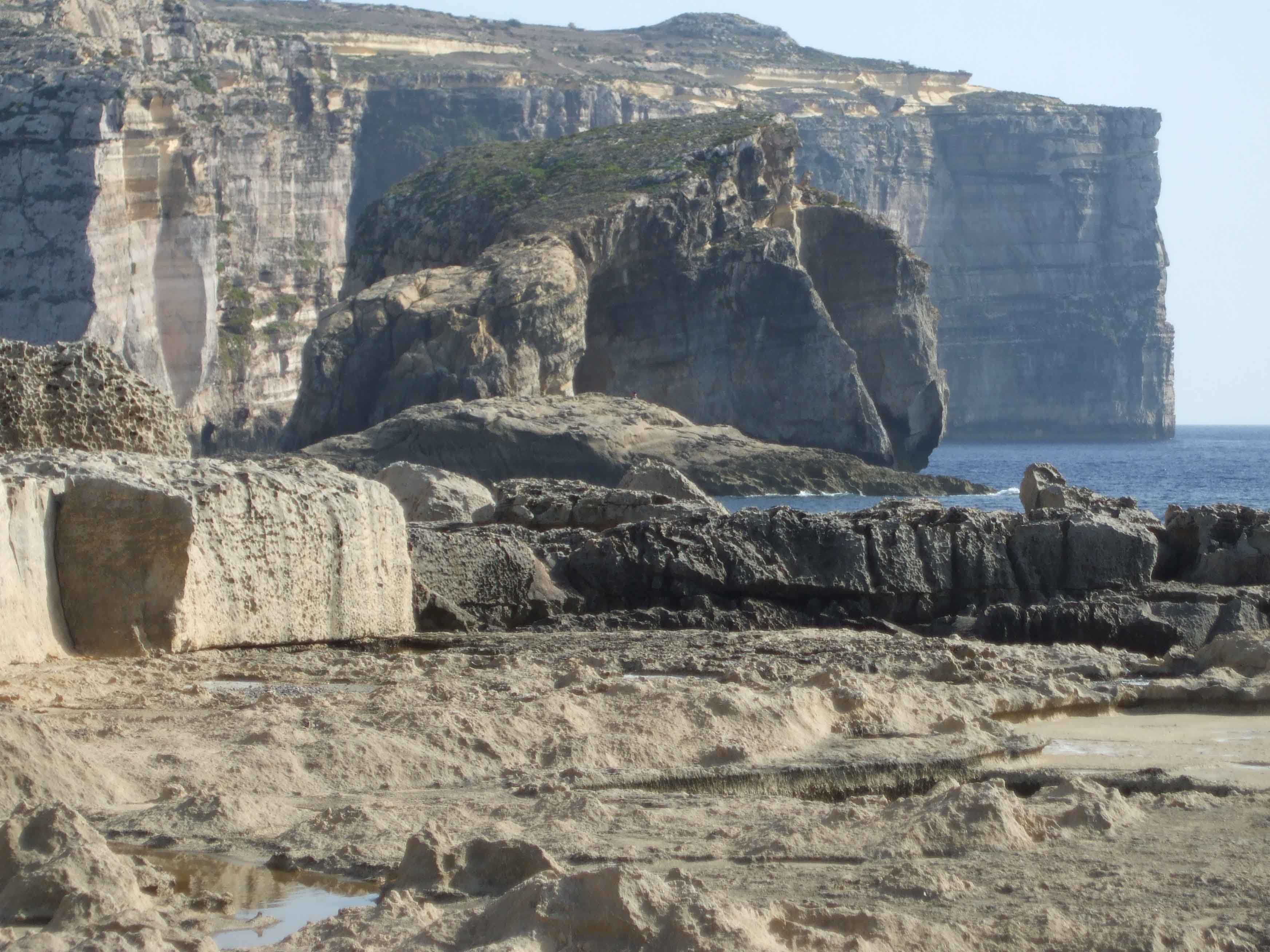
Close to the Azure Window (behind us as we photographed the arch) is Fungus Rock – so named because of its mushroom-like shape. I wasn’t totally convinced it resembled a mushroom, but who am I to know these things? Well, here it is:
Eventually, we headed for Victoria (Rabat) the capital of Gozo:
Citadella, Victoria (Rabat) Gozo, Republic os Malta. Author: Radoneme, Wikimedia Commons
The city’s original name was Rabat, but on Queen Victoria’s Golden Jubilee in 1887, the British government changed it to Victoria. Many Gozitans, however, still call it Rabat, so both names stick together. The city is located in the cente of Gozo.
At the city’s centre is the Citadel or Citadella (pronounced Chitadella) which has its roots in the late medieval times. But the hill on which Citadella stands has been used since Neolithic times as a sanctuary from attack by Barbary pirates and Saracens.
Unfortunately, we weren’t permitted – mayor’s orders! – to enter the Citadella, as building work was going on. (Don’t ask – we didn’t understand that either!) I don’t think we would have had time, anyway, as the tour guide rushed us back to the coach as soon as we’d had our meal of the day at almost 5 pm. We did manage five minutes inside the Basilica of St. George before we had to rush off. The other photos were quick snaps as we walked.
There were several plaques and other reminders of St. George along our route. And the door with the key sitting in it was interesting! It seems that burglary is so rare on Gozo that people think nothing of leaving doors unlocked all night, or even leaving the key in the lock for late arrivals.
We eventually got back to the ferry port, where we saw this interesting looking wooden sculpture. I’ve no idea what it’s about, but here’s the photo anyway:
This is my fourth post about our holiday in Malta in early September and I’ve decided to do it in two parts. Both posts will be about the lovely island of Gozo, which we visited on the Wednesday of our week.
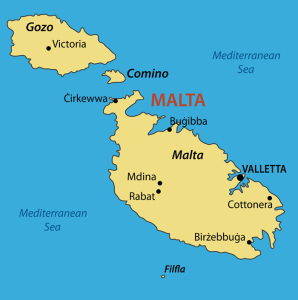
Here’s the map again, just to show where Gozo is in relation to Malta:
Gozo is the second largest of the three main Maltese islands, and just a 25 minute ferry crossing away from Malta – or 15 minutes by seaplane. The island has been described as ‘Malta’s prettier little sister’ because it’s greener and more rural than Malta. Gozo also boasts an impressive number of historical sites and cultural events and has still-thriving agricultural and fishing industries.
The island has long been associated/equated with that of Ogygia, the home of the nymph Calypso in Homer’s Odyssey. The story tells of how Calypso – who possessed supernatural powers – fell in love with Odysseus, holding him captive for several years before releasing him to continue his journey home.
Calypso recieving Telemachus and Mentor in grotto detail. Author: William Hamilton 1751-1801. Public Domain. Wikimedia Commons
The calypso Grotto on Gozo. Author: A. Ocram. Wikimedia Commons
Our day involved a guided tour, for which we were picked up by coach from our hotel in Bugibba and taken to the ferry port at Cirkewwa on the north-west of Malta to make the short ferry journey over to Gozo with the The Gozo Channel Line.
At the port of Mgarr on Gozo, we boaded our next coach and our first stop was the most famous site on the island: the Ggantija Temples at Xaghra.
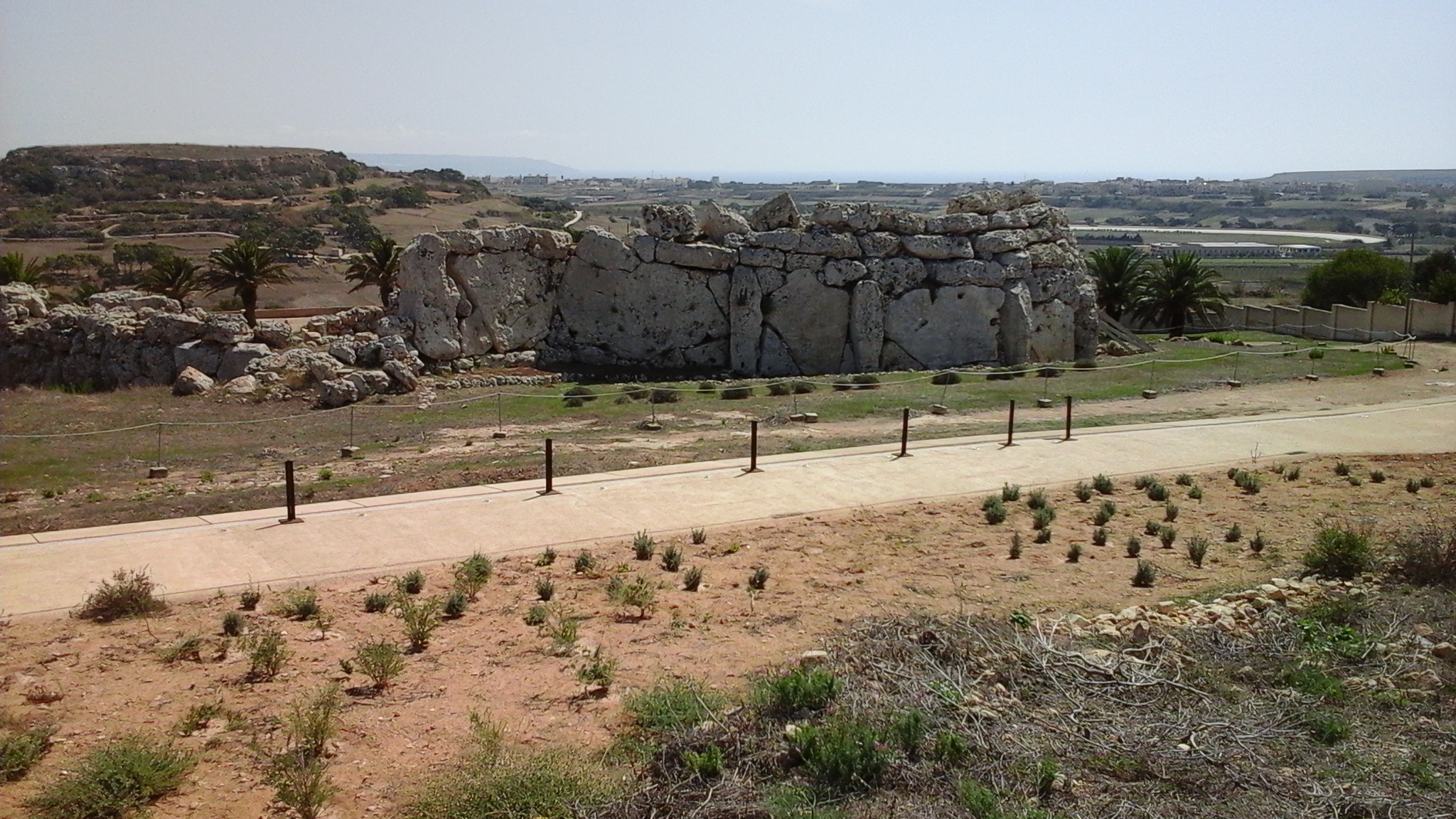
The Ggantija Temples (commonly called The Giant’s Tower in the past) are the earliest of the megalithic temples on the Maltese islands and possibly the oldest, free standing megalithic structures in the world, dating from around 3,600 years BC – older than the pyramids of Egypt. Today the site is a UNESCO World Heritage Site. This is a view of the outer wall:
Ggantija consists of two separate systems of courtyards, not interconnected, known as the South Temple and the North Temple. The South Temple is the bigger and earlier (3,600 BC) of the two, the North Temple being a later addition (c. 3,000 BC). The North Temple has a five-apse structure, the South Temple has four.
These are some of the photos of the site we took as we walked around it:
The stone spheres (top right photo above) were thought to have been used as a method of moving the great slabs of rock. The entire temple complex was built out of two types of rock: the harder Coralline limestone for the outer walls and the softer, golden Globerigina for the doorways and floor slabs -though some of the floors were just covered with beaten earth (torba).
Many of the slabs were once covered with the spiral and pitted designs common to all the Maltese temples. These are some seen in the Archeological Museum in Valletta, from the Tarxien Temples on Malta, which show how some of the stones at Ggantija there would have been decorated:
At Ggantija, the spirals can now hardly be seen, although they were visible when the temple was discovered in 1826, suggesting there must have been a roof of some sort to preserve them.
The huge megaliths of the outer wall were positioned alternately, one vertically and one upright, and the space between the outer and inner walls is filled with earth and rubble. It is thought that it was this that has given Ggantija the stability to survive 5,000 years.
In the South Temple, the great court measures twenty three metres from apse to apse and the walls here are eight metres, the highest of all the temples. Arches weren’t used at this period, and since the span of the apses was quite large for any stone roofing to be used, it is thought that the roofing material would have been wood or animal hides.
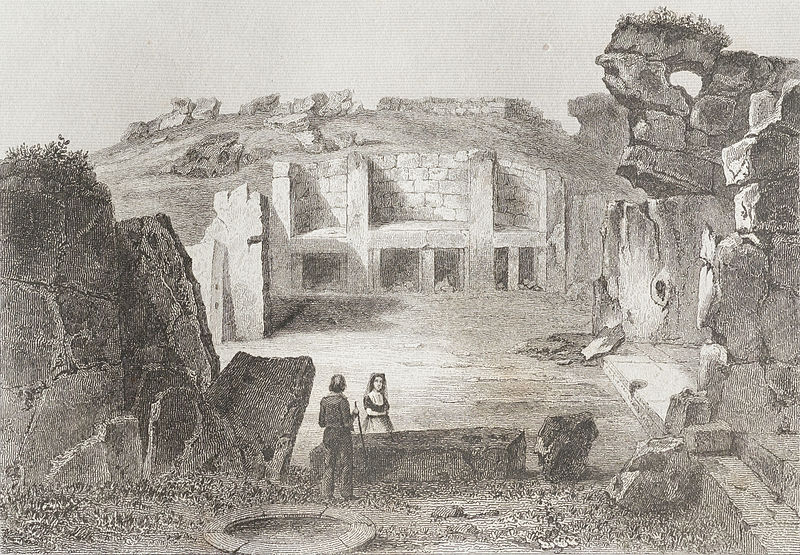
Here is a picture of the interior I found on Wikipedia:
Engraving of the Ggantia megalithic temple in Gozo made in 1848. Title: ‘Gozo (Giants’ tower)’. Photographer: Marie-Lan Nguyen (2013). Public Domain. Wikimedia Commons
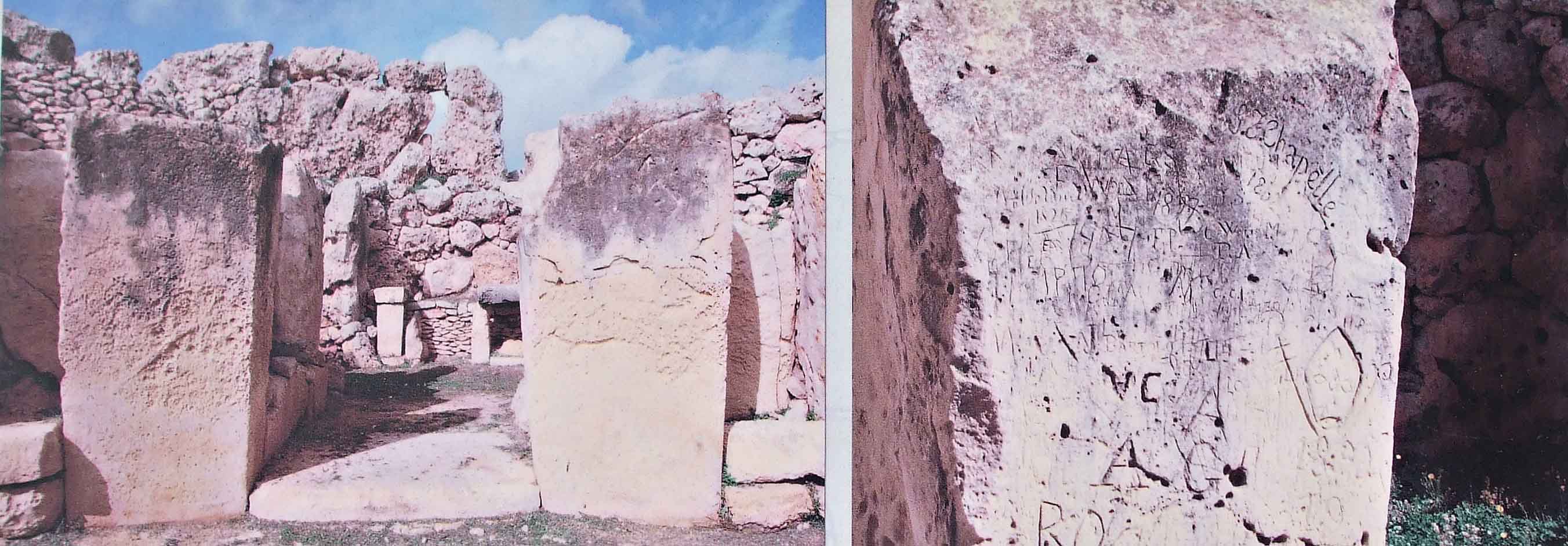
The interior walls were plastered and painted with red ochre, traces of which have been found. It’s interesting to speculate just how this place must have looked 5,000 years ago, and on how all the ceremonies would have taken place at the altars and libation pools. Circular holes have been found in some of the larger floor slabs and, although their purpose isn’t clear, it has been suggested that they were used for the pouring of liquid offerings. One slab, shown below, is marked on the side with pitted decorations:
On each side of the door leading into the temple are hollows carved opposite each other on two large megaliths (two pictures in the gallery above – second and last rows). It is thought that these held some sort of barrier – a door or a bar, perhaps both at different times – to close the entrance.
Finally, I couldn’t finish without showing yet another example of graffitti (as at the Mosta Dome). This fine artwork dates from the 1800s:
Word of the Week (WOW) is a weekly challenge created by Heena Rathore P. It’s a fun way to improve vocabulary by learning new words every week. To participate, simply do a post with your word and leave the link as a comment on Heena’s WOW post for this week (above link).
I’m looking at the letter Dthis week.
I’m still in the middle of my Malta posts. Back to those soon . . .
Diminutive doorway. A tiny doorway, 18 inches high, in an ancient wall on Motherby Hill. The notice on the door says: “DANGER steep staircase”. Source: geograph.org.uk. Author: Richard Croft.
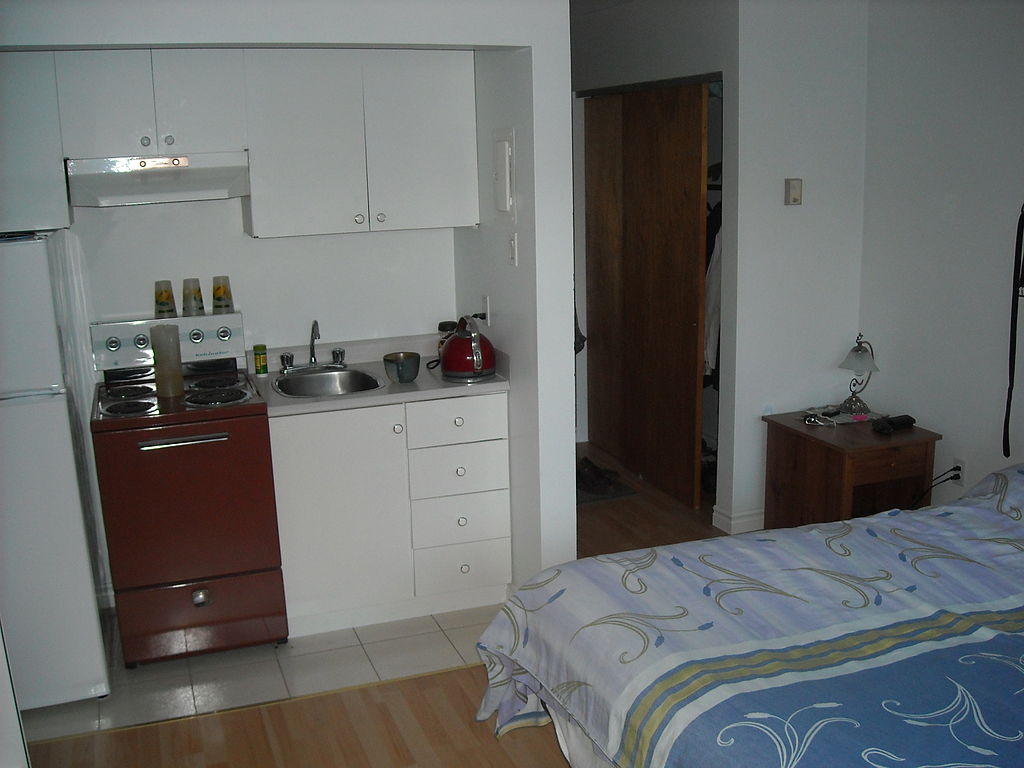
2. n. Grammar: Of or being a suffix that indicates smallness or qualities such a youth, familiarity, affection – or even contempt. Egs: -let in booklet,-kin in lambkin, or -et in nymphet, or – ette, as in kitchenette.
An example of a Canadian cuisinette /kitchenette in a studio apartment in Quebec. Author: Shadiac. Commons
3. A diminutive suffix, word or name, e.g. Maggie for Margaret, Tommy /Tommie for Thomas. (My son, Thomas – fifth ‘child’ now 34 – positively refuses to answer to Tommy!)
4. n. A very small person or thing (persons in this example):
Diminutive humans attack a giant cat. A ghost-like figure sits in a boat at the top left. Wellcome Trust mages. Commons
Word Origin:
1350-1400; Middle English diminutif, from Old French, from Latin dīminutīvus, from dīminūtus, past participle of dīminuere.
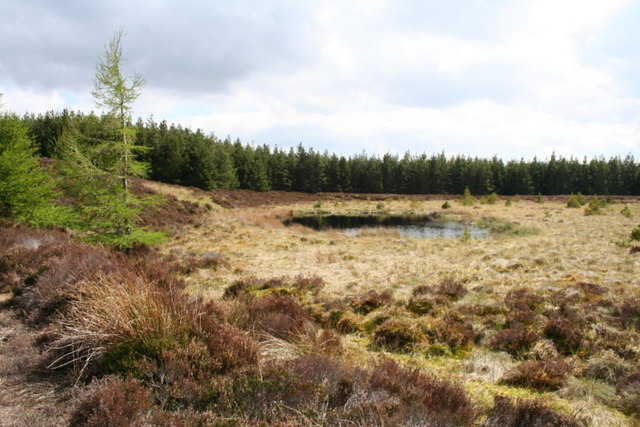
We emerged from the pine forest into an open space, with a diminutive loch, little more than a pond, at the centre of it:
Diminutive Fir Loch. geograph.org.uk. Author: Des Colhoun. Commons
2. The body of the female Giant House Spider can reach 18.5 mm (0.73 in) in length, with that of the male being much more diminutive at 12.7 mm (1.5 in):
Female Giant House Spider, of the genus Tegenaria atrica, building its second egg sac. From Cologne, Germany. Author: Sarefo. Commons
3. In the silent room at one minute to midnight on Christmas Eve, the diminutive green-clad elf hopped down from the Christmas tree, ready to help Santa unload his toys when he came down the chimney:
A diminutive Christmas elf on a Christmas tree decoration. Originally posted on Flickr. Author: Jolene Morris. Commons
*
If you’d like to view more interesting words, visit Heena’s Page
This post was intended to be my piece of extra information to accompany my story for FFfAW (here). As it became rather long (although it’s more pictures than information -some photos my own, others from Wikipedia) I’ve made it into a separate post. It’s about an area of England I’ve loved since I was a child – the Lake District. The information includes a little about the area today, and a little about it in the days when it was part of the old Celtic kingdom of Rheged, where my story takes place.
The Lake District – also known as The English Lakes or just Lakeland – is one of England’s most popular holiday destinations. It is one of the 13 National Parks of England and Wales (No. 2 on the first map below) which today is situated entirely in the county of Cumbria:
National Parks of England and Wales. Author: Keith Edkins. Creative Commons.Map of The Lake District National Park. Source: Office of National Statistics and Geography OpenData. Author: Nilfanion. Commons
People are drawn to this area by the natural beauty of its mountains (fells), forests and many lakes. The highest mountain in England, Scafell Pike, lies within the Park’s boundaries . . .
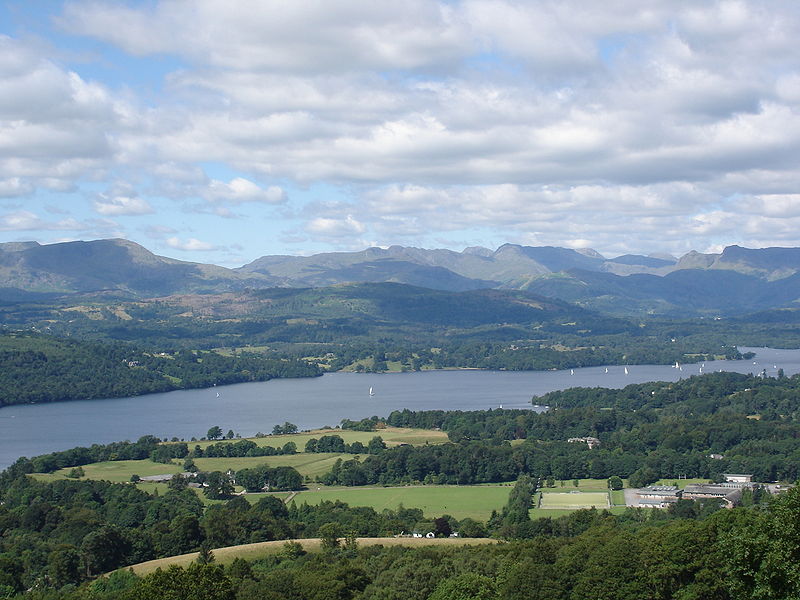
. . . as does the longest and largest lake, Windermere . . .
Windermere, Lake District, from hill. Author: Abbasi 1111. Commons
. . . and the deepest lake, Waswater (also shown on my first photo):
Unfortunately for the many holidaymakers, it does rain a lot up there! Seathwaite, in the Borrowdale area, holds the record for being the wettest inhabited place in England (130 inches of rain per year). But the many old towns tend to have lots going on, as we noted when we were in Keswick a couple of months ago:
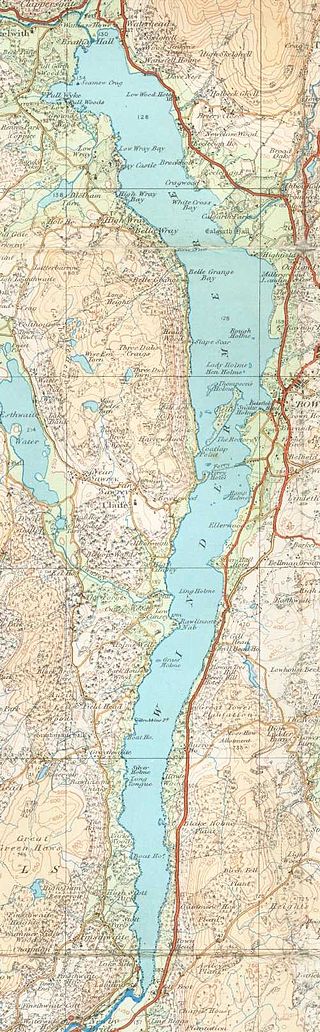
Evidence of glaciation during the last Ice Age, can be seen all over the Lake District. I won’t go into the many features other than those of the lakes. As the great glaciers moved out from the centre of the upland region, it gouged out the existing V-shaped valleys into the familiar U-shaped valleys with the ‘ribbon’ lakes we see today – as clearly shown on this O.S. map of Lake Windermere and the picture of Thirlmere below it:
Windermere2cropped3. Public Domain.A Herdwick sheep grazing above Thirlmere. Author: Sara Blazkova. Commons
In the Lake District, the lakes radiate out from the central upland like the spokes of a wheel – which you can see in the second map on my post.
The area around Lake Windermere is one of the most popular tourist areas of the Lake District. Steam vessels of the late 19th century carried tourists the length of the lake . . .
Windermere Steam Ferry, Lake District, circa 1895. Author: The Library of Congress@Flickr Commons. Public Domain
. . . and nowadays modern ferries run continuously, many tourists heading for the town of Bowness (where we got off) halfway along the lake, or to Ambleside in the north.
MV Swan on Lake Windermere, 2006. Creative Commons
There’s plenty to see along the route: there are 18 islands, various old buildings and private villas, and lots of yachts and other craft moored along private jetties. And motor boats and water skiers provide plenty of entertainment.
Other tourists visit The Lake District simply to see the land so loved by poets such as William Wordsworth and Samuel Coleridge, and the children’s author, Beatrix Potter. Wordsworth’s house in Grasmere, Dove Cottage, is a honeypot for tourists:
Dove Cottage at Grasmere, home of poet, William Wordsworth, now a museum. Author: Christine Hasman. Commons
So many other books have been set in this wonderful place – Swallows and Amazons for one – and many contemporary ones.
Cumbria, along with parts of what is now Southern Scotland and further south, the English county of Lancashire, were thought to have once been what was the the Celtic Kingdom of Rheged, although its exact location and extent are still uncertain.
Yr Hen Ogledd 550 650 Koch by myself. Creative Commons
I won’t go into detail about this kingdom, except to say that it survived well into the 7th, possibly 8th century, when it was annexed by the Anglo-Saxon kingdom of Northumbria. Rheged had been a powerful kingdom in its time. King Urien in particular (c 530-590) is well known, having been written about by his bard, Taliesin. Both Urien and his son, Owain, became heroes in the stories about King Arthur and his fight against the invading Anglo Saxons. The Brynaich and Deifr on the map above became the A.S. kingdoms of Bernicia and Deira – which both became a part of Northumbria.
*
Finally, below is another of the the Lake District’s attractions – the Neolithic stone circle at Castlerigg – about which I have a post to do sometime soon.
Flash Fiction for for Aspiring Writers is a writing challenge hosted by Priceless Joy. It asks us to write a piece of fiction from the photo prompt provided in around 100-150 words – give or take 25 words. It encourages us to comment, constructively, on other entries, so supporting each other’s writing. If you’d like to join in with this challenge, follow the above link to see what to do. The challenge runs from Tuesday to Tuesday every week.
Here is this week’s prompt, kindly provided by Louise:
And this is my story – which is very late this week:
Leaving Rheged
A low mist hung over the lake, the small craft moored along the bank materialising only as she crept closer. In the pre-dawn gloom the lakeside village still slept. By the time her people rose, Brietta would have long since gone.
She feared her trembling legs would betray her, that she’d collapse before she reached the boat. Yet she must reach the man she loved…
But Cynric was Prince of the hated Bernicians, and her unforgiving father, King Urien of Rheged, would kill them both if he knew.
A dark shape suddenly loomed and panic struck.
‘It’s only me,’ Owain whispered, hugging her tight. ‘Don’t worry, sister. I’ll make up some story about where you’ve gone to delay anyone searching for you.’
Brietta choked back a sob of gratitude. ‘I’ll come back to see you once –’
‘Once Father is dead and can’t make you marry the loathsome Hueil. I know. Go! Cynric’s waiting.’
Cynric rowed out into the mist-shrouded lake, the pain of Brietta’s loss diminished by being with the man she loved.
Word Count: 174
If you’d like to view other entries, click the little blue frog below:
Just a note:
Rheged was one of the ancient Celtic kingdoms of Britain, located in the area of present day Cumbria (Lake District area, where Louise took the prompt photo) and spreading out quite extensively to both north and south. It survived until the beginning of the 8th century when it was assimilated into the Angle kingdom of Northumbria.
Bernicia – where I have Cynric coming from – was one of two earlier, independent Angle kingdoms (the other being Deira) which became part of Northumbria in the 7th century, well before Rheged was was also ‘consumed’.
I have set my story during the reign of King Urien (c 530-590) when Bernicia and Deira were still kingdoms in their own right. Needless to say, the Celtic kingdoms fought hard against the invading Angles, Saxons and Jutes, as the stories about King Arthur well illustrate. King Urien and his son, Owain, are included in some of those tales.
Information about this Celtic kingdom can be found at The Rheged Discovery Centre at Penrith. We went when it first opened in 2000, and were quite disappointed with what was on offer, but I believe it’s quite different today. However, reviews are still very mixed.
Entrance to the Rheged Discovery Centre, Penrith, Cumbria. Named after the ancient nation of Rheged, it is built in a disused limestone quarry. Author: R. Hawarth. Wikimedia Commons. Public Domain
For anyone interested, I have written a post about The Lake District to accompany this one. It can can be found here.































 Millie Thom
