I am a reader and writer of historical fiction with a keen interest in the Earth's history and all it involves, both physically and socially. I like nothing better than to be outdoors, especially in faraway places, and baking is something I do when my eyes need respite from my computer screen.
Flash Fiction for for Aspiring Writers is a writing challenge hosted by Priceless Joy. It asks us to write a piece of fiction from the photo prompt provided in around 100-150 words – give or take 25 words. It encourages us to comment, constructively, on other entries, so supporting each other’s writing. If you’d like to join in with this challenge, follow the above link to see what to do. The challenge runs from Tuesday to Tuesday every week.
It’s a while since I was on my blog, let alone participate in a flash fiction challenge, but I thought I’d have a rest from my own writing today.
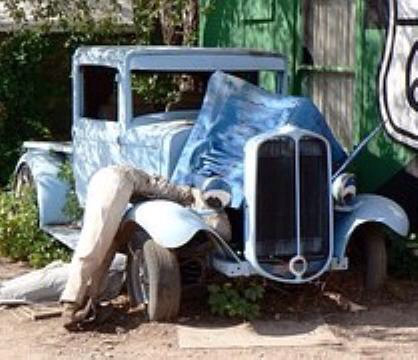
This is the prompt, kindly provided by Priceless Joy. Image courtesy of Pixabay . . .
. . . and this is my story:
Another Harebrained Scheme
‘Just what do you intend to do with this old thing?’
Bert’s head surfaced from beneath the bonnet of the old pickup and he turned indignant eyes on his wife. After forty years he’d hoped she’d understand his love of old cars.
‘Well,’ he said, wiping oily hands on a piece of rag, ‘you know Ted’s old barn along Rookery Lane?’ Connie nodded. ‘I bought it with the money I made from selling our old tractor. Ted wasn’t asking much . . . been thinking of pulling it down anyway. And Jim down in Aldford let me have the pickup cheap.’
Connie gestured to the many farm buildings. ‘Haven’t we got enough barns here?’
‘Aye, reckon we have. But this one’s right close to town, where folks’ll have no bother finding it.’
‘What folks?’
‘Folks who like museums, love. I’m opening a museum for old automobiles.’
Connie rolled her eyes. ‘Another of your harebrained schemes! Who’s going to pay for more exhibits?’
Bert shrugged. ‘I’ll let you know when I’ve had another think.’
*
Word Count: 175
If you’d like to read other entries, or add a story yourself, click on the little blue frog:
I was nominated for this award by a great blogger, a lady from Texas who writes books and short stories under the pen name of L.T. Garvin – which is also the name of her blog. If you enjoy reading witty and humorous stories and poems, I recommend you take a look at this blog. L.T. has two published books: Dancing With the Sandman –available on Amazon, and a children’s book, Confessions of a 4th Grade Athlete – available from Crystal Publishing LLC. I suggest you check out this page on Lana’s blog to have a look at both of these. Lana also writes short stories and has recently had a short, non-fiction piece selected for publication in the Texas Writers Journal Quarterly. You can check this out here on her blog. Thank you so much for the nomination, L.T.
Now down to business . . .
The Rules:
Say ‘Thank You’ to the person who nominated you and link their blog to your post. Done
Answer the 10 questions given to you.
Pass the award on to 7 other bloggers and let them know they have been nominated.
Include the Award Badge in your post. Done
The Questions:
I’ve used the questions that L.T. answered herself – as I wasn’t given different ones – and have decided to pass them on again. So my nominees can use either these questions or write ten new ones for their own nominees to answer.
1. What made you want to start your blog?
I had no idea what a blog was until several months after finishing Book 1 of my trilogy. (Nor did I know what Facebook, Twitter, LinkdIn – or any other form of social media was all about). It was after various people suggested that, as an author, I should set up a blog that I eventually decided to have a go. And even then the process was a farce. I opened the WP account in May 2014, and did nothing with it until the end of July. It was only when my daughter, Louise, got her blog up and running that I was shamed into starting mine. I also started on Twitter a little while months ago, but have only very recently attempted to make a few tweets (mostly my blog posts, but I can probably start to widen things out a bit now).
I would welcome with open arms anyone who would care to take the risk and follow me.
2. What have you wanted to do on your blog but haven’t yet?
Several months ago now, I discussed with the lovely Amanda (Forestwoodfolkart) on her blog, Something to Ponder About, about (me) starting a weekly post involving British sayings and their origins. This idea was a result of my enjoyment of Amanda’s Thursday posts, Proverbial Thursday, on which she presents quotes and proverbs for her readers to interpret and discuss. I love this post, and I mentioned I’d like to do something similar with the many, odd British sayings, and Amanda graciously said she would link her post to my page! How amazing and kind is that! Well, needless to say, I haven’s started it yet, but intend to do so sometime during this year.
3. Name one item your bucket list – or more if you like.
Other than travelling to see as much of the world as possible, I really don’t have a bucket list. Naturally, I want to finish my trilogy, and write other books I have in mind, but travel is top of my (non-existent) list. And now, after connecting with some wonderful people on WP, we have plans to ‘meet up’ at some stage. I won’t name them here and embarrass them, but I really would like to say ‘Hello’ in person to these blogging friends.
4. What is your biggest fear?
I have no real personal fear other than sharks, as mentioned in other award posts. I do fear wars – the needless bloodshed and loss of life – and dread seeing the news about what is happening around the world. Like so many of us, I long for a time when the human race can live together in peace and harmony, and have tolerance and understanding for each other’s beliefs and customs. I’m also greatly concerned about what we are doing to this planet that sustains us all. I won’t go into detail about the depletion of natural resources, or the effects of climate change and species extinctions, but I’m sure you’ll all know what I’m saying. What kind of world are we leaving for future generations? We’re becoming a species whose motto seems to be, ‘I’m All Right Jack’.
5. What is/was your best moment in life?
I’ve had six ‘best moments’ in my life, which all happened between 43 and 32 years ago. The names of these moments are Nicola, Richard, Neil, Louise, Thomas and Christopher – in order of age.
6. Have you made any New Year resolutions this year? If so, name one. If not, why don’t you like them?
Yes, my main resolution is to get two more books finished – the third book of my Sons of Kings trilogy . . .
. . . and a book of short stories. These aren’t really resolutions, more determined aims. Fortunately I don’t need to lose weight or give up anything harmful to life and limb.
7. If you could host a challenge on your blog, what kind would it be?
As I love writing stories, I can only think of some kind of writing challenge – probably short stories from a given prompt – but there are already a lot of those around. So I’d have to think hard about this one and try to make it different to the others in some way. I’d also like to do my own version of a Word of the Week challenge, involving something a little different to the one I participate in now. I really enjoy investigating the meanings and origins of interesting words- and writing little stories to illustrate them.
8. What was the name of your first pet? What do you remember the most about them?
My very first pets were several mice – six of them – when I was five. Some were white and two were black and white. I never gave them names, probably because I didn’t have them long enough to do so. Somehow they all got out of the cage, (probably because I left the cage open) and ended up infesting the neighbourhood due to their rampant breeding. I don’t remember how the freedom of these mice ended, but I do remember lots of neighbours coming round looking (and sounding) anything but pleased! We also had an old, bad-tempered, rough-haired terrier called Rover at this time, but he was my mum’s. He bit one of my friends once – resulting in another very displeased neighbour. The escapee mice were all mine – and I was very upset that they didn’t like me enough to stay with me.
9. Do you ever go to a high school/old school reunion? Was it fun or not?
No, I’ve never been to this kind of reunion. I don’t think they’re as popular in the UK as they are in the US, but some reunions do take place. One group of students that Nick and I both taught in Wantage in the mid 1970s, have met up every ten years since they left school. We were both invited to their last one (and we went along!) and were very touched by the gesture.
10. Do you have a pet peeve?
I’m afraid I have to mimic L.T’s answer for this one. I can’t stand people who are rude, arrogant and loud-mouthed; in other words, people who are totally obnoxious to others. Good manners are all that I ask, and tolerance to others, no matter what their opinions and /or beliefs.
Now for my nominees:
This is the third time I’ve done the Sisterhood of the WorldBloggersAward, the second time for this particular logo – and that was only a few weeks before Christmas. So I’m having difficulty in finding people to nominate, especially as this award is aimed only at women bloggers. On top of that, so many blogs are now ‘Award Free’.
Although I wouldn’t normally do this, I’m just going to throw this award open to anyone who would like it. I love all my followers out there and would be delighted if some of you accepted this one.
***
Since writing this, I’ve decided to go ahead and nominate at least one person whose blog I think well derserves this award:
Parul, on her cookery blog, Gharkepawan, is someone I’ve followed for a little while now. Her blog is aimed at presenting ‘healthy and nutritious vegetarian’ recipes, which I have found very useful for trying out on my vegetarian husband!
This is a little story I wrote 20 years ago! I wrote it for some competition at the time for a well known brand of tea here in the UK which uses little Tea Folk as part of its advertising campaigns. (I’d better not name this tea – I don’t want to be accused of advertising!) But I never did anything with it and the other day, I found the manuscript in an old file I’d kept. The paper was all yellow round the edges, reminding me of the way schoolchildren try to make stories and treasure maps look authentic by staining the paper with coffee or tea. Well, I didn’t need to do that. Anyway, I made the characters into gnomes, gave them different names and changed a few details and typed it up.
I love the film Gnomio and Juliet and am quite partial to gnomes. My husband refuses to have any in the garden, so I have to use my imagination. On one occasion, my mischievous daughters, Nicola and Louise, bought a few gnomes and hid them around the flower beds. My husband’s growls as he found each one, were quite hilarious.
So here’s the story:
Rainbows, Roses and Raindrops
One warm and sunny summer’s afternoon, the Garden Gnomes of Greenwich were relaxing in Gerald’’s favourite tea garden. Horace was brewing the tea and Michael was sharing his plans for his next detective story, when a sudden flash and a puff of smoke made them all jump.
Seven pairs of eyes blinked as an odd little man, no bigger than a nearby plant pot, became visible through the smoke. Seven gasps of astonishment caused the little man to wobble precariously on the rock he’d landed on at the edge of Gerald’s delightful fish pond.
‘You’re a leprechaun!’ young Freddie blurted, pointing at the tiny figure.
‘Of course I am!’ the indignant elf snapped in crotchety Irish tones. ‘Sure, isn’t that plain fer all t’ see?’ He brushed down his velvety green jacket and breeches then, holding on to his tiny green cap, he sprang from the rock like a grasshopper before he found himself spluttering with Gerald’s goldfish beneath the lily pads.
‘B…but how did you get here? I mean…er…where did you –?’
‘Do stop burbling Freddie,’ Gerald reprimanded. ‘Remember your manners. That’s no way to greet a guest to our tea garden, no matter how he arrived!’
Samuel, the kindly grandfather gnome, decided it was time to intervene. ‘Won’t you join us for a nice cup of tea, sir? I didn’t catch your name…?’
The leprechaun proudly stroked his shiny, golden beard. ‘Me name’s Leopold,’ he replied, his beady eyes scanning the garden. ‘I’ve followed the rainbow all the way across the Irish Sea t’ this very garden. Me crock o’ gold must be here somewhere. So now I’m going t’ find it!’
Leopold clicked his bony fingers and six garden spades magically appeared, hovering over the beautiful flower beds, ready for work. Gerald’s face turned a ghastly white as he imagined his cherished roses in tatters.
Just then, a mouth-watering aroma of baking wafted across the garden. Leopold’s nose twitched and his tiny tummy gave a loud rumble.
‘My delightful cakes must be ready. Do excuse me.’ Tanya smiled at Leoplod, then rushed off towards the kitchen.
Gerald, tactful as ever, took the opportunity to repeat Samuel’s earlier invitation to Leopold, who now gratefully accepted.
Over a refreshing cup of tea, with a morsel of one of Tanya’s delicious cakes, the little leprechaun even managed a smile. Michael opened his notebook to jot down suggestions for helping Leopold to search for the gold, without spoiling Gerald’s roses, when a few glistening raindrops plopped in the middle of his page.
They scanned the clear, blue sky for the offending cloud, just as another few raindrops tinkled onto Horace’s teapot. A stifled chuckle drew everyone’s attention towards the fish pond, where Cyril was perched, with his fingers in the water. ‘Just my Rainy Day joke,’ he chortled.
Then, as he looked down, Cyril’s face took on a puzzled expression. ‘There’s an odd-looking goldfish in your pond, Gerald. It isn’t swimming about like the others.’
Gerald hurried over to investigate. ‘My goodness!’ he gasped. ‘I see what you mean, Cyril. But…wait a minute. That isn’t a goldfish…but it is gold!’
Later, Leopold stood clutching his crock of gold, his elfish grin stretching from ear to ear.
‘How did your gold get into our pond?’ Freddie asked.
‘Leprechaun magic,’ Leopold replied, tapping the side of his tiny nose.’ Now I’ll be thankin’ yer all an’ making me way home. The cup o’ tea was just what I needed. Following rainbows is thirsty work.’
With another click and a flash, Leopold and his spades vanished.
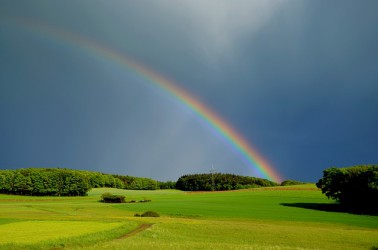
‘He must be travelling across that rainbow,’ Cyril remarked, pointing up at the sky.
Freddie now looked really perplexed. ‘But rainbows only come after it’s been raining…don’t they? And it hasn’t been raining!’
Once again I am delighted to have received two more blog awards, and am very grateful to the wonderful bloggers who nominated me. I’ll respond to the first one I received in this post and the second one in another.
This is the first one. Now isn’t that pretty. . . ?
I was nominated for the Dragon’s Loyalty Award by the amazing blogger Aquileana. For anyone who loves Greek Mythology, Aquileana’s blog is an absolute must. Her posts are incredible, so informative and visually brilliant. Aquileana is extremely knowledgeable in her subject and I’ve learnt so much from reading her posts. I’m so glad I found her and recommend you all to take a look at her site. Thank you so much for the nomination, Aquileana!
So here are the Rules:1. Display the award on your blog. Done
2. Announce your win with a post and link to the blogger who nominated you. Partly done
3. Present 6 deserving bloggers with the award.
4. Link to your awardees in the post.
5. Write 7 things about you.
Before I do Q’s. 3 and 4, I’ll answer Q.5 – Facts/things about me (if I can think of anything remotely interesting that I haven’t already shared in previous award posts!).
Well, here goes…
1. I detest snakes. I’ve written about my great fear of sharks in previous posts, but this phobia is a little different. My fear of sharks makes me very nervous when I’m swimming in the sea – and I love to swim and go out snorkelling. With snakes it’s more of a visual thing . . . something about the way they slither along, and those forked tongues that flick in and out! It’s more of a revulsion with snakes than the great fear of being eaten by a shark. They just make me shudder – especially when there are a lot of them, all writhing and slithering about (as in that Indiana Jones film (youtube scene shown here – I did note the spelling of Indiana in the title):
It’s a pity they don’t all look like this little fellow who just popped over from Pixabay.
2. The Blue Danube Waltz, composed in 1866by Austrian composer Johann II, is one of my favourite pieces of music. I love the whole, dreamy sound of it, as it conjures up images of that magnificent river. I’ve even inflicted the music on my Year 8 students on several occasions. It’s an ideal piece to use in geography lessons to illustrate the characteristic features of the three sections of a river: upper, middle and lower courses. Geography lesson ends here, but here is a video I found for anyone who hasn’t heard of The Blue Danube Waltz. I specifically picked this one from amongst many because it has views of the beautiful River Danube:
3. I’m waiting impatiently for the return of Poldark, the BBC TV series set in 18th century Cornwall. I watched the first version of the serialisation of the novels – written by Winston Graham – in the mid 1970’s. and in black and white. We had no colour TV in those days. Still, I loved it, and was sure I really wouldn’t like this new version when Series One came on last year. But I found this new version excellent and have been longing for Series Two. Not long now . . .
4. One of my favourite genres is Crime/Murder Mystery, and I like it even better when it has an historical setting. There are many authors I like who write Historical Who-Done-Its, and I don’t have any preference for time period, or country of setting. Most of the ones I read tend to be set inBrtain, but I’ve enjoyed some set in many other places as well. Most are a very light read, which is fine, considering my only reading time tends to be last thing at night.
5. One of the books I really want to write (amongst several others!) is one set in the 1950s. You know . . . the time period of the novel and TV series, Call the Midwife (post WW2). Advice to authors is often to ‘write about what you know’. Well, I was a child in that decade, and remember a lot about it. Whether I’ll base the book on memoirs, or go for something purely fictional, I don’t know. Right now, I think it’s likely to be the latter. But images and smells of school dinners of that time will never disappear.
6. I’d much rather sail than fly when going on holiday. I have no fear of flying or anything, I just prefer the freedom of being able to walk around on a ship instead of being seated all the time. I’m the restless type, you see. I’ve never been on a long cruise, and am not sure I’d want to. But we’ve been to Ireland, Denmark and across the English Channel to France on ferries, which I really enjoyed. But… flying is so much quicker.
7. Last one… I’m struggling here. I hate getting ‘dressed up’, and make up is a no-no. It’s really not me. I’ve had to dress up on occassion, of course, but I usually can’t wait to get back into my jeans and go out for a long walk. Yes, I’m a real party pooper.
These are my 6 nominees:
I. Joy Pixley – a great fantasy writer. Joy is currently finishing off her book, set in Eneana, right now. She did brilliantly in NaNoWriMo, and I have every admiration for her hard work and determination. The book promises to be fascinating.
2. Lina – who has a great cookery blog, but who also writes lovely short stories and has recently started to participate in flash fiction (FFFAW).
3. Yinglan – a prolific and successful blogger, who mostly participates in writing challenges. Her stories are always interesting and show great imagination. I believe Yinglan also aims to write her own book one day.
4. Tracey-Lynne – an talented aspiring author, who has recently returned to Blogland after a short break. Tracey is now taking part in falsh fiction challenges as well as continuing to write her own short poems and stories.
5. Gavin Zanker – another talented writer who will be publishing his first book early this year. How exciting is that!
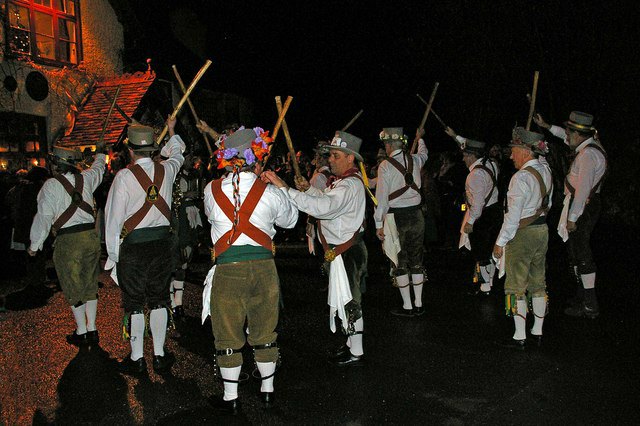
Prelude to a Wassail. Broadmarsh Morris Men perform outside the White Horse before heading for the orchard. Author: Glyn Baker. geog.org.uk. Creative Commons
Tomorrow is Twelfth Night, January 6th, the date traditionally accepted as the end of the Christmas period. It’s the day our Christmas trees and other decorations come down, to be stored away for another year. Nowadays, with many people returning to work straight after New Year’s Day – if not before – many households pack away all traces of Christmas festivities much earler.
In England, January 6th is also often remembered as the day for ‘wassailing’ – which is what this post is about. I’m posting it the day before so you can all get ready the following items for your own wassailing ritual: a nice big, stout stick; a mug of wassail (generally mulled cider, nowadays); a bucket ot the same wassail, with a good stack of toast. Oh . . . and a handy Green Man, if you can find one lurking about anywhere.
More about that to follow. . .
The custom of wassailing in England has its origins in pagan times, although it has seen some renewal in popularity in recent years due to the return to favour of cider amongst drinkers. Wassailing has been associated with the Christmas season since the 1400s, as a way of passing on best wishes to family and friends.
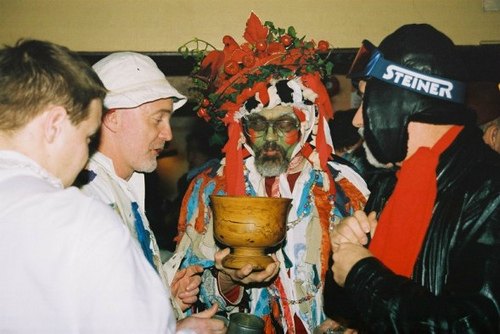
Sharing a Wassail bowl on Twelfth Night. Author Tracey P. Creative Commons
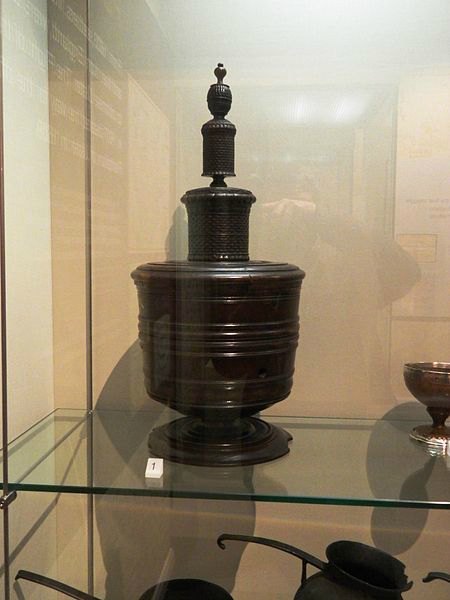
The word ‘wassail’ comes from the Anglo Saxon phrase ‘waes hael’ – which means ‘good health’ or ‘be well’. The wassail itself was originally a drink made from mulled ale, curdled cream, roasted apples, eggs, cloves, ginger, nutmeg and sugar. The Wassail drink mixture was sometimes called ‘Lamb’s Wool’, because the pulp of the roasted apples looked all frothy, rather like a lamb’s wool. It was served from huge bowls, often made from silver or pewter. One wassail bowl, housed at Jesus College at Oxford University, holds up to 10 gallons of drink. The one in the image below is not quite as big and is held in Ulster Museum:
Wassail bowl in Ulster Museum. Made of turned lignum vitae, originally belonging to the Chichester family, Earls of Donegal. Author: Bazonka. Creative Commons
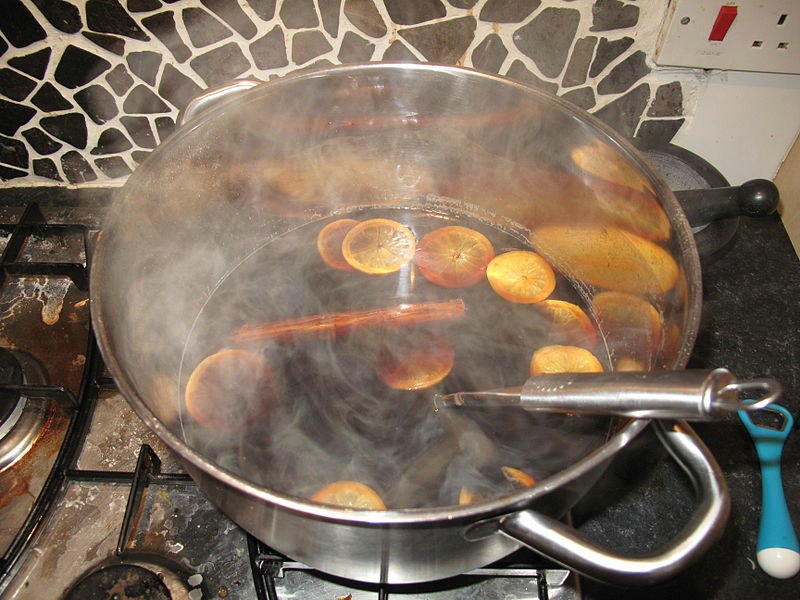
The ingredients in the drink varied between different areas of the country, some using cider instead of ale. This image shows another recipe for the brew being prepared:
There were three ways in which wassailing was celebrated:
The first waywas the passing around a room of a common bowl, often called a ‘loving cup’, to be shared. It would be accompanied by the greeting, ‘Wassail!’ This seems to be the only use, as far as I can see, of a bowl as huge as the one in Oxford. I can’t imagine a great 10 gallon vessel being hauled around the houses, or out to the orchards – although, I suppose, a horse and cart could have been used. According to one legend, wassailing was created when a beautiful Saxon maiden, called Rowena, presented Prince Vortigen with a bowl of wine while toasting him with the words ‘waes hael’.
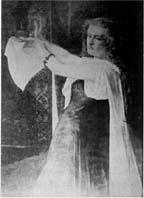
Rowena offering the Wassail Cup to Vortigen. Artist: Joanna Mary Bryce 1831-1861. Wikimedia Commons. Public Domain
Over the centuries this simple act developed into an elaborate ceremony, with the bowl being carried into the room with great fanfare. A carol about the drink would be sung before the hot beverage was drunk.
The second way of wassailing was what is generally known as carolling today. People would go from door to door with a bowl of wassail, bringing good wishes to those inside. In return, the wassailers would be given drink, money, or some kind of Christmas treat, like a mince pie. The householders believed that this would bring them luck in the coming year.
This is the first verse of the most well known wassailing song/carol, which was popular throughout England by the middle of the 19th century. It’s simply called The Wassail Song:
Here we come a wassailing Among the leaves so green, Here we come a wandering So fair to be seen.
This video shows a really good, modern version of this song, albeit faster and more lively than the way it would have originally been sung. I love the Irish fiddle! You need only watch for a moment or two if time is scarce, just to get the idea of the tune.
The third wayinvolved drinking to the health of the apple trees in the orchards to ensure a good crop in the coming year. This ancient rite was well known in the counties of Devon, Herefordshire, Gloucestershire, Somerset, and other parts of the West Country where apple growing for cider production was common. It generally took place on Twelfth Night –which is generally thought of as being January 6th but, more correctly, it was the evening of January 5th. Sometimes, it was as late as January 17th, which was known as Old Twelfth Night (or Old Twelvey Night).
There are many customs associated with this event, from many different areas, just as there are different recipes for the brew. In one tradition, families and friends would eat hot cakes and drink cider before going into the orchard with more supplies. A cake soaked in cider would be laid at the point where the tree forked and more cider splashed onto it. The men fired guns into the tree and banged on pots and pans while the rest of the group sang the Wassail Song. This rite was intended to ward off evil spirits and encourage good spirits to ensure a good harvest the following year.
Another custom involved carrying the wassail bowl into the orchard, where the apple trees would be alternately serenaded and threatened. Singing, dancing and drinking (the latter for people and trees) continued until, finally, the trees were threatened with an axe if they did not produce an excellent crop in the coming year. There are several songs related to this type of ceremony, so here’s the opening verse from two of them:
‘Health to thee, good apple-tree, Well to bear, pocket-fulls, hat-fulls, Peck-fulls, bushel-bag-fulls.’
And this one:
‘Here’s to thee, old apple-tree, Whence thou may’st bud, and whence thou may’st blow, And whence thou may’st bear apples enow Hats full! caps full! Bushel-bushel-sacks full, And my pockets full, too, huzza!’
I get the impression that the people really, really wanted a good harvest the following year.
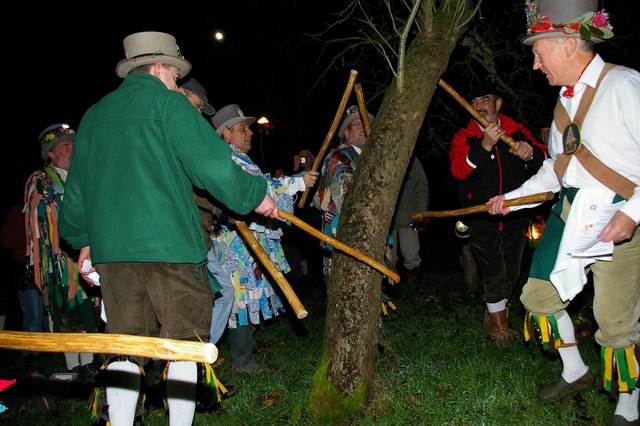
The photo below is a modern re-enactment of a similar ritual:
Broadmarsh Morris men beating the apple trees with sticks to drive out evil spirits that may spoil the crop. Author: Glyn Baker. geog.org.uk. Creative Commons
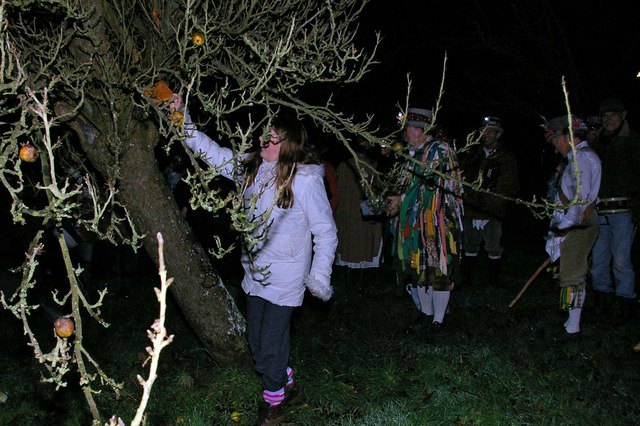
Most Wassail ceremonies today, as in past times, vary from area to area, but there seems to be a roughly similar order for the service. Generally, a wassail queen (and/or) king leads the procession and singing on the way from one orchard to another. The queen is lifted up in order to place pieces of toast soaked in wassail from a clay cup in the boughs of the tree. This is intended as a gift to the tree, but also to represent the apples formed there the previous year:
A “virgin” hangs cider soaked toast in the branches of the tree. The robins will eat the toast and carry away any evil soaked up by the toast. Author: Glyn Baker. geog.org.uk. Creative Commons
Then a song is sung or incantation recited – like those above – and this one:
‘Old apple tree we wassail thee And hoping thou will bear For the Lord doth know where we shall be ‘Til apples come another year.’
Here are another couple of YouTube videos to show how wassailing is celebrated in some areas. The Green Man, in the last video, is a traditional figure from pagan folklore. Many churches built in the Middle Ages have a little carving of him, generally in a non-too-obvious place. I mentioned him in my post about Fountains Abbey back in October, as there’s a little sculpture of him there, above a high, outside window. Even as late as the 11th and 12th centuries in Christian England, long-held pagan beliefs still lingered. Long associated with the forests, it stands to reason that many wassail ceremonies included the Green Man. I intend to write a post about him sometime soon – if my daughter, Louise, doesn’t get there first. She has her own photo of him at Fountains Abbey on the post I’ve linked to here.
As with the Wassail Song above, the second video below needs only a quick look to see what the Green Man looks like, dressed in his finery. The first video shows one version of the wassail ceremony in an apple orchard. There are several other YouTube videos online – all from different areas.
Wassailing seems to be particularly English, but I came across one ceremony elsewhere that seemed very similar . . .
In Romania, the housewife would knead her special holiday dough in the kitchen. On his way to the orchard, her husband would pass through the house in a terrible temper. She followed him as he passed among the trees, threatening each barren one with being cut down. The wife would ask him to spare this one or that, by saying: ‘Oh no, I’m sure this tree will be as heavy with fruit next year as my hands are with dough this day.’
I’m sure I’d find several others, if I looked hard enough.
The WordPress.com stats helper monkeys prepared a 2015 annual report for this blog.
Here’s an excerpt:
The concert hall at the Sydney Opera House holds 2,700 people. This blog was viewed about 25,000 times in 2015. If it were a concert at Sydney Opera House, it would take about 9 sold-out performances for that many people to see it.
This is the second Annual Review I’ve had from WordPress, although I didn’t post the one from 2014. I hadn’t written too many posts by last Christmas, so it didn’t seem worth posting a review, somehow. I have no such excuse for this year’s, so here it is.
As it’s already 2016, I’m a little late in wishing everyone a Happy New Year, but that wish goes out sincerely to you all. Christmas week is always chaotic in our house, and the last thing I managed to post was on December 22nd. I’ve responded to some comments, and I’ve visited a few blogs, but I know I’ve got a lot of catching up to do.
I want to thank all the wonderful people out there who’ve supported my blog this past year. I’ve loved working on my various posts – even if I did almost wreck the entire blog on one occasion! (here) I’ve also thoroughly enjoyed reading so many great posts from you, and learning so much from them. Most of all, I’ve loved connecting with you – my blogging friends. I feel as though I’ve known many of you for years.
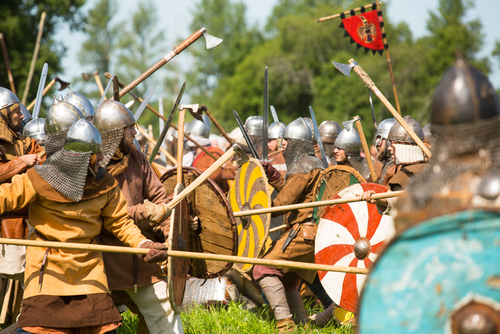
As some of you know I need to concentrate on my third book this year, so my blog posts will be few and far between for a while. I have a couple to do this coming week, before I slow right down and retreat to the 9th century again. My battle helmet awaits . . .
As 2016 gets going, I’m feeling very positive about the year ahead, and what I can achieve. This is how I feel today . . .
The word solstice comes from the Latin word, solstitium, which means ‘Sun standing still’. The December solstice is the day on which the Sun is at its most southerly point, directly overhead at the Tropic of Capricorn, before it reverses its direction and gradually starts to move north again. The image above shows the winter solstice in the Northen Hemisphere over Asia. (Author: Jecowa at English Wikipedia. Creative Commons).
To people in the Northern Hemisphere the winter solstice means the longest night, with the latest dawn and shortest day of the year, with the sun at its lowest point in the sky. The day after the winter solstice marks the beginning of lengthening days, as we head towards the summer solstice on June 21st 2016.
For those in the Southern Hemisphere the opposite is true: people will experience the shortest night and the earliest dawn, with the longest day and the sun at its highest point in the sky.
The December solstice happens at the same time everywhere on Earth. This year it is on Tuesday, December 22nd (today!) at 04:49 GMT/Universal time. At Stonehenge, in Wiltshire, UK, the sun rose this morning at 08:04. The time is different every year, and can be between December 20th and 23rd, although it’s rarely on the two extremes. The last time it was on December 23rd was in 1903, which will not happen again until 2303.
Interpretations of the winter solstice have varied worldwide and across cultures, but many have involved the recognition of the rebirth of sunlight after the darkest time of year. As such, it has been celebrated with holidays, gatherings, festivals and rituals around that time. Many of these celebrations have been observed since the earliest times.
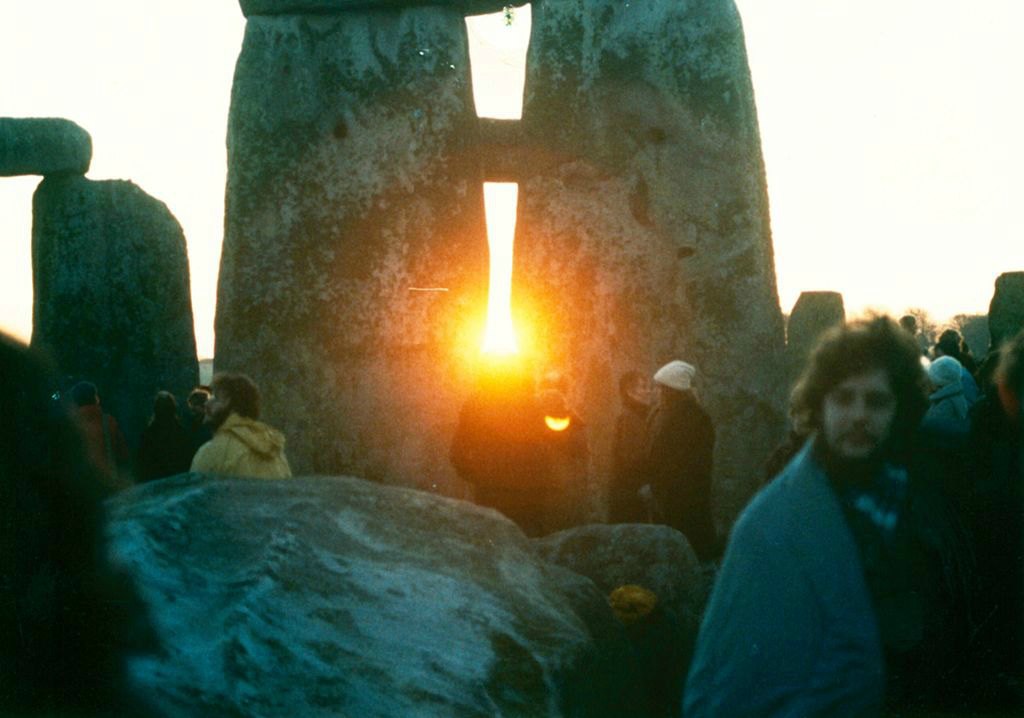
The prehistoric monument of Stonehenge in Wiltshire, UK (constructed from 3000-2000 BC) is aligned on a sight-line that points to the winter solstice sunset . . .
Sunrise between the stones at Stonehenge on the winter solstice. Author: Mark Grant. Creative Commons.
. . . in comparison to the Newgrange prehistoric monument in County Meath, Ireland, which points to the winter solstice sunrise:
Newgrange prehistoric monument, County Meath, Ireland. Author: Shira. Creative Commons
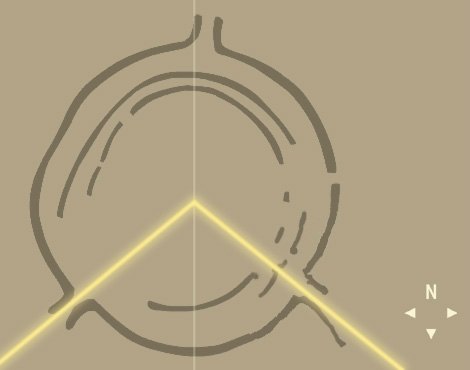
Then there is the Goseck circle in Germany, which is aligned to both sunset and sunrise:
Neolithic site of the Goseck circle. The yellow lines are the direction the Sun rises and sets at winter solstice. Author: de:Benutzer:Rainer Zenz, Public Domain
It is believed that the winter solstice was more important to the people who constructed Stonehenge than the summer solstice. The winter solstice was a time when cattle were slaughtered, so they would not have to be fed throughout the winter, and most of the wine and beer was finally fermented by then, and could be enjoyed.
In ancient Rome, the winter solstice was celebrated with a festival called Saturnalia. This began on December 17th and lasted for seven days. Saturnalian banquets were held as far back as 217 BCE to honour Saturn, the father of the gods. It began with a sacrifice at the Temple of Saturn in the Roman forum, followed by a public banquet, a private gift giving and continuous partying!
The carnival overturned Roman social norms, being more like a free-for-all, when all discipline and orderly behaviour was ignored; colourful clothes replaced the formal togas. Wars were interrupted or postponed, gambling was permitted and slaves were served by their masters. All grudges and quarrels were forgotten (but were they suddenly remembered again afterwards, I ask?).
Dice players on a wall in Pompeii. Author: WolfgangRieger. Public Domain
At the gift giving (December 19th) it was traditional to offer gifts of imitation fruit – a symbol of fertility. Dolls were given, which were symbolic of human sacrifice, and so were candles – a reminder of the bonfires associated with pagan solstice celebrations. The whole festival would become a week-long orgy of debauchery and crime:
Saturnalia sculpture by Ernesto Biondi: a bronze copy n the Botanical Gardens in Buenos Aires. (Original in the National Gallery of Modern art in Rome). Uploaded by Roberto Fiadone. Creative Commons
In the Norse lands of pre-Christian Scandinavia, the winter solstice was celebrated with the feast of Jul (or jól), from which we get the terms Yule and Yuletide. Yule is what later evolved into today’s Christmas, though the Danes still call it Jul. The Danish Vikings sacrificed and offered up goods and animals to the gods in order to conquer the darkness of winter. Then they drank a toast for the year and for peace. The toast was very important and a beaker of beer was offered to the gods. Then the people would toast and drink and thank each other and the gods for the past year and welcome in the new.
People would light fires to symbolise the heat and light of the returning sun and a Jul /Yule log was brought in and dropped in the hearth as a tribute the god Thor. The Yule log was often an entire tree, carefully chosen and brought into the house with great ceremony and sometimes, the largest end of the log would be placed into the fire hearth, while the rest of the tree stuck out into the room.
Image from Shutterstock
I wrote a short post about the Yule log last December, with a brief paragraph from Shadow of the Raven describing the Yule celebrations. It can be found here.
The log would be lit from the remains of the previous year’s log which had been stored away and, later on, in Christian times, was often fed into the fire through the Twelve Days of Christmas. The log was burned until nothing but ash remained, then the ashes were collected and either strewn on the fields as fertiliser every night until Twelfth Night or kept as a charm and or as medicine. A piece of the log was kept as both a token of good luck and as kindling for the following year’s log.
These are just three of the ways in which peoples of the past celebrated the winter solstice. There are many others from different times and cultures, but I can’t do them all. There’s only a couple of hours left of December 22nd, 2015, here in the UK, so the shortest day has almost been and gone . . .
Flash Fiction for for Aspiring Writers is a writing challenge hosted by Priceless Joy. It asks us to write a piece of fiction from the photo prompt provided in around 100-150 words – give or take 25 words. It encourages us to comment, constructively, on other entries, so supporting each other’s writing. If you’d like to join in with this challenge, follow the above link to see what to do. The challenge runs from Tuesday to Tuesday every week.
It’s been a couple of months since I participated in a flash fiction challenge, but this prompt brought two different stories to mind, so I decided to have a go at one of them. Unsurprisingly, this one has a historical slant.
This is the prompt, kindly provided by Priceless Joy. Image courtesy of Pixabay . . .
. . . and this is my story:
They’re All The Rage!
Lady Penelope withdrew her hand from the marmalade pot and gaped at the grinning sixteen-year-old across the breakfast table. Her husband, Lord Geoffrey Troughton, engrossed in reading the morning news, showed no signs of having heard their son’s request.
‘What on earth do you mean Archie?’ she demanded. ‘I’ve no idea what a ‘Penny Farthing’ is,let alone where to buy you one for Christmas.’
Archie let out an exasperated sigh. ‘Surely you’ve heard of them, Mother . . . everyone’s talking about them. They’re really quite the rage. All the chaps at school are getting them for Christmas, and I’d like one, too.’
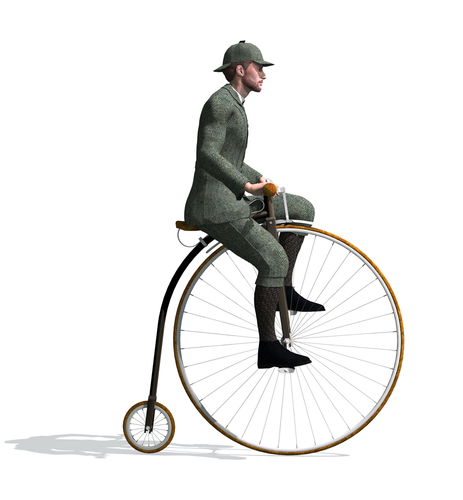
Lord Troughton lowered his newspaper. ‘It’s another of those bicycle machines, my dear,’ he explained. ‘It has a large wheel at the front and the smaller one at the back, reminiscent of the different sized coins, the penny and the farthing. They’re remarkably fast, Archie – just right for the modern age . . .’
Penelope went back to eating her toast. She’d have no further say in the matter now.
Word Count: 175
Penny Farthing, invented 1880-82. Image courtesy of Pixabay
If you’d like to read other entries, or add a story yourself, click on the little blue frog:
On Saturday I went into Nottingham with my elder daughter, Nicola, and grandson Kieran, to do some Christmas shopping. We went on the train – just to keep my train-mad grandson happy – and were out all day, not getting home until the evening. As you can see from the photo above, it poured down for most of the day, so we did spend more time than we’d have liked mooching around inside the shops.
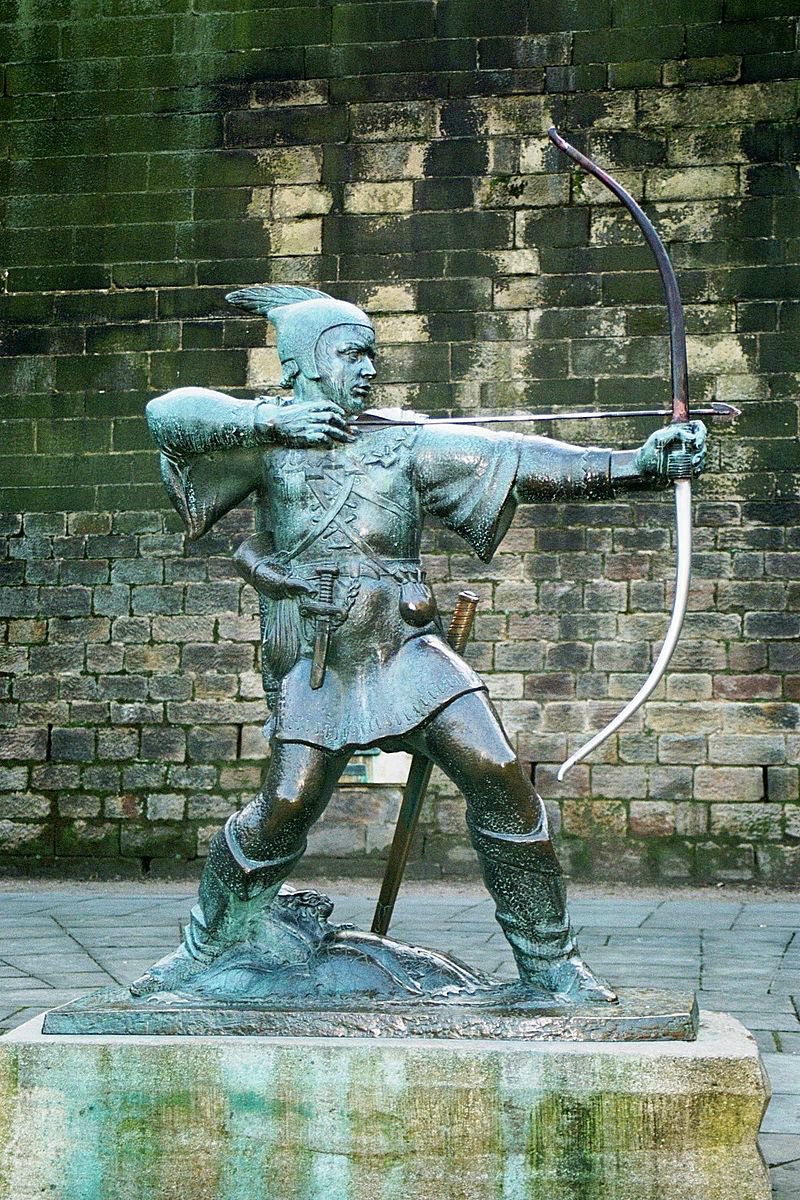
Nottingham is a big city with a history that goes back hundreds of years. It is known worldwide mostly for its connections with the Robin Hood stories, but there’s a lot more to Nottingham than that, and I’ll probably do a post about it sometime next year.
Robin Hood Memorial in Nottingham, near to the castle. Uploaded by Soerfm under GNU Free Documentation License. Wikimedia Commons.
For now I’ll just share some of the photos I took of the Old Market Square, and give you a little bit of information about it:
In the days before the City of Nottingham existed as such, the area which is now the Market Square was the centre-point between two Anglo Saxon towns in the old kingdom of Mercia. One of these towns was Snotengaham (also called Snothryngham, Snottingaham and – the usual name around here – just Snottingham). Whichever name is used, it simply means ‘the settlement of Snot’s people’ – to most people’s amusement. So the central area between these two settlements has been the centre of the city’s growth for hundreds of years.
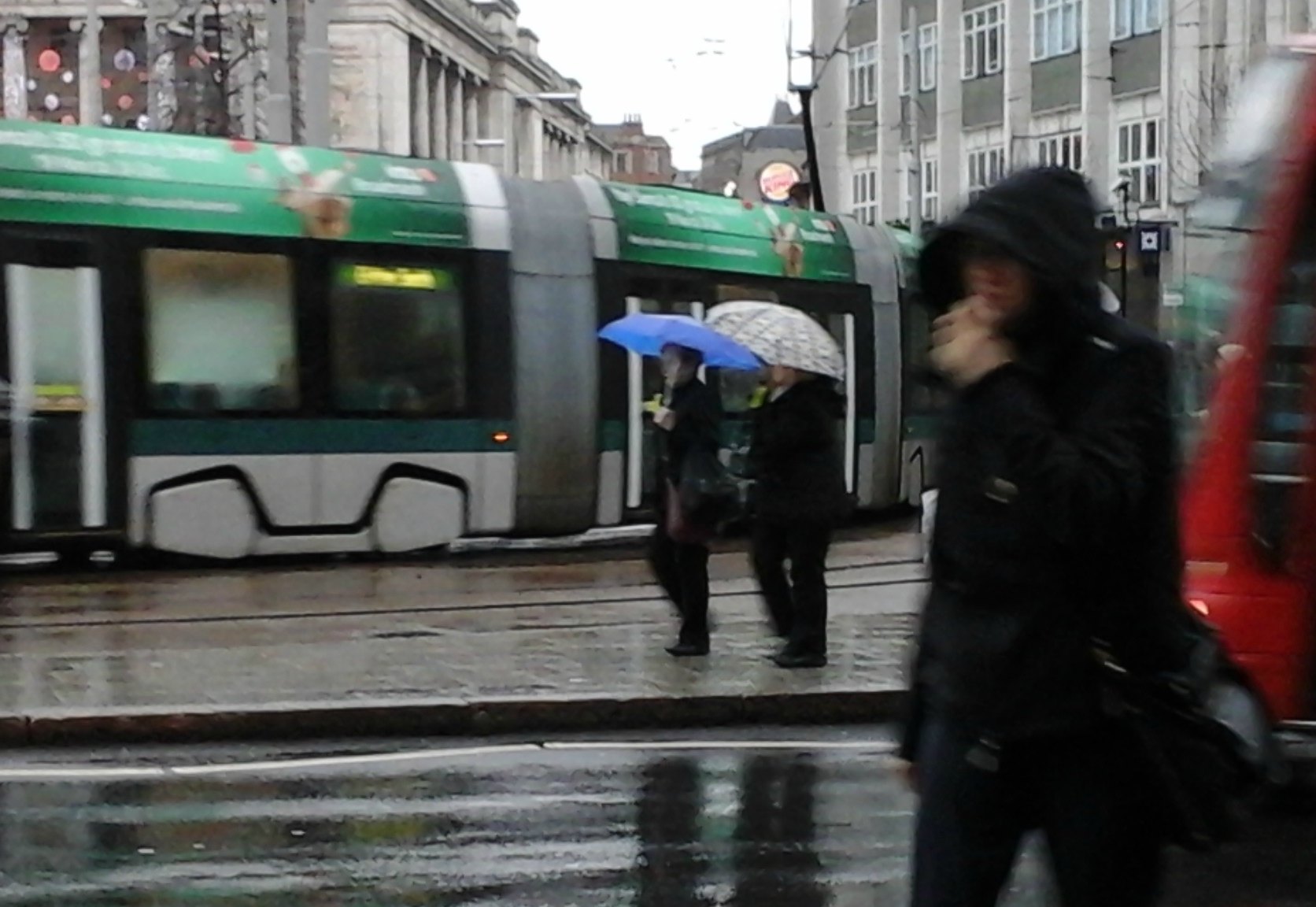
The Old Market Square, as it is known, is an open, pedestrianised area, from which shopping streets spread out in all directions. It’s a place where friends can meet and do some shopping, or visit one of the many cafes, restaurants and pubs. It is the largest public space in the U.K. after Trafalgar Square in London and is a centre for Nottingham’s transport links. Trams run around the outer edge of the square, as can be see from the overhead lines in a photo of the Council House lower down the page. Unfortunately the only photo I took of a tram is not a good one, particularly as people stepped in front of me as I snapped it. Here it is anyway:
In summer for several years now, a large area of the square has been converted into an artificial, sandy beach for parents to take their children to play on, with a huge paddling pool in the middle – an excellent idea for a ‘Midlands’ city, a long way from the coast. The square was also the original site for Nottingham’s famous Goose Fair, which originated over 700 years ago and is held every October. In 1928, the fair was moved for redevelopment of the square and is now held on the Forest Recreation Ground, an open space about a mile north of the city centre.
The Bell Inn, thought to be one of the UK’s oldest pubs and dating back to around 1276, can also be seen at the back of the square. I forgot to take a photo of it as we dodged the rain, so here’s a (summertime) photo from Wikipedia:
Updated photo of the Bell Inn in Nottingham Market Square. Author: Lee J. Haywood. Creative Commons,
But the building that dominates the square, although undoubtedly impressive, is nowhere near as old as the Bell Inn. This is the Nottingham Council House building as seen on my ‘header’ image and this one below. It was built to replace two much older buildings that had been used for this purpose over the years – the old Norman ‘Moot Hall’ and the English Guildhall, last used in 1877.
This new Council House was designed by Nottinghamshire architect T. Cecil Howitt and a building called ‘The Exchange’ was demolished in 1926 to accommodate it. In 1929, thousands of people gathered to watch its official opening in by the Prince of Wales, who later became King Edward VIII, open the great doors with a golden key, which is still displayed on a wall plaque, just inside the building to the left of the grand staircase.
Unlike the Lincoln Christmas Market, held only over a long weekend, Nottingham’s is held throughout December. Like several others in the U.K. nowadays, it is also fashioned after the German markets, although Lincoln was the first in the country to do so. Still, it all looked very pretty, with a little fun fair and lit-up stalls – despite the rain.
The ‘Helter Skelter’ pub.
Lincoln Christmas Market, however, has the great advantage of its wonderful setting in the castle bailey and being overlooked by the beautiful, towering medieval cathedral. It draws people back, year after year.
Throughout this summer the city of Lincoln celebrated the 800th anniversary of the signing of the Magna Carta at Runneymede. Only four copies of this ‘Great Charter’ are still in existence today: two in the British Library, one in Salisbury Cathedral and one that belongs to Lincoln Cathedral, but is on display in Lincoln Castle.
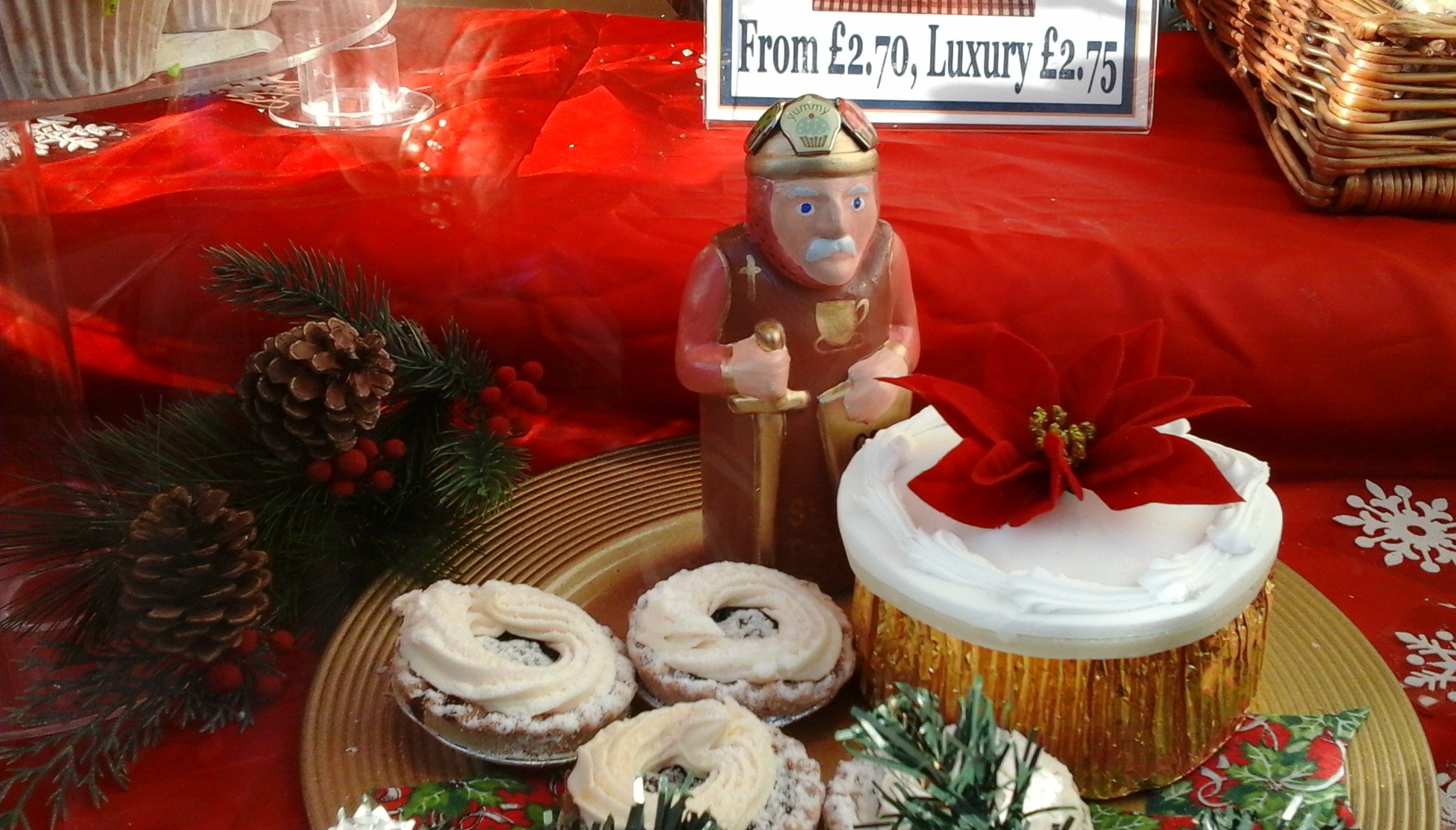
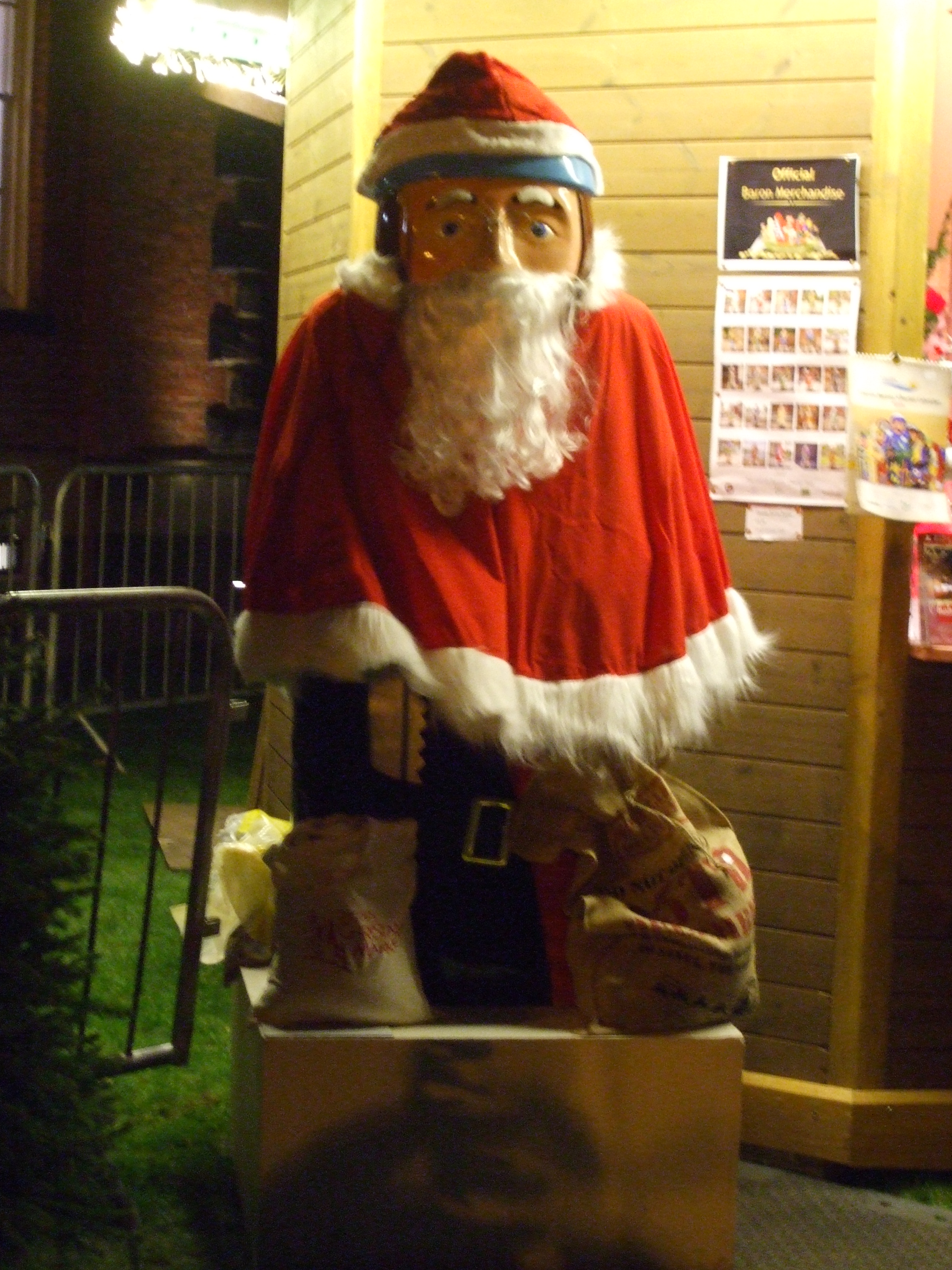
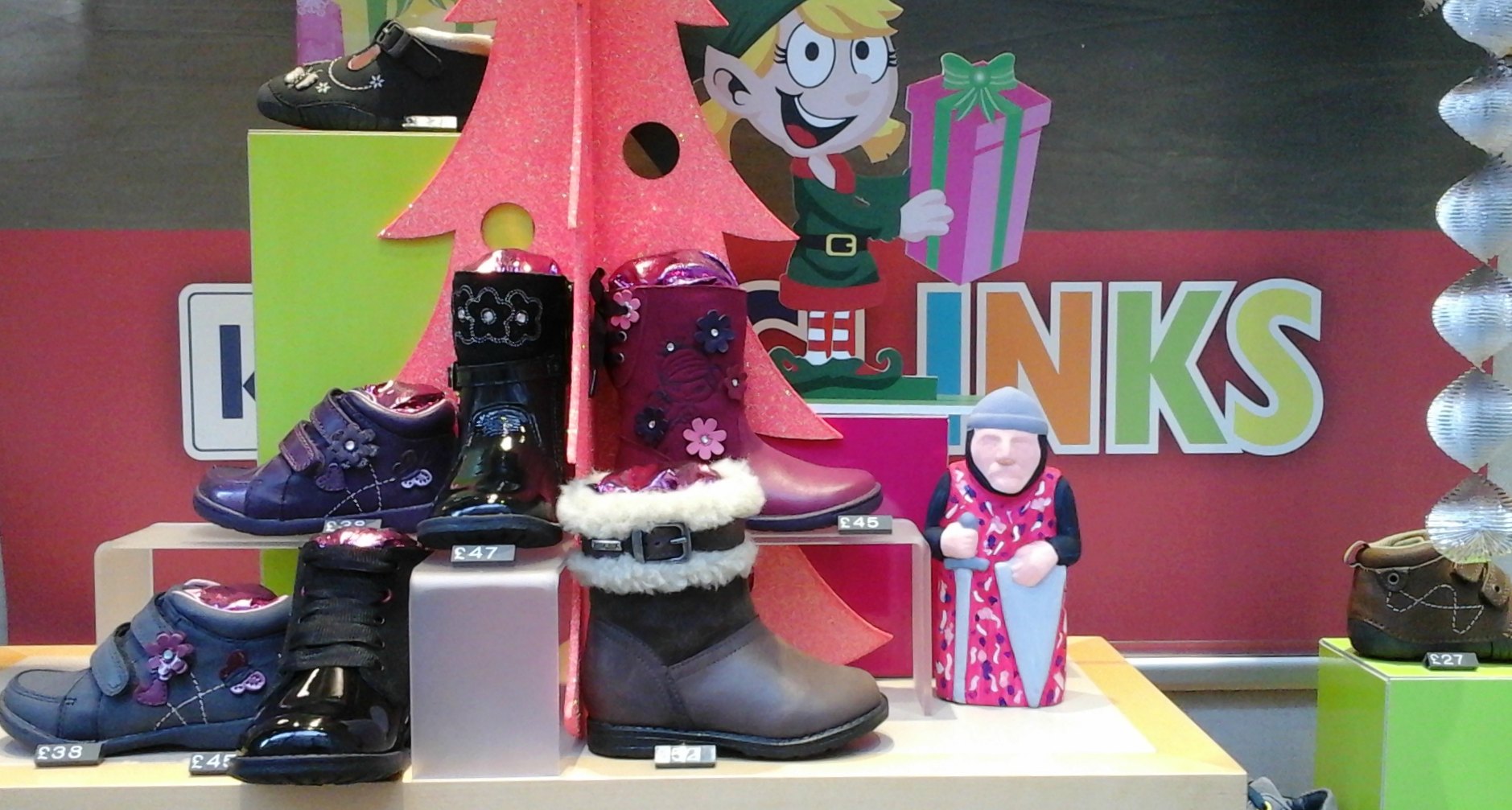
As part of the anniversary celebrations in Lincoln the organisers created a Barons’ Charter Trail for children to follow. Twenty five lifesized and colourful ‘barons’ were created and given names like ‘Truck Driver Baron’ and ‘Wild Flower Baron’. They were placed in prominent positions across the city centre and little ‘mini barons’ were produced for people to buy and decorate themselves.
I wrote a post about the Magna Carta, with pictures of the life-sized barons in August (here) but here is a picture of just three of them . . .
. . and this one had changed his clothes to welcome people to the Christmas market over last weekend:
In September the barons were brought together for one last ‘reunion’ in the castle grounds before they were auctioned off. Since then, as part of the Christmas festivities in Lincoln, many shops and businesses have been given one of these mini barons to decorate and display in widows, or on check-out counters. Again, the challenge has been to see how many people can find them. Last week we went into ‘downhill Lincoln’ – the main shopping area – and photographed some of the barons we found:
On Friday evening, we went to Lincoln Christmas Market and had a look for a few more of these little barons in shops in the ‘uphill’ part of the city. These are some we found:
The Barons – both big and small – have been good for Lincoln. Along with the Magna Carta and the Sand Sculptures, they have brought many visitors and trade to the city. Last weekend the Christmas market added to the festive feel as 2015 draws to a close. I wonder what 2016 will bring . . .?





























 Millie Thom
